
Retail Space for Lease in Noida: An Operator's Checklist Before Signing
A retailer-first checklist for leasing shop space in Noida: catchment, visibility, permitted use, tenure, licences, fit-out limits and sustainable occupancy cost.
Answer: Choose retail space in Noida around the customer journey and your store economics, not around a marketing footfall projection. Before you sign, verify the real catchment across different days and times, the unit's actual visibility and arrival, the permitted commercial use and lease tenure, the licences your format needs (UP Shops Act registration, fire NOC, FSSAI for food), the fit-out feasibility, and a full occupancy-cost model tested on a downside sales case. A prominent project can still hold low-visibility units, and a good rent can still hide an unopenable unit, so treat every claim as something to test on site and in writing.
Independent guide: we do not quote live prices, approvals or returns. Verify project-specific facts against current official documents before acting.
Observe the catchment instead of assuming it
The single most common leasing mistake is accepting a footfall or catchment number supplied by the person who wants you to sign. Projected footfall is an assumption until an auditable method and current operating evidence support it. Your own observation is cheaper, faster and more honest than any projection.
Visit the location on different days and in different time bands: a weekday morning, a weekday evening, and a weekend. Record what actually drives people to the spot, the occupied homes and offices nearby, the walking routes, vehicle movement, the competing and complementary formats already trading, and the reasons customers are physically present. A mall food court, a high-street strip and a neighbourhood convenience parade each generate footfall for different reasons and at different hours, and your format has to match the reason people are there.
Note what the catchment is becoming, not only what it is today. In Noida and Greater Noida, occupancy in a new commercial block can lag its launch by a long time, so distinguish demand you can see now from demand that is promised. Do not lease against a catchment that does not yet exist.
Walk the complete customer journey to the door
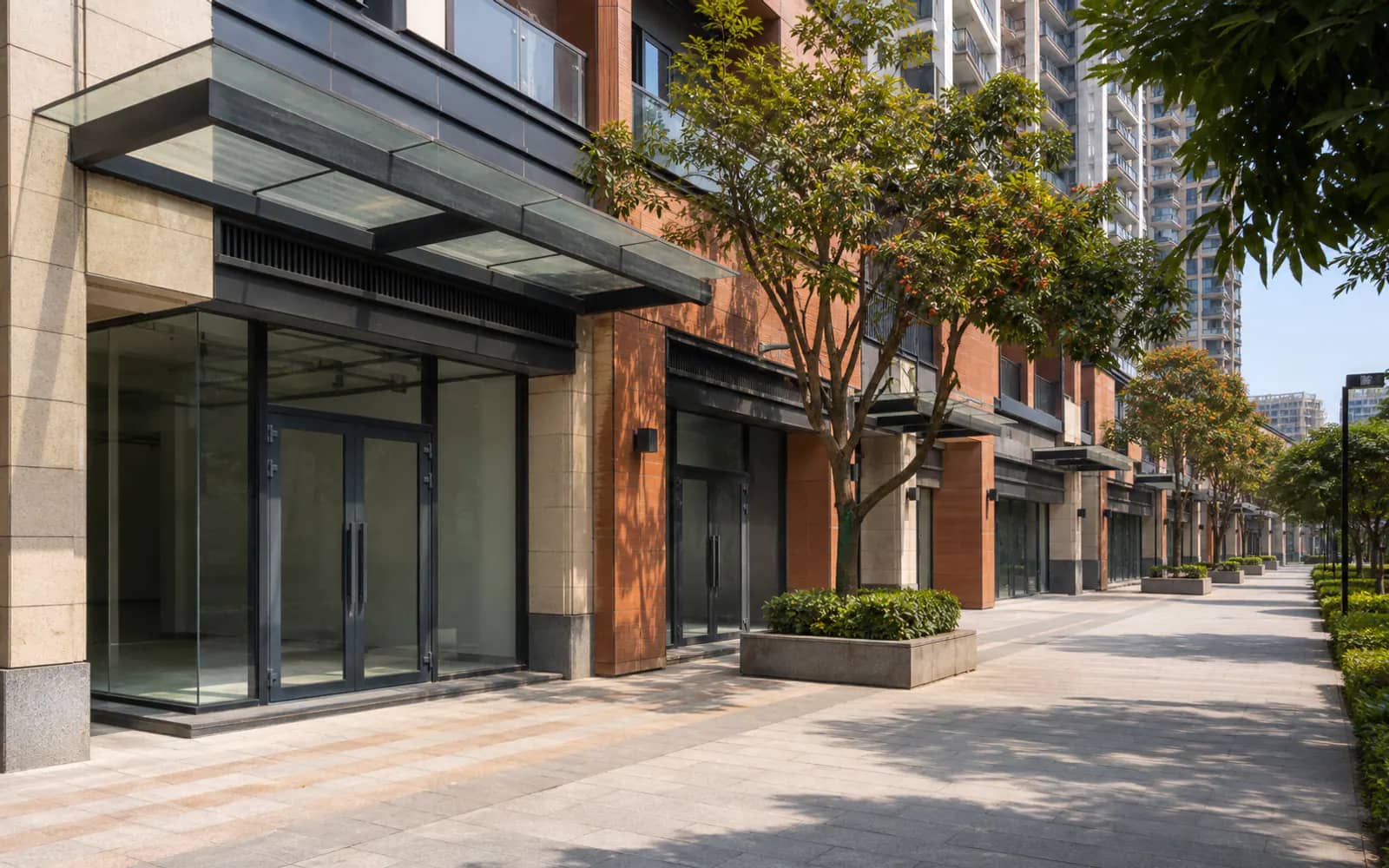
A prominent project can still contain low-visibility units, so evaluate the specific unit, not the building headline. Walk the full journey a customer takes: how they first see your signage, the turn or exit they must take, the drop-off, the parking, the lift or escalator movement, and the last few metres of storefront approach. Units set behind a pillar, on a dead corridor, above ground level, or past a poorly signed turn convert far worse than their rent card suggests.
Test arrival by the modes your customers actually use. Confirm the nearest operational Delhi Metro Blue Line or Aqua Line (NMRC) access and the real walking distance and route from the station, not the straight-line distance. Check car and two-wheeler parking, whether it is free or paid, and how loading and customer parking are separated. Frontage width, ceiling height and the ability to run a visible shopfront often matter more to a physical format than the total project size.
Confirm permitted use, tenure and who can actually lease it to you
Establish that the unit is legally a commercial unit for your activity before anything else. Much land in Noida, Greater Noida and the Yamuna region is allotted by the development authority (NOIDA, GNIDA or YEIDA) on a leasehold basis, with use, sub-lease and transfer conditions set in the lease deed. Confirm the sanctioned commercial use of the specific unit against the sanctioned plan and the authority's conditions, and confirm your intended activity is permitted, retail, food, clinic, salon and gym are not interchangeable in planning terms.
Confirm who holds the head-lease and whether they are entitled to rent or sub-lease that unit to you. Ask whether the development authority requires a no-objection or permission for sub-lease, and get that position in writing. If you are dealing with a sub-lessor rather than the allottee, trace the chain back to the authority allotment so you know your occupancy is not built on an unauthorised arrangement that a later transfer or dispute can unwind.
Where the unit sits inside a registered real-estate project, RERA registration can apply to qualifying commercial developments, not only residential ones. Confirm the current position for the specific project on the official UP RERA portal rather than assuming either way, and use it as one evidence source alongside your own legal review of tenure and title.
Map the licences and NOCs you cannot open without
A retail store in Noida is not open when the fit-out is done; it is open when the statutory approvals are in place. Establish early which licences your format needs and, critically, whether the building and the specific unit can actually obtain them. A unit that cannot get a fire clearance or a food licence is not a bargain at any rent.
Common requirements for a Noida retail operator include registration under the Uttar Pradesh Shops and Commercial Establishments Act (the state single-window portal, Nivesh Mitra, routes many of these approvals), a fire NOC where the premises or building fall within fire-safety thresholds, an FSSAI registration or licence for any food business (the tier depends on turnover and scale), GST registration, and signage or advertising permissions from the authority or building. Specialist formats add their own layers, for example a drug licence for pharmacy or specific clearances for a clinic.
Ask the landlord which building-level approvals already exist (the occupancy or completion certificate, the building fire clearance) because your unit-level licences often depend on them. Get technical confirmation for anything format-critical before you commit, not after your deposit is paid.
- UP Shops and Commercial Establishments Act registration (via the Nivesh Mitra single-window portal)
- Fire NOC where the premises or building fall within fire-safety thresholds
- FSSAI registration or licence for any food business (tier set by scale and turnover)
- GST registration and, for specialist formats, activity-specific licences (for example a drug licence)
- Signage and advertising permission from the authority and the building management
- Building-level basis for the above: occupancy or completion certificate and building fire clearance
Test fit-out feasibility and operating constraints
The lease can look affordable and still be unworkable for your format. Confirm the unit's sanctioned electrical load and whether it is adequate for your lighting, refrigeration, kitchen or HVAC, and clarify who pays to enhance the load if it is short. Check the water supply and drainage, the exhaust and chimney provision for food, waste handling and storage, and the loading and unloading arrangements and timings.
Confirm the building's operating rules before you sign, because they govern your daily economics. Trading hours, permitted delivery windows, common-area and HVAC operating hours, signage rules, and any restrictions on your format inside the complex can quietly erode a plan that looked fine on rent alone. Specialist formats, food, wellness, entertainment, should obtain written technical confirmation on ventilation, effluent, structural loading and fire compartmentation before commitment.
Build a store-level occupancy cost model, then stress it
Rent is only one line in what the store actually costs to occupy. Build a full store-level model that combines base rent, any revenue-share or minimum-guarantee arrangement, CAM (common area maintenance), utilities, any marketing or promotion levy, fit-out capital, security deposits and interest-free maintenance amounts, and the expected sales ramp. Then test it on the downside case, not only the launch plan, because early-stage occupancy and footfall in a new Noida block often build slowly.
For every money line, pull the current figure from the primary source rather than a rounded verbal quote, and get it in the lease or an annexure. CAM in Noida commercial buildings in particular is frequently underestimated at signing and can move materially with occupancy and services, so ask how it is calculated, what it includes, and how it can escalate. Circle-rate, stamp duty and registration costs on the lease apply too; confirm the current rates from the official registration portal (IGRSUP) for Gautam Buddh Nagar before you model them.
Use the table below as a checklist of the cost lines to source and lock in writing.
| Cost line | What it covers | Where the real number comes from |
|---|---|---|
| Base rent and escalation | Monthly rent and the annual escalation rate and basis | The lease term sheet; confirm the escalation percentage and frequency in the deed |
| Revenue share / MG | Percentage of sales or minimum guarantee, whichever applies | The commercial terms; clarify which of MG or revenue share prevails |
| CAM | Common area maintenance for shared services and upkeep | Landlord's CAM statement; ask for the basis, inclusions and escalation |
| Utilities and load | Electricity, water, any DG backup, load-enhancement cost | Metering arrangement and the sanctioned load document |
| Deposits and IFMS | Security deposit and interest-free maintenance amounts | The lease; confirm amount, refund terms and timeline |
| Taxes on the lease | GST as applicable, stamp duty and registration on the deed | Official Gautam Buddh Nagar / IGRSUP registration portal and a tax adviser |
| Fit-out and rent-free | Capital cost of fit-out and any rent-free fit-out period | Your contractor quote and the negotiated fit-out clause |
Read the lease terms that decide your downside
The clauses that protect or trap you are rarely on the headline rent. Test the lock-in period and whether it is mutual, the escalation rate and how often it applies, the security deposit amount and refund mechanism, and the fit-out or rent-free period granted for setup. Weigh a long lock-in against your confidence in the catchment, because a lock-in on an unproven location transfers the risk of a slow ramp entirely to you.
For a store in a managed complex, look for exclusivity and co-tenancy comfort (whether a direct competitor can open beside you, and what happens if anchor tenants leave), permitted-use and assignment rights so you can sublet or exit, and clear repair, insurance and force-majeure allocation. Have a property lawyer review the lease or sub-lease deed, the tenure and the authority conditions, and align the sanctioned plan with the exact unit before you pay any money.
How to verify this yourself
- Confirm the sanctioned commercial use of the specific unit against the sanctioned plan and the development authority's lease conditions, and confirm your exact activity is permitted.
- Confirm the leasehold tenure and any sub-lease or no-objection requirement with NOIDA, GNIDA or YEIDA, and confirm the party leasing to you is entitled to do so.
- Visit the catchment across at least three different day and time bands and record actual footfall drivers, not a projected footfall figure.
- Confirm the unit's sanctioned electrical load, water, drainage and exhaust provision are adequate for your format, and clarify who pays for any enhancement.
- Confirm which licences your format needs (UP Shops Act registration, fire NOC, FSSAI for food, GST, signage) and that the building and unit can obtain them.
- Model occupancy cost on a downside sales case including CAM, escalation, deposits and any marketing levy, sourcing each figure from its primary source (including current stamp duty and circle rate from the IGRSUP portal) and fixing it in the lease.
Sources and where to verify
- NOIDA Authority (official): commercial allotment and lease schemes
- UP RERA (official portal): project and promoter verification
- Nivesh Mitra (UP single-window portal): business approvals including UP Shops Act registration
- FSSAI FoSCoS (official): food business registration and licensing
- IGRSUP (UP Stamp and Registration Department): stamp duty, registration and circle-rate reference
Continue your Noida research
Frequently Asked Questions
Is projected footfall reliable when leasing retail space in Noida?+
Treat projected footfall as an assumption, not evidence, until an auditable method and current operating data support it. Your own observation across several days and time bands is more reliable than any number supplied by the party that wants you to sign.
What matters more for a retail store, frontage or project size?+
Unit-level visibility and customer access usually matter more than a large project headline for a physical retail format. A prominent project can still contain low-visibility units, so evaluate the specific unit's frontage, sightlines and arrival, not the building's reputation.
Do I need a fire NOC and an FSSAI licence to open a retail store in Noida?+
A fire NOC is required where the premises or building fall within the applicable fire-safety thresholds, and any food business needs FSSAI registration or a licence with the tier set by its scale and turnover. Confirm which approvals your format needs and, importantly, that the building and unit can actually obtain them before you commit.
Can I sub-lease authority-allotted commercial space in Noida?+
Sub-leasing depends on the leasehold conditions set by the development authority (NOIDA, GNIDA or YEIDA) in the lease deed, and often needs the authority's permission or no-objection. Confirm the tenure and sub-lease conditions for the specific unit in writing, and trace the chain back to the original allotment before you rely on the arrangement.
Is retail space leasing covered by UP RERA?+
RERA registration can apply to qualifying commercial real-estate projects, not only residential ones, so it may be relevant to a retail unit inside a registered project. Confirm the current status for the specific project on the official UP RERA portal rather than assuming, and treat it as one evidence source alongside independent legal review.
How should I judge a fair lock-in and rent escalation?+
There is no single fair number; judge lock-in and escalation against your confidence in the catchment and your projected sales ramp. A long lock-in on an unproven location shifts the risk of a slow start onto you, so match the commitment to the evidence you actually have.


