Can you buy a share of a Noida shop in 2026?
Fractional ownership in Noida commercial property explained: structures, costs, risks and what to verify before investing.
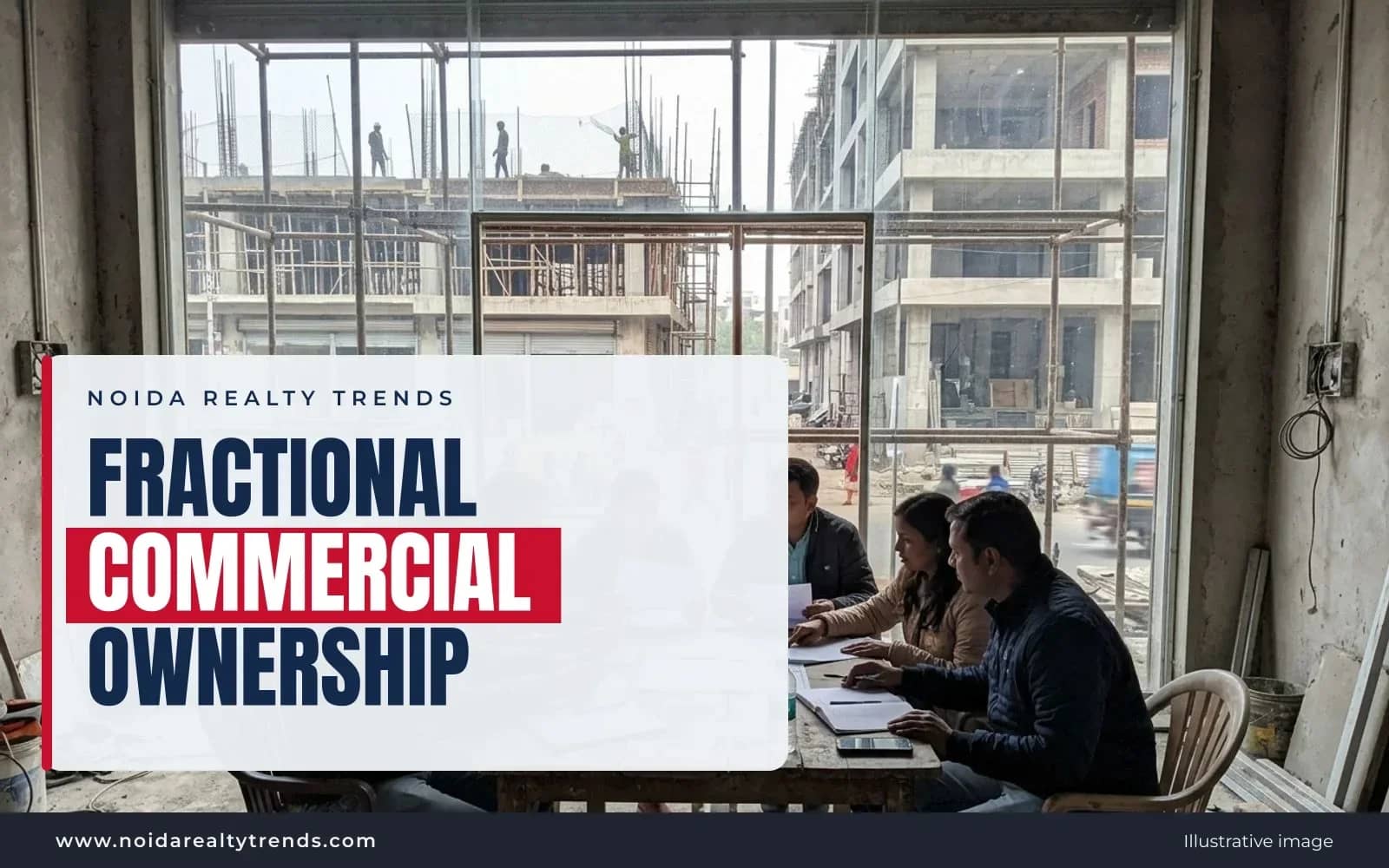
Answer: Fractional ownership lets several investors share the cost and income of a commercial unit, usually through a co-ownership agreement, an SPV holding shares, or a SEBI-regulated SM REIT. In Sectors 72, 94, 97 and 98, developers mostly sell individual shops and retail units outright; genuine fractional products, if offered, are typically arranged by third-party platforms or REIT-like vehicles, so verify title, regulatory status and exit rights before paying anything.
Evidence-led guide: we do not quote live prices, approvals or returns as our own claims. Verify project-specific facts on the official sources linked below before acting.
What does fractional ownership actually mean in Noida?
Fractional ownership means multiple investors collectively hold an interest in one commercial asset instead of each buying a whole shop or retail unit outright. The legal form of that interest varies enormously, and the form determines what rights you actually get.
The main structures seen in Indian commercial real estate, including Noida, are co-ownership agreements where several buyers are named owners with rights set out in a contract, SPV or company ownership where the entity holds the title and investors hold shares in that entity, and SEBI-regulated small and medium REITs (SM REITs) where a scheme holds completed, income-generating property on behalf of unit holders. A fourth, less formal version is platform-arranged participation, where a broker or app markets small fractions of a property but the buyer may receive only a contractual claim rather than direct ownership.
These are not interchangeable. Owning shares in a private company that owns a shop is legally different from owning direct title, and both are different again from holding units in a SEBI-registered SM REIT. Before paying anything, ask in writing who holds the title, whether the structure is registered with SEBI, and what your voting, income and exit rights are.
How much does it cost to buy a fractional share in a Noida commercial unit?
There is no single standard price for a fractional share in Noida, because the cost depends on the specific building, unit size, ownership structure and how many investors split the asset. Public project listings give a sense of the range for whole units, but they are advertised inventory prices, not confirmed fractional-share prices, and must be checked against the developer's current cost sheet.
For example, retail and studio-style inventory at M3M The Line in Sector 72 has been listed in the roughly 65.5 lakh to 1.73 crore range in public listings, while retail inventory at the Cullinan Avenue project in Sector 94 has appeared in listings spanning roughly 1.16 crore for a 210 sq ft retail unit up to over 4 crore for larger retail space. Branded residential inventory such as Jacob and Co Residences in Sector 97 does not have a verified fractional commercial-ownership scheme in the available material, so buyers should ask the developer directly what structures are available. Comparable large-format commercial and mixed-use projects from developers such as Bhutani Group, Gaurs Group and ACE Group on the Noida Expressway belt also list individual units rather than confirmed fractional products.
If a platform divides a unit among, say, 30 investors, the arithmetic looks simple on paper, but the real cost to you includes GST, stamp duty and registration charges, structuring or platform fees, ongoing CAM and maintenance, and your share of vacancy risk. Always ask for the final all-in cost sheet, not just the headline fraction price, and verify the base price and applicable charges against the project's official price list and UP RERA disclosures.
| Project | Sector | Reported unit type | Publicly listed price range |
|---|---|---|---|
| M3M The Line | Sector 72 | Retail / studio units | Approx. 65.5 lakh to 1.73 crore (verify on developer price sheet) |
| Cullinan Avenue | Sector 94 | Retail unit, ~210 sq ft | Approx. 1.16 crore (verify on developer price sheet) |
| Cullinan Avenue | Sector 94 | Retail unit, ~750 sq ft | Approx. 4.13 crore (verify on developer price sheet) |
Which Noida developers actually offer fractional ownership in shops?
The available evidence does not establish a confirmed list of Noida developers offering a regulated fractional-ownership product. What is confirmed is that several developers active on the Noida Expressway belt, including projects marketed by M3M in Sectors 72 and 94, sell commercial inventory as individual retail and studio units through standard builder-buyer agreements.
Selling a small shop or compact retail unit is not the same as offering fractional ownership. A developer listing a 210 sq ft retail unit is simply selling a small whole unit; it becomes fractional ownership only if a separate legal structure, such as an SPV, LLP or SM REIT, is created to split that unit's title or income among multiple unrelated investors.
Where fractional products do exist in the wider Noida and NCR market, they are typically arranged by third-party investment platforms or asset managers rather than by the developer itself. This means your counterparty for a fractional deal may be a platform or SPV manager, not the builder who constructed the project, and that distinction matters for recourse if something goes wrong. Always ask directly: is this entity SEBI-registered, and is the developer itself a party to this ownership structure, or only the seller of the underlying unit?
Is fractional commercial ownership in Noida a good investment for small investors?
It can work for a small investor in limited circumstances, chiefly when the underlying asset is completed, leased to a paying tenant, and held through a properly regulated or at least clearly documented structure. The appeal is obvious: a lower entry ticket than buying a whole shop, and in theory, diversified exposure across more than one property.
The risks are equally real. Liquidity is the biggest one, since selling a fraction of a commercial unit is far harder than selling a listed security or even a complete, ready unit, because the pool of buyers for a fractional interest is small. Construction risk applies if the asset is still under-construction, since SEBI's own framework for SM REITs explicitly excludes under-construction or non-revenue-generating properties from that regulated structure, which tells you something about how the regulator views incomplete assets as fractional investments. Retail income also depends heavily on footfall, tenant mix and competing supply nearby, so a fractional share in an empty or newly-opened retail block carries real income uncertainty in its early years.
A reasonable working rule: treat fractional ownership as suitable only for money you can leave locked in for years, in an asset you have personally verified as completed, leased and properly titled, through a structure whose regulatory status you have confirmed independently rather than taken on a broker's word.
How does fractional ownership compare with buying a whole shop outright?
Buying a whole unit gives you direct title, full control over leasing and resale, and a straightforward record at the registrar, but it requires the full purchase price upfront. Fractional ownership lowers the entry cost but introduces a layer of structure, paperwork and counterparty risk that a direct buyer does not have to deal with.
For most retail investors in Sectors 72, 94, 97 and 98, buying a smaller whole unit, such as a compact studio-retail space, achieves a similar lower-ticket goal without the added legal complexity of a shared ownership vehicle. The trade-off is that a whole unit, however small, still gives you a clean, individually registered title that is easier to sell, mortgage or pass on.
What should you verify before putting money into any fractional ownership offer?
Verify the title holder, the regulatory status of the structure, and the exit mechanism before signing anything or wiring any amount. These three checks catch most of the problems that surface later.
Confirm project registration, promoter details and sanctioned plans on UP RERA (up-rera.in). Check applicable stamp duty and registration norms on IGRSUP (igrsup.gov.in), since a fractional interest that is not properly registered may not hold up as a legal claim. Confirm land use, lease status and any transfer restrictions with the Noida Authority, since most Noida commercial land is held on a 99-year lease and a Transfer Memorandum may be required before any resale or transfer of interest is valid. If the offer is pitched as an SM REIT or similar regulated vehicle, verify the manager's registration directly with SEBI rather than relying on a platform's marketing claim.
- Who legally holds the title: a named co-owner, an SPV, or a SEBI-registered REIT scheme
- Whether the structure is SEBI-registered, and whether the manager appears on SEBI's public list
- What happens on resale: can you sell your fraction freely, or only back to the platform
- Who bears GST, stamp duty, registration, CAM, property tax and vacancy costs
- Whether any quoted rental return is contractually guaranteed in a registered lease, or simply a projection
Why do community and buyer forums treat 'assured return' as a red flag in fractional deals?
Because 'assured return' or 'guaranteed lease income' claims have repeatedly been used in Indian real estate to market schemes that later failed to pay, several state RERAs and consumer forums now treat such phrasing with real caution, and buyer communities have picked up the same instinct. The safest approach is to treat any return figure as a projection unless it is backed by an actual registered lease deed with a named tenant, a fixed term and a clearly stated rent, not a marketing brochure.
If a seller cannot produce the underlying lease document and show you the tenant's occupancy, do not treat a stated percentage return as a fact. Ask for the lease registration details and verify them independently rather than relying on the figure quoted in a sales pitch.
How to verify this yourself
- Confirm project registration, promoter and disclosures for any underlying asset on UP RERA (up-rera.in)
- Check stamp duty and registration requirements for the specific ownership structure on IGRSUP (igrsup.gov.in)
- Verify land lease status, permitted use and Transfer Memorandum requirements with the Noida Authority
- If pitched as an SM REIT or similar vehicle, confirm the manager's registration status directly with SEBI
- Request the registered lease deed and tenant details before trusting any stated rental return figure
- Obtain the full cost sheet covering GST, registration, CAM, maintenance and platform fees before paying anything
Sources and where to verify
- UP RERA official portal
- IGRSUP stamp duty and registration portal
- SEBI FAQ on SM REITs (PDF)
- Noida Realty Trends: M3M Group companies active in Noida, a complete guide
- Noida Realty Trends: Which Noida developer has the best mixed-use project in 2026
Continue your Noida research
Frequently Asked Questions
Is fractional ownership legal in Noida commercial property?+
It can be legal, but legality depends entirely on how the structure is documented. A properly drafted co-ownership agreement, an SPV with clear shareholding, or a SEBI-registered SM REIT are all legitimate routes, while a verbal or loosely documented 'fraction' sold by a platform may carry no enforceable ownership right at all; always get the structure reviewed by an independent lawyer.
How much money do I need to start with fractional commercial ownership in Noida?+
There is no fixed minimum, since it depends on the specific deal and platform; entry amounts in the broader Indian fractional-ownership market have ranged from a few lakh rupees up to tens of lakhs, but Noida-specific minimums should be confirmed directly from the entity offering the fraction, along with the full cost sheet including fees and taxes.
Do any Noida developers sell fractional shares directly, or only whole units?+
The confirmed pattern is that developers active in Sectors 72, 94, 97 and 98, including projects marketed by M3M and by other Noida Expressway developers, sell individual retail and studio units outright; fractional structures, where they exist, are generally arranged by separate platforms or SPVs rather than by the builder itself, so confirm who you are actually contracting with.
Is fractional ownership in Noida commercial space a loss or a profit for a small investor?+
It can be a profit if the underlying asset is completed, genuinely leased, properly titled and bought through a regulated or clearly documented structure with a realistic exit plan; it tends to become a loss when investors buy into under-construction assets, unverified structures, or deals pitched on an unverified 'assured return', so the outcome depends almost entirely on due diligence done before investing, not on the fractional format itself.
What is the difference between fractional ownership and an SM REIT in Noida?+
Fractional ownership is a broad term covering any arrangement where multiple investors share one asset, while an SM REIT is a specific SEBI-regulated vehicle that can only hold completed, income-generating property and must follow SEBI's disclosure and governance rules; a fractional deal that is not registered as an SM REIT does not carry the same regulatory protection, so always check which category a given offer actually falls into.
Can I get a loan against a fractional share in a Noida commercial unit?+
Generally this is difficult, since most banks and NBFCs lend against clear, individually registered title rather than against shares in an SPV or units in an unlisted structure; confirm financing options directly with your lender before assuming a fractional interest can be mortgaged in the same way as a whole, registered unit.
Tags