
Delhi to Noida: What Is Actually Pulling Families Across the Border in 2026
Families are leaving Delhi for Noida for space, planned sectors and cleaner air narratives. Here is what to verify before you follow them.
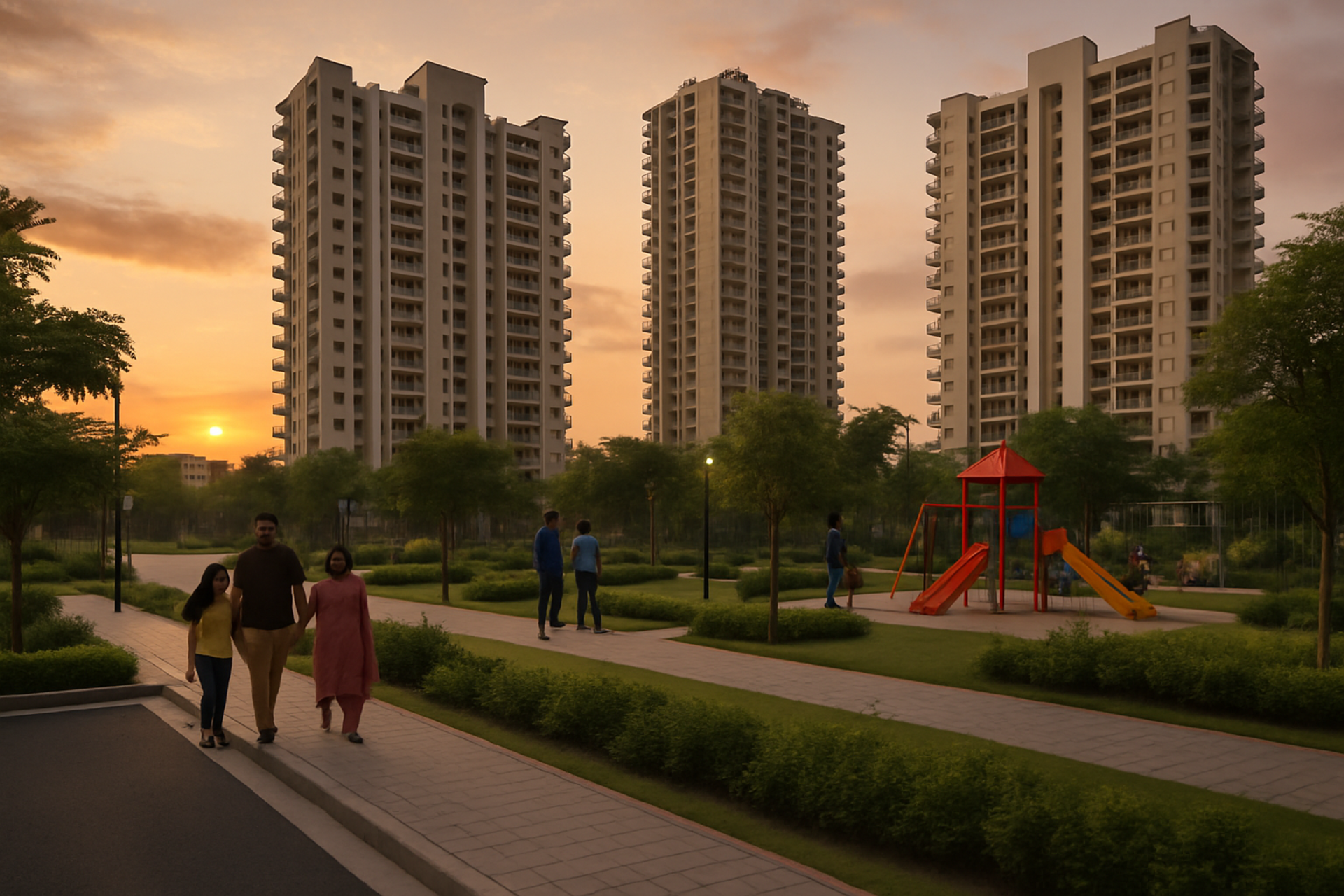
Answer: Families are moving to Noida mainly for larger homes at comparable budgets, gated-society living, wider planned roads, and pollution-escape narratives repeated across buyer forums and market commentary. The city works best for families who prioritise established, occupied sectors with school access and metro or expressway connectivity. None of this replaces due diligence: verify project legality on UP RERA, registered prices on IGRSUP, and layout facts with the NOIDA Authority before deciding where exactly to buy.
Evidence-led guide: we do not quote live prices, approvals or returns as our own claims. Verify project-specific facts on the official sources linked below before acting.
Why are families moving to Noida from Delhi?
The most consistently cited reason across buyer forums, relocation guides and market commentary is space and planning. Families report getting a larger configuration in Noida for a budget that buys a smaller, older flat in central or south Delhi, though exact numbers vary sharply by sector, project age and current asking rates, so treat any specific price comparison as a starting point to verify rather than a fixed fact.
Recurring secondary reasons include wider roads, newer gated societies with organised parking and amenities, and a sense of more methodical urban planning than many older Delhi colonies offer. Health and air-quality narratives also show up repeatedly in family relocation stories, including reporting on residents citing improved health after moving away from Delhi's pollution corridor, though air quality varies by season and location and should not be treated as a permanent guarantee for any specific Noida sector.
Commute flexibility to NCR job hubs is another frequently mentioned driver, particularly for households where one or both earners work in sectors accessible via the Noida-Greater Noida Expressway, DND, or metro extensions. This is a directional pattern from buyer commentary and journalism, not a government statistic, so cross-check your specific commute against current NMRC metro maps and traffic reality before committing.
Is Noida a good place for families with kids and schools?
Noida can work well for families with children when the choice is anchored to a specific, occupied sector rather than a citywide assumption. Gated communities with organised security, on-site play areas and RWA-managed common spaces are the most commonly cited family benefit in independent buyer writeups, and this pattern holds across many mid-market and premium sectors.
The honest caveat that appears repeatedly in buyer commentary, including candid Reddit threads from people who have actually relocated, is that suitability depends heavily on which specific sector you pick. Some pockets are heavily car-dependent with limited walkable school access, while others have dense, established school ecosystems within a short drive. There is no substitute for physically visiting shortlisted schools and timing the actual commute yourself before signing anything.
For families evaluating the Billionaires' Corridor belt of Sectors 94 to 98 alongside Sector 72, the appeal for kids typically centres on newer, larger-format gated developments with more contained amenity ecosystems, plus expressway access for weekend mobility. Confirm current school proximity, society occupancy levels, and on-ground infrastructure completion directly rather than relying on brochure maps.
What makes Noida affordable for middle-class families buying homes?
The affordability argument made in most market commentary rests on three factors: larger average apartment sizes, newer building stock with modern amenities, and master-planned sectors that in many cases price lower per square foot than comparable Delhi micro-markets. This is a recurring theme in independent real-estate writing, not a government-published statistic, so the actual per-square-foot comparison for your target sector needs to be checked against live listings and, more importantly, registered sale deed data.
IGRSUP is the only source that shows what a property actually sold for, as opposed to what a broker or portal is asking. Asking prices in marketing material can run well above actual registered transaction values, so a family budgeting seriously for a purchase under a specific ceiling should pull comparable registered deeds for the target sector before finalising a number.
UP RERA registration status matters just as much for affordability as the sticker price, because a project stuck in litigation or with a stalled possession timeline effectively costs a family far more than the listed price once carrying costs, rent-while-waiting, and legal fees are added in.
Which safe, family-friendly Noida areas fit a budget under one crore?
There is no government-backed sector-by-sector crime ranking for Noida in the public domain, so any citywide safety claim should be treated with caution. The most defensible approach used in market guides is to favour well-established, densely occupied residential sectors with active RWAs and visible on-ground security over sparsely inhabited or still-under-construction pockets, and to verify current local conditions directly with Noida Police and society management rather than relying on broad reputation.
Market guides commonly mention Sectors 73, 75, 76, 117, 137, and parts of 49 and 61 as family-oriented, mid-market pockets, though whether a specific unit fits under a one crore budget depends entirely on configuration, project age, and current asking versus registered price, all of which must be verified independently rather than assumed from a sector's general reputation.
Within the sectors this publication focuses on, Sector 72 sits closer to the mid-to-premium band and can be relevant for families stretching toward the upper end of a sub-one-crore budget who want gated, newer-stock housing with expressway access, provided the specific project's RERA status and current pricing are confirmed directly rather than taken from marketing collateral.
What should families check before signing anything?
Noida residential purchases, including in the Billionaires' Corridor belt, are almost universally on 99-year leasehold land allotted by the NOIDA Authority, not freehold. This affects resale documentation, financing in some cases, and the Transfer Memorandum process required when a resale changes hands, all of which carry their own charges payable to the Authority. Families used to Delhi's freehold colonies should budget time and money for this process rather than assume it works the same way.
Every other due-diligence step follows a similar pattern: verify, don't assume. UP RERA confirms whether a project and its promoter are legally registered and what the disclosed completion timeline is. IGRSUP shows the registered transaction history for comparable units. The NOIDA Authority's records confirm sector layout, land-use classification, and whether promised infrastructure like roads, parks or sewage lines are actually sanctioned versus aspirational.
- Confirm leasehold tenure and outstanding lease years directly with the NOIDA Authority before valuing any resale unit
- Budget separately for Transfer Memorandum charges on any resale purchase, these are not optional
- Cross-check the project's UP RERA number against the promoter and phase you are actually buying into
- Pull comparable registered sale deed values from IGRSUP rather than trusting listed asking prices
- Visit the shortlisted school and time the actual commute yourself before finalising a sector
Is Sector 72 retail-heavy oversupply a concern for residential buyers nearby?
Sector 72 and its surrounding stretch have seen a cluster of retail and high-street projects, including names like Spectrum Metro, Dasnac Arc and Central 50, which sometimes raises a concern among prospective residents that the area is becoming overly commercial rather than residential-friendly. This is a legitimate question to ask, and it deserves a direct answer rather than deflection.
The realistic response is that retail density near a residential sector is not inherently a negative for families; well-anchored retail and food-court catchments can add convenience, footfall-driven security in common areas, and daily-use access without requiring a long drive. The concern becomes valid only if a specific residential project you are evaluating faces genuine catchment overlap or documented vacancy issues in its own retail component, which is a project-specific fact to verify through occupancy data and RERA disclosures rather than a blanket sector-level judgment.
For residential buyers specifically, the more relevant checks are the residential project's own RERA registration, its distance from the busiest retail stretch, and its own amenity self-sufficiency, not the retail supply figures of unrelated nearby projects.
How does the Billionaires' Corridor fit into the family-buying conversation?
Sectors 94 through 98, often referred to in search and buyer conversation as the billionaire corridor, billionaires corridor, or the Sector 94-98 luxury belt along the Noida Expressway, represent the premium end of the family housing spectrum rather than the entry-level end. Families evaluating this belt are typically trading a higher budget for larger formats, newer amenity stacks, and expressway-linked commute options toward Delhi and the upcoming Noida International Airport corridor.
Within this belt, M3M India Noida has an active presence, including The Cullinan in Sector 94 and Jacob & Co Residences in Sector 97, both positioned as branded luxury propositions. Families considering this tier should verify the current UP RERA registration, inventory type, and possession status for the specific tower and phase directly, since branded luxury launches can see structural or pricing changes over their sales cycle that only the official filing will reflect accurately.
Separately, M3M The Line in Sector 72 offers a more centrally located, mixed-format option for families wanting proximity to established retail and social infrastructure without moving fully into the expressway-side luxury belt, again subject to the same RERA and possession verification before any decision.
Noida versus Delhi for families: a practical comparison
The table below summarises the checkable, non-price factors families most often weigh when comparing a Delhi neighbourhood against a Noida sector. It intentionally avoids inventing numbers; where a figure matters, it points to the correct verification source.
| Factor | What buyer commentary says | Where to verify before deciding |
|---|---|---|
| Apartment size for budget | Larger configurations often cited for similar budgets in Noida | Live listings plus IGRSUP registered deed values |
| Road and society planning | Wider roads, newer gated layouts commonly reported | Physical site visit, NOIDA Authority layout plans |
| Air quality and health | Some residents cite improvement after leaving Delhi's core pollution zone | Seasonal AQI data, not a permanent guarantee |
| Commute to NCR job hubs | Expressway and metro access cited as advantages in specific corridors | NMRC metro map, actual timed commute test |
| Land tenure | Almost all Noida residential stock is 99-year leasehold, not freehold | NOIDA Authority allotment and lease records |
| Legal safety of purchase | Project-specific, not citywide | UP RERA registration and disclosed timeline |
What is the honest verdict: is a family move to Noida worth it?
For a family prioritising more space per rupee, newer gated infrastructure, and a planned layout over an older Delhi colony, a move to Noida is generally a defensible decision, provided the specific sector, project RERA status, and registered price comparables all check out independently. The upside case is real and repeatedly documented in buyer experience, not just marketing material.
It becomes a loss-making or regrettable move when a family skips verification: buying into an unregistered or stalled project, overpaying against actual registered deed values because they trusted an asking price, or picking a sector based on reputation alone without checking school access and commute reality for their specific routine. The difference between a good and bad outcome in Noida is almost entirely in the diligence, not the city itself.
How to verify this yourself
- Confirm any project's registration, promoter details and disclosed possession timeline directly on UP RERA (up-rera.in)
- Pull actual registered sale deed values for comparable units from IGRSUP (igrsup.gov.in) rather than trusting asking prices
- Verify sector layout, land-use classification and infrastructure sanctioning with the NOIDA Authority before assuming amenities are complete
- Check current leasehold tenure, remaining lease years and Transfer Memorandum charges with the NOIDA Authority for any resale purchase
- Verify current local safety conditions with Noida Police and society-level security practices rather than relying on general city reputation
- Confirm current metro and expressway connectivity timelines with NMRC and the NOIDA Authority before committing to a commute assumption
Sources and where to verify
- UP RERA official portal
- IGRSUP registered property records
- Reddit r/noida: Moving from Delhi to Noida discussion
- Times of India: health improvements cited after moving away from Delhi pollution
- Economic Times: NCR planned townships and connectivity commentary
Continue your Noida research
Frequently Asked Questions
Why are families moving to Noida from Delhi in such large numbers?+
The dominant reasons in buyer commentary and market writing are more living space for a comparable budget, newer gated-society infrastructure, wider planned roads, and improved commute options to NCR job hubs, alongside recurring pollution-escape narratives. These are patterns from buyer experience and journalism, not government statistics, so verify specifics for your target sector before deciding.
Is Noida genuinely good for families with young kids and school access?+
Yes, for families who choose an established, occupied sector with a gated community and confirmed nearby schools, Noida is repeatedly described as workable and even preferable to older Delhi colonies. The caveat is that suitability varies sharply by exact sector, so visit shortlisted schools and time your actual commute rather than assuming citywide suitability.
Is buying a home in Noida under one crore realistic for a middle-class family?+
It can be, particularly in established mid-market sectors, but the exact fit depends on configuration, project age and current registered pricing rather than sector reputation alone. Always confirm live asking prices against IGRSUP registered deed values before assuming a budget ceiling is achievable in a specific project.
Is moving to Noida a smart financial decision or a potential loss for families?+
It tends to be a sound decision when the buyer verifies UP RERA registration, checks registered comparable prices on IGRSUP, and confirms leasehold and Transfer Memorandum obligations upfront. It becomes a loss when buyers skip this diligence and rely purely on brochure pricing or sector reputation, which is the most commonly cited regret in buyer forums.
Does heavy retail development in Sector 72 make it a risky place for residential buyers?+
Not inherently. Retail clusters like Spectrum Metro, Dasnac Arc and Central 50 add daily-use convenience and footfall near residential pockets rather than automatically signalling oversupply risk for nearby homes. The relevant check for a residential buyer is the specific project's own RERA status and amenity self-sufficiency, not the retail supply figures of neighbouring developments.
Is Noida's 99-year leasehold land structure a problem for family buyers coming from Delhi?+
It is a real structural difference families should plan for, not ignore. Leasehold tenure affects resale documentation and requires Transfer Memorandum charges payable to the NOIDA Authority on transfer, so confirm remaining lease years and applicable charges directly with the Authority before purchase rather than assuming it works like Delhi's freehold colonies.
Tags