
FNG Expressway in 2026: Route, Real Status and What It Actually Means for Noida Buyers
FNG Expressway route, construction status and delay history explained, with an honest read on which Noida sectors gain and how to verify claims before buying.
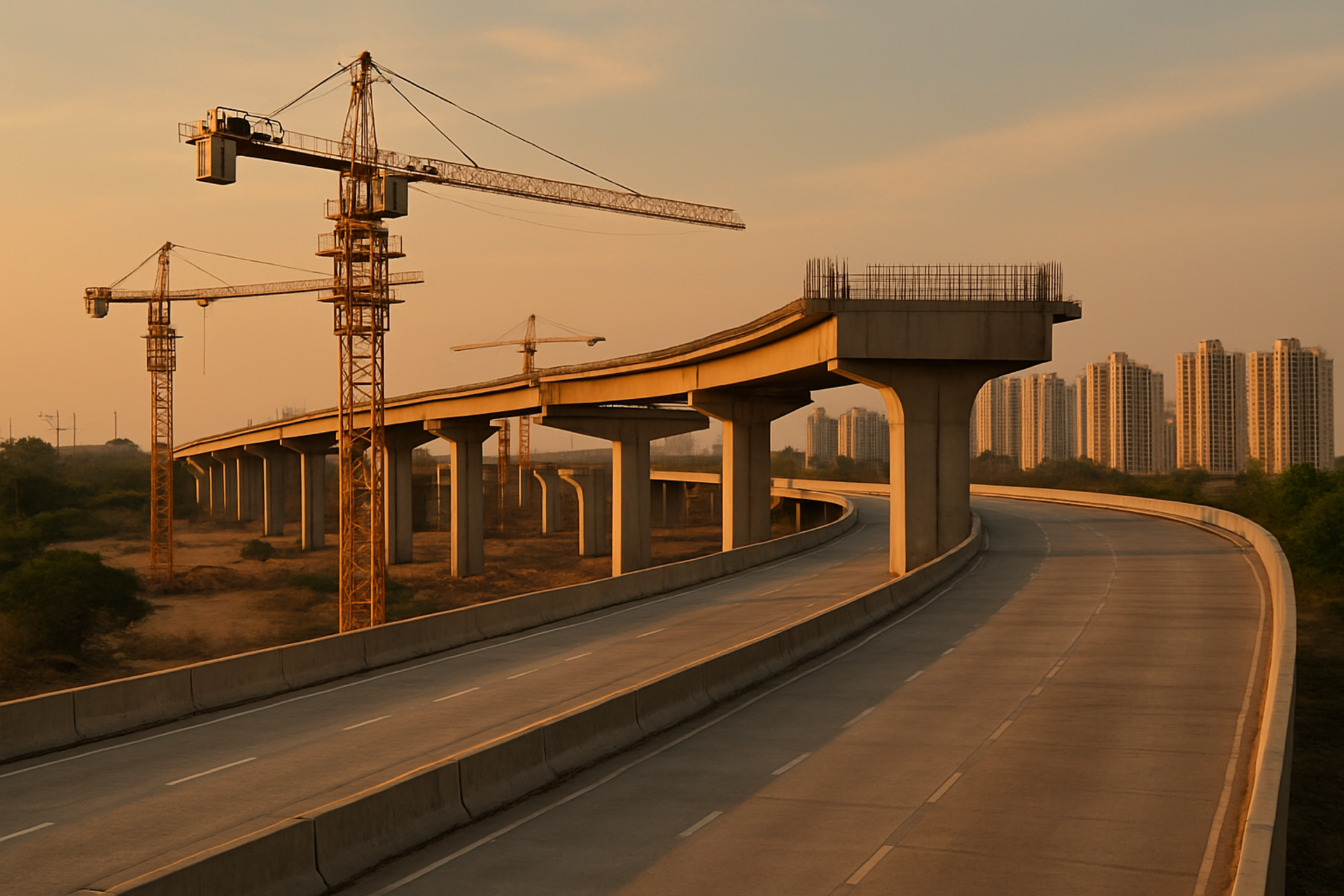
Answer: The FNG Expressway is a planned 56 km, six-lane corridor that includes a Noida-side segment connecting through the Noida-Greater Noida Expressway belt toward Ghaziabad and beyond. As of mid-2026 the Noida portion remains under construction with no single confirmed completion date. Treat it as a long-horizon connectivity catalyst, not a short-term price trigger, and verify current status directly with the Noida Authority and NHAI before factoring it into any purchase decision.
Evidence-led guide: we do not quote live prices, approvals or returns as our own claims. Verify project-specific facts on the official sources linked below before acting.
What is the FNG Expressway and what route does it follow?
The Faridabad-Noida-Ghaziabad Expressway, commonly called FNG, is a proposed roughly 56 km corridor designed to link multiple NCR cities with a six-lane carriageway that planners have discussed expanding to eight lanes in the future. The Noida segment of the alignment runs through the Noida-Greater Noida Expressway belt, effectively creating improved cross-city connectivity.
The project has been on the drawing board for roughly two decades, and its scope has been discussed and revised multiple times. Because the expressway crosses multiple jurisdictions, execution has depended on parallel approvals from multiple state and national authorities, which is one reason the timeline has moved so often.
For a precise, current alignment map showing which sectors and villages the corridor passes through in Noida, readers should consult Noida Authority master plan documents and NHAI project pages rather than older news graphics, since alignments have been revised over the project's long history.
Has FNG Expressway construction actually started? Status as of 2026
Reporting on FNG status has been inconsistent, and that inconsistency is itself the most honest thing to communicate to a buyer. Some coverage has described government approvals that would unlock broader construction movement. Other reporting, closer to the ground, continues to describe the road as under construction with only partial completion, and a widely cited estimate puts one section, an elevated stretch between Sector 88 and Sector 143, as still pending as of recent reports.
A separate figure circulating in market and media sources suggests the Noida-side portion of the work is roughly 70 percent complete, but this is a market-commentary estimate, not a government status bulletin, and should be treated accordingly. Completion estimates in secondary sources have ranged from late 2025 to as far out as 2027, and given the project's long history of slippage, no single authoritative completion date should be taken as confirmed without checking current NHAI and Noida Authority announcements.
The practical takeaway for 2026: the Noida-side stretch appears to be progressing, though outside portions of the broader corridor have historically faced delays. Buyers should verify the latest construction bulletins before assuming any near-term completion.
Which Noida sectors are positioned to benefit most from FNG?
Based on the alignment details available in current reporting, a few areas stand out as more directly exposed to FNG connectivity than others.
Sector 168 is specifically named in reporting as positioned near the alignment, making it one of the more directly exposed sectors to FNG traffic flow once links are completed. Sectors along the Noida-Greater Noida Expressway belt and the eastern edge of Noida, particularly where new underpasses or connecting links are planned, are also positioned to gain from reduced travel times once the corridor is functional.
The Sector 88 to Sector 143 elevated stretch mentioned in reporting is significant because it indicates where a major piece of the Noida-side alignment still needs to be finished, which in turn signals which sectors sit closest to the eventual through-route.
On Sector 72: available reporting treats this as more of an indirect access play than a direct FNG frontage location. Its benefit from FNG specifically would depend on feeder road improvements and traffic distribution rather than direct corridor frontage, so it should not be treated as a primary FNG beneficiary based on current sources. Any Sector 72 investment case should rest on its own established connectivity, such as proximity to the Noida-Greater Noida Expressway and Aqua Line access, rather than FNG alone.
How should a first-time buyer weigh FNG in an investment decision?
The upside case is straightforward: better cross-NCR connectivity tends to improve end-user demand, commute convenience and long-term location appeal for sectors near a completed corridor. If FNG reaches functional completion, sectors on or near its Noida-side alignment could see improved accessibility to job and retail catchments.
The risk case is equally important to state plainly. FNG has been discussed for roughly two decades, and even recent 2025-2026 reporting describes it as partially complete with conflicting completion estimates. A buyer should not price in near-term appreciation on the assumption that FNG will complete on any specific date. Infrastructure-driven price appreciation historically follows actual, verified completion and traffic opening, not announcement or partial construction.
The more defensible approach for a first-time buyer is to treat FNG as a long-horizon catalyst layered on top of a property's existing fundamentals, rather than as the primary reason to buy. A project that already has strong livability, established road access via the Noida-Greater Noida Expressway, social infrastructure and a documented delivery record offers a sounder base case, with FNG completion functioning as a bonus rather than the thesis.
Sector 72, 94 and 97: how does FNG exposure compare across the Billionaires' Corridor belt?
Readers researching the Noida Expressway belt sectors, sometimes referred to as the Billionaires' Corridor for Sectors 94 to 98, often ask how FNG connectivity compares across these locations. Based strictly on the alignment details in current reporting, Sectors 94 and 97 sit closer to the broader east Noida expressway network and connectivity improvements associated with the corridor's progress, while Sector 72's FNG benefit is comparatively indirect and depends on feeder infrastructure rather than direct alignment.
This distinction matters for due diligence, not for marketing. No developer or project should be presented as having a confirmed FNG-driven premium, because current sources do not establish a direct, sector-specific link between FNG completion and any individual project's pricing. What can be verified independently is each project's RERA registration, its approved layout plan, and its access roads, all of which should be checked against Noida Authority records rather than assumed from FNG proximity alone.
Buyers evaluating options along this belt, including projects such as M3M India Noida properties in Sectors 72, 94 and 97, should treat FNG as one input among several, weighted alongside confirmed RERA status, construction progress reports, and the project's own documented delivery record.
What should buyers verify before factoring FNG into a purchase?
Because FNG status has shifted across multiple reporting cycles, a buyer's due diligence checklist should go directly to primary sources rather than relying on secondary market commentary or developer sales narratives.
Noida Authority documents will show which sectors sit on or near any confirmed alignment and whether acquisition or approach-road work has been completed in that stretch. NHAI announcements will carry the most current execution status, including whether recent 'approval' news translates into actual construction contracts being awarded. UP RERA remains the definitive source for any individual project's registration status, approved possession timeline and any recorded delays, independent of infrastructure narratives used in marketing.
FNG Expressway: quick reference for what is confirmed versus uncertain
The table below summarises what is reasonably well-supported across current reporting versus what remains unconfirmed or inconsistent, so buyers can separate fact from projection when evaluating FNG's relevance to a purchase decision.
| Aspect | What reporting supports | What remains unconfirmed |
|---|---|---|
| Total length | Approximately 56 km across multiple NCR cities | Exact final alignment in some stretches |
| Lane configuration | Six lanes, with expansion to eight lanes discussed | Confirmed final lane count on all sections |
| Construction status | Under construction, partially completed as of recent reports | Whether Noida-side is 70% complete, as cited in market sources, or a different figure |
| Completion timeline | Estimates ranging from late 2025 to 2027 across different reports | No single authoritative, government-confirmed completion date |
| Most exposed sectors | Sector 168 named as aligned location; Sector 88-143 elevated stretch cited as pending | Precise sector-by-sector benefit ranking beyond named stretches |
| Sector 72 relevance | Indirect access play, not a direct frontage sector per current sources | Extent of benefit once feeder roads are upgraded |
How should Sector 72, 94 and 97 buyers use this information practically?
For a buyer specifically looking at Sector 72, 94, 97 or 98 within the Noida Expressway belt, the practical use of FNG information is contextual rather than decisive. These sectors already carry their own connectivity fundamentals tied to the Noida-Greater Noida Expressway, Aqua Line access, and Noida Authority-approved infrastructure plans, and FNG should be understood as a potential additional layer of connectivity rather than the primary investment driver.
A project like M3M India Noida, which has developments positioned across this expressway belt, illustrates the point: the stronger due-diligence questions are about RERA registration, construction milestones, and delivery track record, verifiable independently through UP RERA, rather than about an unconfirmed FNG completion date. Readers can review project-specific details on the M3M India Noida official website and cross-check every claim against UP RERA and Noida Authority records before treating FNG as part of the investment case.
How to verify this yourself
- Confirm current FNG construction status and completion timeline directly with NHAI and Noida Authority, since secondary reports conflict
- Check exact sector-level alignment and approach-road status in Noida Authority master plan documents before assuming a sector benefits from FNG
- Verify any project's RERA registration, approved layout and possession timeline on UP RERA (up-rera.in), independent of FNG-related marketing claims
- Check current circle rates for any sector on IGRSUP (igrsup.gov.in) rather than assuming FNG has already moved local valuations
- Treat any 'assured return' or guaranteed-appreciation claim linked to FNG completion as a due-diligence flag, and verify enforceability of any lease/return commitment before relying on it
Sources and where to verify
- Wikipedia: Faridabad-Noida-Ghaziabad Expressway
- Moneycontrol: FNG Expressway gets key nod, completion expected by 2027
- Housing.com: FNG Expressway news and status
- 91infra: FNG Expressway route, status and construction timeline
- Magicbricks: FNG Expressway connectivity and real growth
- UP RERA
- IGRSUP
Continue your Noida research
Frequently Asked Questions
What is the FNG expressway route and when will it be completed near Noida?+
The FNG Expressway is a planned roughly 56 km, six-lane corridor that includes a Noida-side segment running through the Noida-Greater Noida Expressway belt toward Ghaziabad. As of 2026, no single authoritative completion date is confirmed, with secondary estimates ranging from late 2025 to 2027; verify current timelines with NHAI and Noida Authority before relying on any specific date.
Has FNG expressway construction actually started as of 2026, or is it still just planned?+
Construction has started in parts, particularly on the Noida side, but the project remains under construction and only partially complete, with an elevated stretch between Sector 88 and Sector 143 reportedly still pending in recent reports. Buyers should check current NHAI and Noida Authority bulletins rather than assume the corridor is close to finished.
Which Noida sectors will benefit most from the FNG expressway project?+
Sector 168 is named in reporting as positioned near the alignment, along with sectors on the eastern Noida Expressway belt near planned links and underpasses. Sector 72's benefit is comparatively indirect and depends on feeder road improvements rather than direct FNG frontage, so it should be evaluated on its own established connectivity rather than FNG proximity alone.
I'm a first-time buyer looking at Noida properties, how should FNG affect my investment decision?+
Treat FNG as a long-horizon infrastructure catalyst rather than a reason to buy today, since the project has faced repeated delays over roughly two decades and still lacks a confirmed completion date in current reporting. Build your investment case on a project's existing livability, documented delivery record and RERA-verified status first, and let FNG completion serve as a potential future bonus rather than the core thesis.
Is buying near the FNG expressway alignment worth it, or could it be a loss if the project keeps getting delayed?+
It depends on what else the property offers independent of FNG: if the sector already has strong Noida Expressway or Aqua Line connectivity, established social infrastructure, and a RERA-registered project with a documented delivery record, FNG delay is a manageable risk rather than a dealbreaker. If a purchase decision rests primarily on FNG completing on a specific date, that is a higher-risk bet given the project's long history of slipped timelines, and buyers should discount any such narrative until construction status is independently verified.
Are there any 'assured return' offers tied to FNG expressway completion that buyers should watch for?+
Any assured-return or guaranteed-appreciation claim tied to FNG completion should be treated as a red flag requiring independent verification, not as a selling point. Confirm whether a lease or return commitment is actually registered and enforceable, and cross-check the underlying project's RERA status on UP RERA rather than relying on a developer's infrastructure-linked sales pitch.
Tags