How Does Construction Linked Payment Work in Noida?
Construction linked payment plans in Noida explained: how milestones work, savings potential, CLP vs full payment, and a first-time buyer checklist.
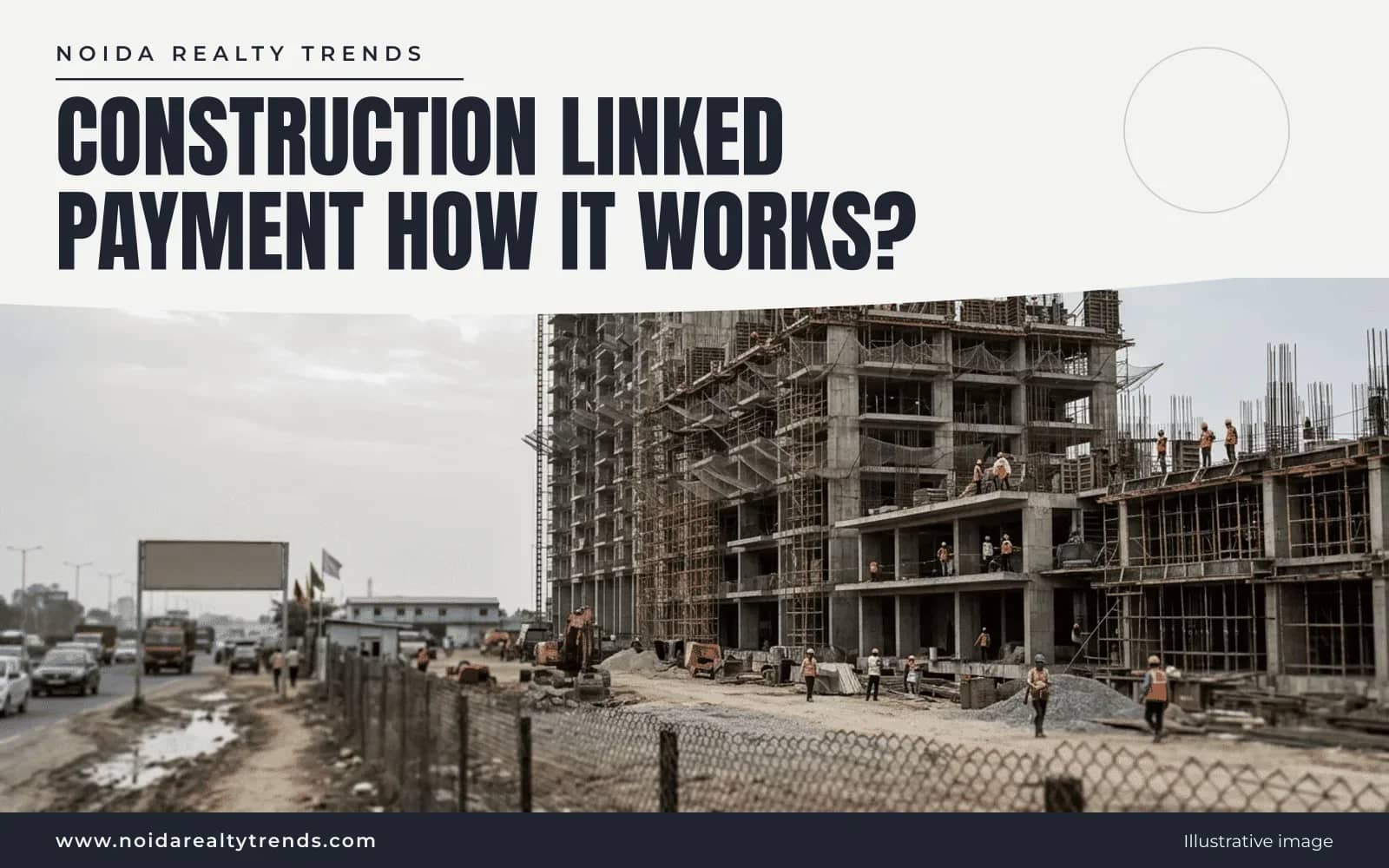
Answer: A construction linked payment plan (CLP) requires instalments at defined construction milestones, such as foundation, slab, brickwork, and possession, instead of paying the full price upfront. It does not cut the flat's price but can lower initial capital needs and pre-EMI interest if the lender disburses in stages. Always verify the exact schedule in the allotment letter, buyer agreement, and the project's UP RERA record before paying.
Evidence-led guide: we do not quote live prices, approvals or returns as our own claims. Verify project-specific facts on the official sources linked below before acting.
What is a construction linked payment plan in Noida?
A construction linked payment plan ties each instalment to a specific, physically verifiable construction stage rather than to the calendar. Typical triggers named in marketing material include excavation, foundation, slab completion, brickwork, plastering, finishing, and possession, but the actual schedule that binds the developer and buyer is whatever is written into the allotment letter and the builder-buyer agreement, not the brochure.
Buyers should treat every advertised CLP structure as a commercial offer that needs independent verification. A recent project-market report describes M3M The Line in Sector 72 as advertising a 20:80 structure, and The Cullinan Avenue in Sector 94 as advertising 20% within 30 days plus 80% on possession. Both claims should be confirmed from the developer's written cost sheet, the signed agreement, and the project's UP RERA record before any payment is made, since marketing language and contractual terms can differ.
How does construction linked payment help buyers save money?
CLP does not automatically reduce the price of the flat. What it can do is lower the initial capital a buyer needs, since money stays with the buyer until the relevant construction stage is reached rather than being paid in one lump sum at booking.
If a bank disburses a home loan in stages matching the construction schedule, interest is usually charged only on the amount actually released, not on the full sanctioned loan. This keeps the pre-EMI burden lower during the construction period compared to a full upfront loan drawdown.
CLP also spreads execution risk. Payments can be linked to independently checkable progress, subject to what the contract actually says, rather than handing over the full price on trust. Some buyers can use the retained funds for other purposes or avoid borrowing costs on money not yet due, though this depends on individual tax position, investment returns, and loan terms. A CLP schedule can also give a buyer negotiating room to compare it against possession-linked or time-linked plans instead of accepting whatever is first advertised.
The real saving has to be calculated against the developer's quoted price, any plan-specific premium, GST and other applicable charges, loan interest, and the cost of a delayed possession. A 20:80 structure can look attractive on paper but be less favourable if the 80% instalment is tied to a vague or unusually early possession trigger, or if the base price itself is higher than a comparable project's full-payment price.
Construction linked payment vs full payment, which is better?
For most first-time buyers, a genuine milestone-based CLP is generally safer for cash flow than paying the entire amount upfront, provided the milestones are objective, the project is properly registered on UP RERA, and the agreement contains clear delay and refund protections.
Full or near-full payment can work out better only after comparing the all-in cost: the genuine written discount offered, financing cost saved or lost, applicable taxes, and the buyer's own risk tolerance for delayed delivery. A discount that does not exceed the financing cost and risk premium of paying early is not really a saving.
| Issue | Construction linked plan | Full or near full payment |
|---|---|---|
| Initial cash requirement | Lower | Much higher |
| Loan interest before possession | Usually lower if disbursement is staged | Can be higher if the full loan is drawn early |
| Exposure to developer delay | Payments may remain outstanding, depending on milestones | Buyer's money is exposed earlier |
| Price certainty | Usually fixed under the agreement, but extras must be checked | More price certainty if all contractual amounts are paid |
| Discount potential | Sometimes available, verify it offsets plan charges | A genuine written discount may improve total cost |
| Liquidity | Preserved | Reduced substantially |
| Best suited to | Buyers wanting liquidity and milestone-based risk control | Buyers with surplus funds and a documented discount |
What should a first-time buyer in Noida check before signing a CLP?
Start by verifying the project on UP RERA. Confirm the registration number, promoter details, approved completion date, sanctioned plans, quarterly progress updates, any encumbrances or complaints, and the uploaded buyer agreement. This single check filters out most unregistered or misrepresented offers.
Demand the complete payment schedule in writing, with every milestone, percentage, due date, applicable taxes, maintenance deposit, parking charge, club charge, power backup charge, lease rent, IFMS, and any other add-on clearly listed. Marketing slides are not a substitute for the schedule in the agreement.
Check whether the plan is truly construction-linked. A schedule such as '10% every 60 days' is time-linked, not construction-linked, even when marketing material calls it a CLP. True CLP instalments are tied to a physical stage, not a date.
Define what evidence proves each milestone. Ask what document, certificate, or site inspection confirms 'foundation', 'slab', 'brickwork', or 'possession'. Vague triggers create room for premature demand notices.
- Confirm loan disbursement terms with your bank in writing, including whether pre-EMI or full EMI starts immediately
- Check the agreement's delay protection: possession obligation, interest or compensation for delay, cancellation and refund rights
- Do not rely on verbal return, lease, or rental assurance claims; any such promise needs to sit inside a signed, enforceable agreement with the responsible counterparty
- Verify stamp duty, registration fee, and circle-rate valuation independently through IGRSUP and the relevant Sub-Registrar before registration
- Use an independent property lawyer to review title, land or lease documents, authority permissions, RERA disclosures, and the builder-buyer agreement
- Pay only into the developer's disclosed account and retain every demand letter, receipt, and bank disbursement record
Is a construction linked plan worth it, or is it a loss?
A construction linked plan is generally a reasonable choice, not a loss, when three conditions hold: the project is UP RERA registered with a credible construction-progress record, the milestones in the agreement are objective and independently verifiable, and the agreement specifies real delay compensation and refund rights rather than vague possession language.
It becomes a poor choice, effectively a loss of leverage, when the buyer pays a large instalment against a milestone that cannot be independently confirmed, when the schedule is time-linked despite being marketed as construction-linked, or when a large final instalment is due on a possession date that has no contractual teeth. In Noida's Sector 72 and Sector 94 to 98 corridor, where several large projects are under construction simultaneously, buyers should ask for the project's quarterly RERA progress filing before accepting any milestone claim at face value, since filings are a more reliable record than sales material.
What does the Sector 72 and Noida-Greater Noida Expressway construction record show?
Sector 72, along with the Sector 94 to 98 on the Noida-Greater Noida Expressway on the Noida Expressway, has multiple large residential, retail, and studio-format projects at different construction stages, and a CLP buyer in this belt should treat each project on its own documented record rather than assuming the corridor's overall profile applies uniformly.
Developers active in and around this stretch and comparable addresses elsewhere in the NCR market, such as Godrej Properties, Gaurs Group, ATS Greens, Mahagun, Supertech, and Max Estates, each carry their own RERA filing history and delivery record, which is the only fair basis for comparing payment-plan reliability. A buyer should pull the specific project's RERA page rather than relying on the developer's brand reputation alone.
How do Noida registration costs fit into a CLP budget?
Stamp duty, registration fee, and the applicable circle rate are separate from the construction-linked instalments and must be budgeted alongside them, since they are usually payable at or before registration, which can coincide with a late-stage CLP instalment.
Published secondary sources report commonly cited Noida rates of around 7% stamp duty for male ownership, 6% for female ownership, and roughly 1% registration fee, but these figures, along with any concession, must be confirmed directly through IGRSUP because rates, concessions, and circle-rate valuations can change and vary by sector and property type. Do not treat any third-party blog figure as final; cross-check with IGRSUP and the Sub-Registrar office at the time of registration.
How to verify this yourself
- Confirm the project's UP RERA registration number, promoter details, and quarterly construction-progress filing on up-rera.in before paying any instalment
- Obtain the complete payment schedule in writing from the developer's cost sheet and builder-buyer agreement, not from brochures or sales presentations
- Verify with your bank, in writing, how and when loan disbursements will be released against each construction milestone
- Check that marketed milestone triggers (foundation, slab, brickwork, possession) are defined with verifiable evidence in the agreement, not left vague
- Confirm current stamp duty, registration fee, and circle-rate valuation directly through IGRSUP (igrsup.gov.in) and the relevant Sub-Registrar office
- Have an independent property lawyer review title, land or lease status, and delay/refund clauses before signing
Sources and where to verify
- UP RERA project document portal
- Noida Realty Trends: M3M Jacob & Co. in Noida, what's launched and what's coming
- Square Yards: Stamp duty and registration charges in Noida
- Sobha: Circle rate Noida and Greater Noida sector-wise
- IGRSUP: Stamp duty and registration
Continue your Noida research
Frequently Asked Questions
What is a construction linked payment plan in simple terms?+
It is a payment structure where the buyer pays instalments as construction reaches defined stages, such as foundation, slab, or brickwork, instead of paying the full amount at booking; the exact stages and percentages are fixed in the allotment letter and buyer agreement, not in marketing material.
Does a construction linked plan reduce the total price of the flat?+
No, CLP does not automatically reduce the price; it changes when you pay, not how much you pay in total, so any saving comes from lower pre-EMI interest, preserved liquidity, and reduced upfront risk, not from a built-in discount.
Is construction linked payment better than full payment for a first-time buyer?+
For most first-time buyers, a genuine milestone-based CLP is generally safer for cash flow than full upfront payment, provided the project is UP RERA registered, milestones are objective, and the agreement has clear delay and refund protections; full payment only wins if a documented discount outweighs the financing cost saved.
How can a first-time buyer verify a CLP schedule in Noida before paying?+
Check the project's UP RERA registration and quarterly progress filing first, then demand the complete written payment schedule from the developer, confirm with your bank how the loan will be disbursed against each milestone, and have an independent lawyer review the builder-buyer agreement before any instalment is paid.
Are 'assured return' offers linked to a payment plan safe to accept?+
Any verbal or marketed assured-return, rental-guarantee, or lease-income promise attached to a payment plan should be treated as a due-diligence red flag, not a benefit; it is only meaningful if it appears as an enforceable clause in a signed agreement with a named, responsible counterparty, and even then it should be checked against regulatory norms before relying on it.
What is the difference between a construction linked plan and a time linked plan?+
A construction linked plan ties instalments to a physical milestone like slab or brickwork completion, while a time linked plan ties instalments to a calendar date regardless of actual progress; some developers market time-linked schedules using the term CLP, so buyers must read the agreement's actual trigger language, not the marketing label.
Tags