Is Noida's civic infrastructure good enough for buyers?
Roads, water, power and drainage across Noida sectors in 2026, with what to verify before buying a home.
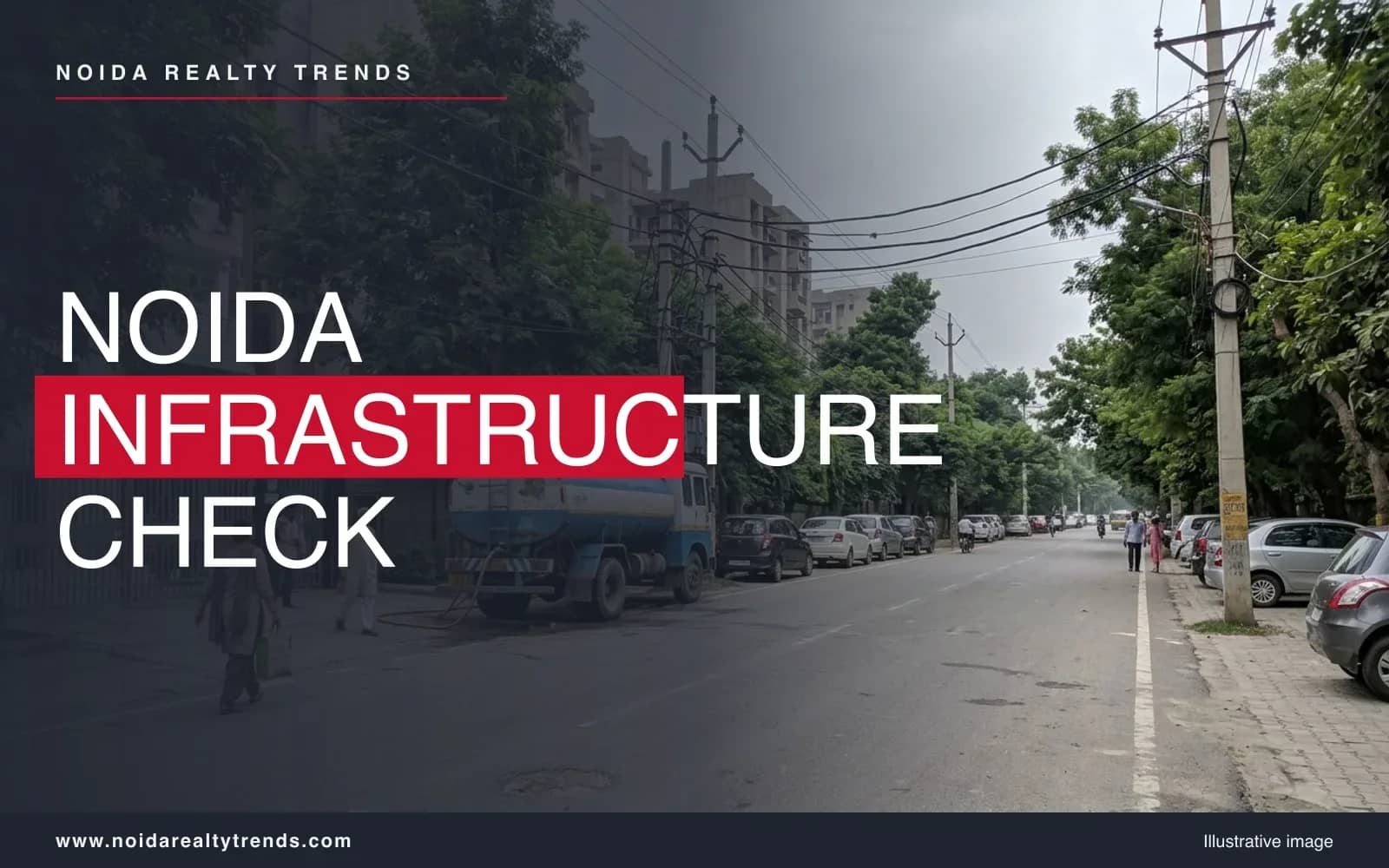
Answer: Noida's civic infrastructure is strong on planning fundamentals, broad roads, metro access and grid layout, but quality is uneven in practice. Established sectors generally offer mature roads and services, while newer expressway sectors have good arterial connectivity but sector-specific gaps in drainage, water pressure and last-mile infrastructure. Buyers should assess at the project level, not the sector level alone, and verify claims with the Noida Authority rather than sales teams.
Evidence-led guide: we do not quote live prices, approvals or returns as our own claims. Verify project-specific facts on the official sources linked below before acting.
What is Noida's civic infrastructure quality like going into 2026?
Noida's civic infrastructure remains a mix of strong planning and uneven execution. The city's sector-based grid layout gives it wide arterial roads and relatively good links to Delhi, Greater Noida, the Noida-Greater Noida Expressway and the DND Flyway, which is a structural advantage over many unplanned urban pockets in the National Capital Region.
However, planning quality does not automatically mean uniform delivery. Drainage, water pressure and quality, construction-related congestion, and last-mile connectivity continue to vary significantly from sector to sector and even within the same sector depending on the specific society and its approach road. A buyer evaluating any property, including those in Sectors 72, 94, 97 or 98 on the Noida Expressway, should treat infrastructure as a project-level question, not a city-level assumption.
Does Noida have good roads, water supply and electricity?
Roads are generally good but not uniformly excellent. Noida's planned grid gives most sectors wide carriageways and reasonable connectivity, though conditions vary by internal road, maintenance responsibility and proximity to ongoing construction. Before buying, a buyer should check who owns and maintains the approach road, the sanctioned road width in the layout plan, current access conditions, peak-hour traffic and parking, and whether the road is public, privately maintained, or tied to a future development phase.
Water supply follows a similar pattern. Noida has a planned municipal network, but reliability and quality differ by sector and by society. High-rise projects often blend authority supply with borewells, treated water and tanker backup, so the practical experience for a resident can differ sharply from the marketing description. Ask for recent water-quality test reports, clarity on authority supply versus borewell or tanker dependence, daily supply timings and pressure, STP and water-treatment arrangements, and recent maintenance bills that reveal tanker costs.
Electricity infrastructure in Noida is comparatively reliable at the urban level, but outages, voltage fluctuations and backup costs still vary by locality and project. Most high-rise societies rely on diesel-generator backup for common areas and partial unit load, which can add meaningfully to monthly maintenance. Confirm whether the connection is domestic or commercial, the sanctioned load and metering arrangement, backup-generator capacity and diesel tariff, transformer and fire-safety provisions, and whether permanent electricity connections and possession have actually been obtained for the specific tower.
Which Noida sectors have the best infrastructure?
There is no single answer, because infrastructure quality is sector-specific and often project-specific within the same sector. Established central sectors such as 14, 15, 18, 27, 28 and 29 benefit from decades of road, market and civic-service maturity, though buyers there should watch for aging buildings, parking constraints and redevelopment uncertainty.
Sectors such as 37, 50, 51, 52 and 61 are generally regarded as having established residential infrastructure and amenities, with the main checks being internal-road maintenance, drainage performance in monsoon and the physical condition of the society itself. Other Noida sectors and nearby employment-adjacent areas have strong road connectivity and established utilities, but also carry more traffic, commercial activity and pollution load.
Newer expressway sectors, including 94 and 97 on the Noida Expressway, offer strong arterial and expressway access along with premium development activity, but a buyer must verify construction stage, approach-road completion, public-transport proximity and whether utility infrastructure, water, sewage and power, is actually commissioned rather than planned. Sectors further toward Greater Noida offer larger, newer developments with planned expansion, but the gap between existing and promised infrastructure needs direct verification rather than assumption.
How should a buyer check infrastructure before signing anything?
Infrastructure due diligence should happen before booking, not after possession. A buyer should physically visit the site, ideally during or shortly after heavy rain, to check for waterlogging, since monsoon drainage has historically been a recurring concern in parts of Noida. Speaking with the resident welfare association of a nearby completed project, rather than relying solely on a broker or sales office, usually surfaces more honest detail about water timings, power backup costs and road maintenance responsibility.
Any claim about upcoming road widening, new metro extensions or planned civic upgrades should be verified directly with the Noida Authority rather than taken from brochure language. Developers across the market reference civic-upgrade plans in marketing collateral; the responsible approach is to treat these as pending until confirmed by the authority, regardless of which developer's project is being considered.
Should you buy in Noida if infrastructure quality matters to you?
Noida remains a reasonable choice for a buyer who prioritises infrastructure, provided the assessment is done at the project level with documentary verification rather than assumption. The city's planned grid, expressway access and metro corridors are genuine structural strengths compared with many unplanned urban markets, but a buyer who skips due diligence on drainage, water arrangements and approach-road status in a specific sector or society risks a mismatch between brochure promises and lived experience.
For sectors such as 94 and 97 on the Noida Expressway, where development is comparatively newer, the practical approach is to ask for the project's RERA filing on the UP RERA portal, request the sanctioned utility layout, and confirm construction-stage infrastructure such as completed roads, operational water connections and commissioned power before treating any civic claim as settled.
How does metro and last-mile connectivity factor into the decision?
Metro connectivity in Noida is strongest near operational stations on the Delhi Metro's Blue Line, which serves central Noida, and the Aqua Line, which links Noida with Greater Noida. Many sectors, however, still depend on road-based last-mile travel to reach the nearest station, which matters for daily commute convenience and resale appeal alike.
A buyer should check the actual walking or shuttle distance from the specific project to the nearest operational metro station, rather than relying on a sector-level claim of metro proximity, since internal-road conditions and traffic can materially extend an apparently short distance.
Which sectors show the stated infrastructure patterns on paper?
The table below summarises broadly reported infrastructure patterns by area type. It is not a verified ranking and does not guarantee the experience at any single project; it should be used only as a starting point for the Noida Authority and site-level checks described above.
| Area | Typical strengths | Main checks before buying |
|---|---|---|
| Other Noida sectors | Mature roads, established markets and civic services | Older buildings, parking, redevelopment status |
| Other Noida sectors | Established residential infrastructure and amenities | Internal-road maintenance, drainage, society condition |
| Other Noida sectors and nearby employment areas | Road connectivity and established utilities | Traffic, commercial activity, pollution |
| Expressway sectors, including 94 and 97 | Expressway access and premium development activity | Construction stage, approach roads, utility completion |
| Peripheral sectors toward Greater Noida | Larger newer developments, planned expansion | Existing versus promised infrastructure, commute |
How to verify this yourself
- Confirm road ownership, maintenance responsibility and sanctioned width with the Noida Authority rather than the sales team
- Request recent water-quality test reports and clarity on authority supply versus borewell or tanker dependence
- Check sanctioned electrical load, backup-generator capacity and diesel-tariff structure for the specific tower
- Visit the site during or after heavy rain to check for waterlogging and ask the resident welfare association about past incidents
- Verify any claimed road-widening, metro-extension or civic-upgrade plan directly with the Noida Authority before relying on it
- Check the project's RERA registration and disclosures on the UP RERA portal before any payment
Sources and where to verify
Frequently Asked Questions
Is Noida's infrastructure good enough to justify buying a home there in 2026?+
Conditionally yes: Noida's planned road grid, expressway access and metro corridors are genuine strengths, but the actual experience depends on the specific sector, society and approach road, so a buyer should verify drainage, water supply and utility completion at the project level before treating any sector-level reputation as sufficient.
What is Noida's civic infrastructure quality like right now?+
It is uneven: established central and mid-tier sectors generally have mature roads and civic services, while newer expressway sectors have strong arterial connectivity but sector-specific gaps in drainage, water pressure and last-mile infrastructure that should be checked directly with the Noida Authority.
Does Noida have reliable water supply and electricity?+
Noida has a planned municipal water network and comparatively reliable urban electricity, but reliability, quality and backup costs vary by sector and project, so buyers should request water-quality reports, supply timings and backup-generator tariffs before purchase rather than assuming uniform service.
Which Noida sectors are considered to have the best infrastructure?+
There is no single best sector; established areas such as other Noida sectors have mature civic services, mid-tier sectors like 37, 50 and 51 have established residential infrastructure, and expressway sectors including 94 and 97 offer strong connectivity with construction-stage utility risks that need direct verification.
Is buying in a newer expressway sector a loss or a reasonable bet if infrastructure is still developing?+
It can be a reasonable bet, not a loss, if the buyer confirms actual construction-stage status, such as completed roads, operational water connections and commissioned power, rather than relying on planned-infrastructure promises, since expressway sectors like 94 and 97 combine strong location fundamentals with infrastructure that is still catching up in places.
Should waterlogging and drainage concerns stop someone from buying in Noida?+
Not necessarily, but they should not be ignored either; waterlogging has historically been a recurring monsoon issue in parts of Noida, so a site visit during or after heavy rain and a direct conversation with a resident welfare association about past incidents is a reasonable due-diligence step before committing.
Tags