Leasehold Land in Noida: What Buyers Must Verify in 2026
Noida land is mostly leasehold, not freehold. Here is what to check on lease term, transfer rules, loans and resale before you pay a token amount.
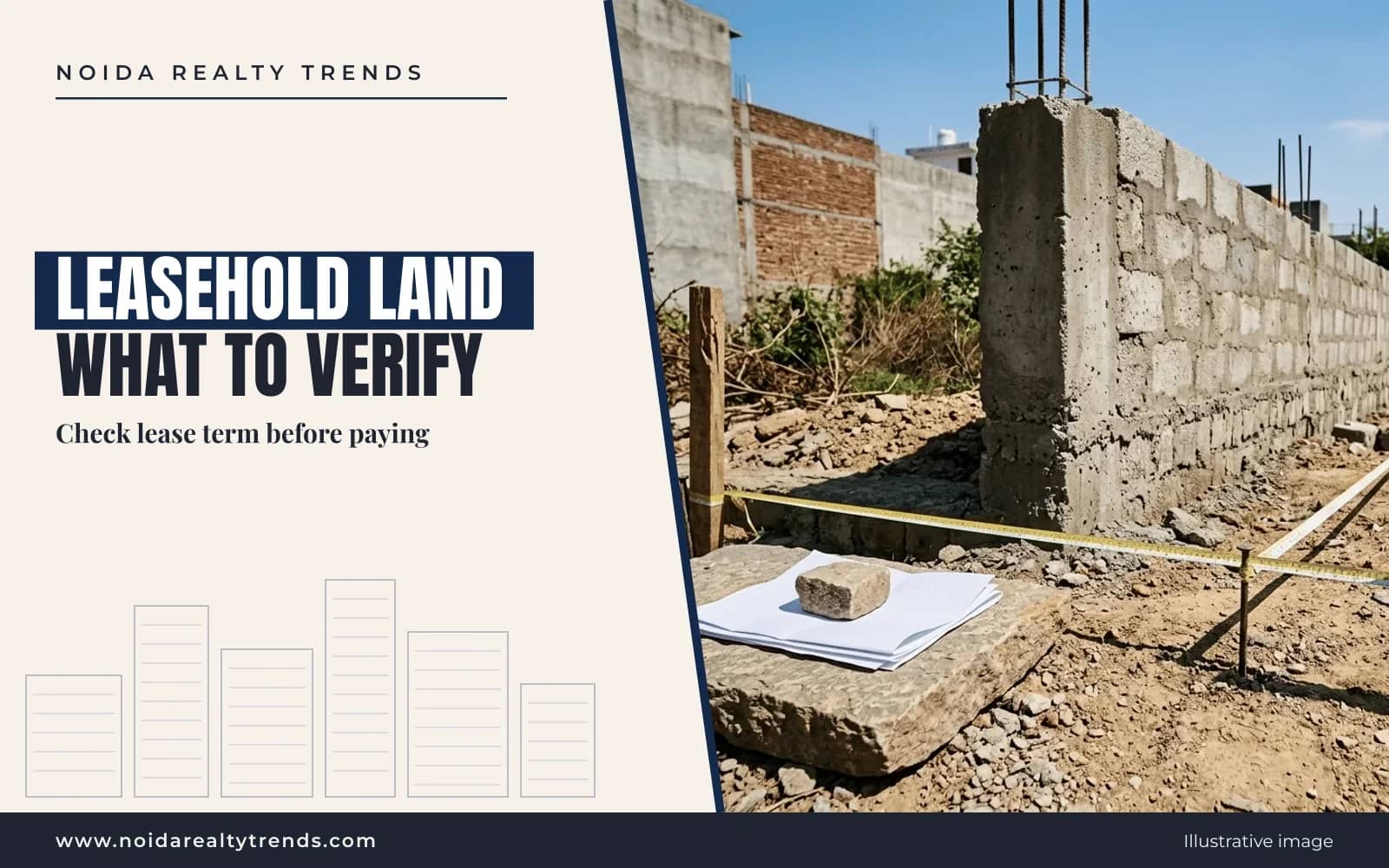
Answer: Most land and built property in Noida sits on Noida Authority leasehold, commonly structured around a 90-year term from allotment, not from your purchase date. Risks include unclear residual tenure, authority consent needs for transfer or mortgage, pending dues, and no guaranteed freehold conversion. Loans are possible but lender-specific. Verify the lease deed, authority dues and RERA status before paying any token amount.
Evidence-led guide: we do not quote live prices, approvals or returns as our own claims. Verify project-specific facts on the official sources linked below before acting.
Is land in Noida leasehold or freehold?
Land allotted by Noida Authority is overwhelmingly leasehold, not freehold. When you buy a plot, apartment or commercial unit built on Noida Authority land, you are generally acquiring leasehold rights for a defined term, not absolute ownership of the underlying land. The Authority remains the lessor and retains defined controls over use, construction, transfer and mortgage.
Do not assume a property is freehold just because a broker or seller uses the word loosely. If freehold status is claimed, ask for the registered document that proves it and have a property lawyer confirm it against Noida Authority records before you proceed.
What are the real risks of buying leasehold land in Noida?
The core risk is that you are buying a right to use land for a finite period, with the Noida Authority retaining lessor powers, rather than buying the land outright. Several practical risks follow from that structure and should be checked line by line before any token payment.
A breach of lease conditions, such as unauthorised construction, change of use, or an unpermitted subdivision or transfer, can expose the property to penalties or even cancellation proceedings. Transfers, mortgages and assignments may need Noida Authority permission or compliance with its transfer policy, so a private sale agreement alone is not enough. Outstanding lease rent, transfer charges, extension fees or property tax dues attach to the property and can block a clean transfer if unresolved.
- Finite tenure: you hold leasehold rights, the Authority remains the lessor
- Lease-condition breaches on construction, use or transfer can trigger penalties or cancellation
- Transfers, mortgages and change of use may need Noida Authority consent
- The lease term may run from the original allotment date, not your purchase date, so verify unexpired tenure
- Outstanding dues, extension fees or penalties can block mutation or resale
- Leasehold-to-freehold conversion should never be assumed; public reporting indicates Noida continues to operate primarily on a leasehold model
- Developer-level risk: in a project you may hold an apartment via sub-lease or conveyance, so the developer's own authority lease and RERA disclosures matter too
How long is a typical Noida land lease, and what happens when it ends?
For residential and commercial plots allotted by Noida Authority, the commonly reported structure is a 90-year lease, including the development period, though some references cite periods up to 99 years depending on the allotment category. The actual figure that governs your property is whatever is written in the signed lease deed, not a general number quoted by a broker or in marketing material.
What happens at the end of the term depends entirely on the lease deed and the policy in force at that time. Possible outcomes include renewal or extension on revised terms with fresh charges, re-entry or resumption by the Authority if the lease lapses or is terminated under its conditions, or continued occupation only if formally permitted. There is no safe basis to assume automatic renewal or automatic conversion to freehold status. Ask Noida Authority for a written, property-specific position and have a lawyer review the expiry, renewal, re-entry and forfeiture clauses in the deed itself.
Leasehold or freehold: which should a Noida buyer choose?
For a genuine Noida Authority leasehold property with a long residual term, a clean title, approved construction and no pending dues, leasehold can be a reasonable and common way to own property in the city, since it is the default structure here. Freehold is preferable in principle for ownership certainty, but you should never pay a premium for a 'freehold' claim unless the seller produces valid registered documents proving that status, since Economic Times coverage on leasehold-to-freehold conversion notes the process and eligibility vary and should not be assumed.
Leasehold versus freehold in Noida: what actually differs
| Issue | Leasehold | Freehold |
|---|---|---|
| Ownership | Lease rights for a defined period, commonly around 90 years per the deed | Perpetual ownership, subject to law |
| Noida availability | The common structure for Noida Authority land and most projects | Do not assume it is available; verify with registered documents |
| Authority control | Greater control over use, transfer, construction and compliance | Fewer lessor-related restrictions once title is clear |
| Financing | Often possible, subject to lender policy and residual lease term | Usually simpler to evaluate if title is clean |
| Resale | Depends on residual lease, authority dues and transfer permissions | Generally more straightforward, subject to title checks |
| End of term | Renewal or extension depends on the deed and policy then in force | No lease expiry to plan around |
Can you get a home loan on leasehold property in Noida?
Yes, financing leasehold property in Noida is commonly possible, but approval is case-specific and depends on the lender's view of the remaining lease tenure and title. Lenders including HDFC Bank's home loan arm serve the broader Noida and Greater Noida market, but each file is assessed on its own documentation, so a builder's claim that 'all banks are funding this project' should never substitute for your own in-principle sanction.
Before relying on financing, ask your lender in writing whether it requires Noida Authority permission for mortgage, a tripartite agreement, a registered sub-lease, or additional NOCs. Lenders typically examine whether the residual lease comfortably exceeds your loan tenure, whether the lease deed permits mortgage without extra consent, the project's RERA registration and disclosures if under construction, and any existing encumbrances, dues or litigation on the property.
- Remaining lease tenure should comfortably exceed the loan repayment period
- Check whether the lease deed requires lessor consent for mortgage
- Ask if Noida Authority permission or a tripartite agreement is needed
- Confirm RERA registration and project disclosures for under-construction units, verifiable on UP RERA
- Get a written in-principle sanction specific to the unit or plot, not a generic builder assurance
What should you verify before paying any token amount?
Verify the lease deed, allotment letter, possession certificate, sanctioned building plan, and completion or occupancy documents before any token payment changes hands. An independent title search and a property lawyer's review of the chain of transfers are non-negotiable steps, not optional extras, given how much rests on the specific wording of the lease.
Separately confirm there are no outstanding Noida Authority dues, no unresolved litigation or notices, and that any construction matches the sanctioned plan. For apartments or commercial units bought within a developer project, separately check the project's registration and filings on UP RERA, since the developer's own authority lease, approvals and RERA disclosures sit underneath whatever sub-lease or conveyance deed you are being offered.
Does buying into a developer project change the leasehold picture?
Yes, a developer project adds another layer: you are typically buying an apartment or commercial unit through a sub-lease, allotment or conveyance structure sitting on top of the developer's own authority lease, so both layers of documentation matter. This applies across Noida regardless of developer, whether the project is in the established corridors or newer micro-markets, and is relevant whether you are evaluating a plotted project, a group-housing apartment, or a retail or studio unit in a mixed-use development.
Distinguish clearly between a direct Noida Authority lease of a plot, a developer's own leasehold development right over that plot, and your individual allotment, sale deed, sub-lease or conveyance deed as the end buyer. Ask for all three layers of documentation, not just the brochure or the builder-buyer agreement, and cross-check the project's registration number and disclosed timelines on UP RERA before relying on any verbal assurance about tenure or conversion.
How to verify this yourself
- Verify the registered lease deed's commencement date, term length and renewal or re-entry clauses rather than relying on a broker's stated tenure
- Confirm with Noida Authority in writing whether transfer, mortgage or change of use on the specific property requires its permission
- Check for outstanding lease rent, transfer charges, extension fees, penalties or property tax dues attached to the property before paying any token amount
- Confirm the project's RERA registration number and disclosures on UP RERA (up-rera.in) if buying an apartment or commercial unit within a developer project
- Get a written in-principle loan sanction from your lender specific to the unit, including any Authority permission or tripartite agreement it requires
- Do not assume leasehold-to-freehold conversion is available; request Noida Authority's current, property-specific written position
Sources and where to verify
- Economic Times: can you convert leasehold property such as in Noida into freehold
- UP RERA project search and registration verification
- HDFC Bank home loans in Greater Noida
Continue your Noida research
Frequently Asked Questions
Is leasehold land in Noida a loss or a reasonable investment?+
It depends on residual tenure, title clarity and dues, not on the leasehold label alone; a property with a long remaining term, clean title, approved construction and no pending Authority dues can be a reasonable buy, while a short residual term, unclear commencement date or unresolved dues make it a genuine risk worth walking away from or renegotiating on price.
What are the main risks of buying leasehold land in Noida?+
The main risks are a finite tenure with the Authority as lessor, possible penalties or cancellation for lease-condition breaches, mandatory Authority consent for transfer or mortgage in many cases, an unclear residual term if the lease runs from allotment rather than your purchase date, and outstanding dues or encumbrances that can block resale.
How long is a typical land lease in Noida and what happens after it ends?+
Noida Authority plots are commonly structured around a 90-year lease including the development period, though the figure that actually governs your property is whatever the signed lease deed states; at expiry, outcomes depend on the deed and the policy then in force, and can include renewal, extension with fresh charges, or re-entry by the Authority, so always get a written Authority position rather than assuming automatic renewal.
Should I choose leasehold or freehold property in Noida?+
Leasehold is the default and most common structure for Noida Authority land, and can be a reasonable choice if the residual term is long and the title is clean, while freehold is preferable in principle for ownership certainty but should never be paid a premium for unless the seller produces valid registered documents proving that status.
Can I get a home loan on leasehold property in Noida?+
Yes, financing is commonly available for leasehold property in Noida, but approval depends on the specific lender's assessment of residual lease tenure, mortgage permission clauses in the deed, Authority NOC requirements, and the property's title and RERA status, so always get a written in-principle sanction for the specific unit rather than relying on a builder's general claim.
Can leasehold property in Noida be converted to freehold?+
Conversion should not be assumed; public reporting, including Economic Times coverage on leasehold-to-freehold conversion, indicates Noida continues to operate primarily on a leasehold model and that a general, guaranteed conversion scheme has not been clearly established, so get Noida Authority's written, property-specific position before counting on conversion.
Tags