Noida metro station commercial space: worth leasing in 2026?
NMRC station leasing explained: which stations have space, reserve rates, and how to check before you sign.
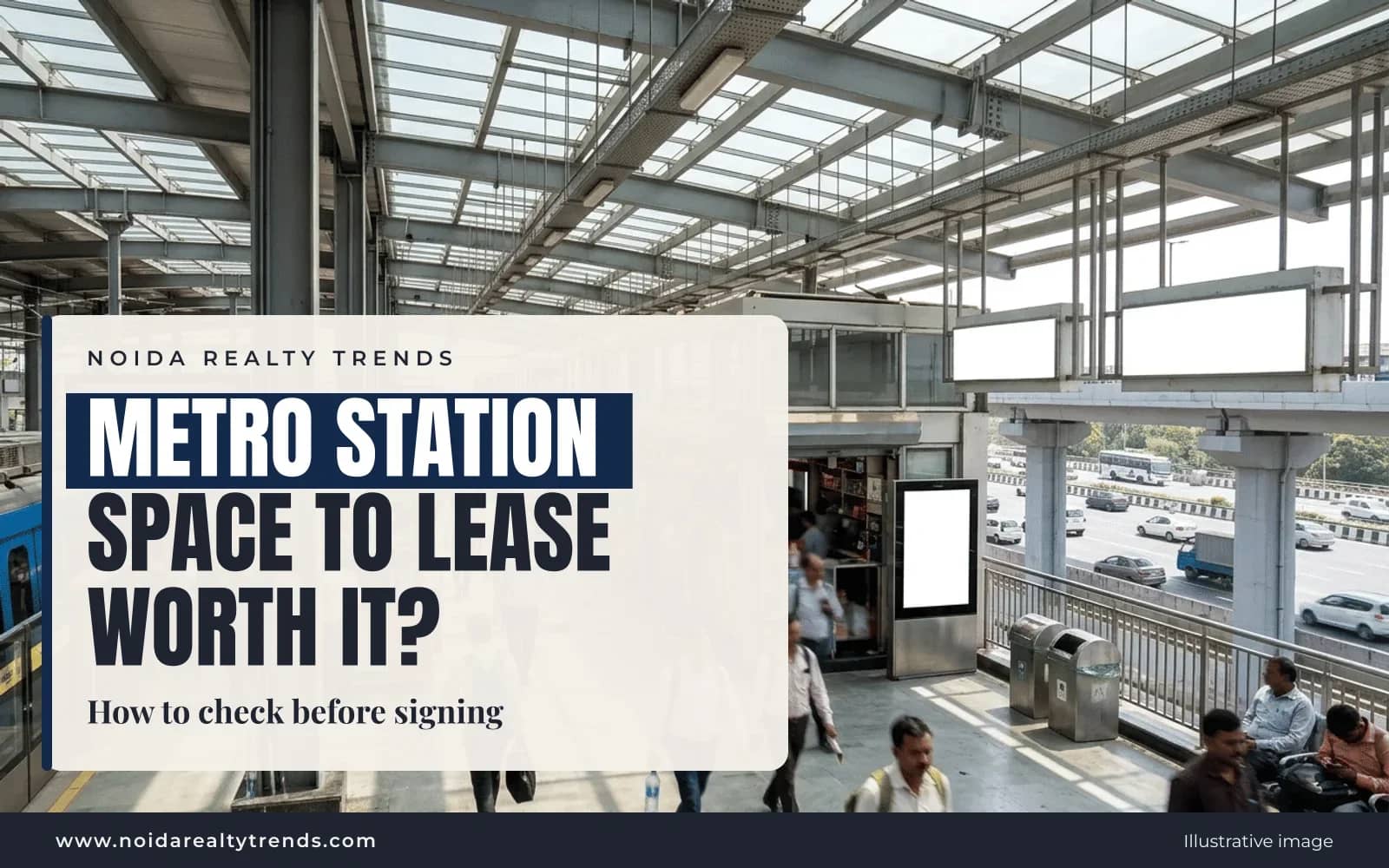
Answer: NMRC has tendered commercial space at Aqua Line stations including Sector 50, 51, 137, 76, 81, 83, 101, 148, Alpha-1, NSEZ, GNIDA and Pari Chowk, but these are license-based opportunities with fixed terms, not ownership. Reserve rates run from roughly 205 to 680 rupees per sq m per month before tax, verified on NMRC's own tender documents. Private shops near these stations are priced separately by the open market, so verify each deal through NMRC, UP RERA and IGRSUP rather than a broker quote.
Evidence-led guide: we do not quote live prices, approvals or returns as our own claims. Verify project-specific facts on the official sources linked below before acting.
Which Noida metro stations actually have commercial space for lease?
Several Aqua Line stations have genuine, tendered commercial space, but it comes from NMRC's own property development program rather than a developer's retail project. Current NMRC tender documents list kiosk and convenience-store format spaces at Sector 51, Sector 50 and Sector 137, bare shell commercial spaces at Sector 76 and Pari Chowk, and larger multi-level commercial areas at Sector 83 spanning first floor, platform level and passenger-deck level.
Sector 101 has rooftop commercial space offered under a nine-year license structure, while a separate multi-station tender covers small ground-floor spaces at Sector 81, NSEZ, Sector 148, Alpha-1, GNIDA and the depot. Every one of these is licensed space inside or adjoining an NMRC station, meaning the successful bidder gets the right to operate for a defined period, not a freehold or leasehold title to the unit.
Tender status changes constantly. Bid deadlines close, properties get re-tendered, and some listings lapse without a successful bidder. Anyone evaluating this route should check the NMRC Property Development and Business Tenders page directly before assuming a specific station space is still open.
- Sector 51, Sector 50, Sector 137: kiosk and convenience-store format
- Sector 76, Pari Chowk: bare commercial shell space
- Sector 83: first floor, platform level and passenger-deck commercial zones
- Sector 101: rooftop space under nine-year license
- Sector 81, NSEZ, Sector 148, Alpha-1, GNIDA, Depot: small ground-floor units
How much does commercial space cost near a Noida metro station?
There is no single market rate for 'near-metro' retail in Noida, because price depends on footfall, floor level, frontage, lease structure and the surrounding sector's occupancy, not proximity to a station alone. The only figures that can be stated with confidence are NMRC's own reserve license rates for station-controlled premises, and even those are starting bids, not final transaction prices.
NMRC tender documents put the Sector 83 station's first floor, platform level and passenger-deck commercial space at a minimum reserve rate of roughly 205 rupees per sq m per month, excluding applicable taxes. Separate multi-station tenders list reserve rates around 360 rupees per sq m per month for selected Sector 81 ground-floor space, and figures ranging from about 480 to 680 rupees per sq m per month for small ground-floor units at Sector 101, Alpha-1 and other listed stations.
These numbers describe NMRC-controlled premises won through competitive bidding, so the final license fee is often higher than the reserve price once bidding closes. They say nothing about what a privately owned shop two minutes from the same station actually rents or sells for. For any private unit, verify the asking price against the applicable circle rate on IGRSUP, confirm the project's registration and disclosed inventory on UP RERA, and check leasehold status and dues with the Noida Authority before treating any broker figure as real.
| Station / location | Space type | Reserve rate stated in tender |
|---|---|---|
| Sector 83 | First floor, platform level, passenger-deck | Approx 205 per sq m per month, excluding tax, per NMRC NIT |
| Sector 81 | Selected ground-floor units | Approx 360 per sq m per month, per NMRC RFP |
| Sector 101 / Alpha-1 | Small ground-floor units | Approx 480 to 680 per sq m per month, per NMRC RFP |
| Sector 51 / 50 / 137 | Kiosk / convenience format | Verify current reserve rate on NMRC tender page |
Which Noida sectors give the best footfall for a retail shop near the metro?
The strongest sectors depend on the retail concept, not metro access by itself, because a station exit with weak surrounding catchment will underperform a slightly farther unit with strong daily footfall. Sector 18 and the Botanical Garden belt carry an established regional catchment and command a correspondingly higher premium, so any unit there needs its title, use permission and actual achieved rent checked individually rather than assumed from the location's reputation.
Sectors 37 to 51 benefit from mature residential populations and the existing Aqua Line to Delhi Metro interchange, making them workable for daily-needs retail, food service and neighbourhood brands, though frontage and parking still decide performance unit by unit. Sectors 75 to 79 carry large residential catchments with Aqua Line access nearby, generally favouring recurring neighbourhood demand over destination retail.
Sectors 81 to 83 and the NSEZ belt sit inside an employment-oriented catchment tied closely to NMRC's own station commercial space, but retail performance there depends heavily on office occupancy and weekday footfall rather than residential density. Sectors 137 to 142 are a growth corridor with Aqua Line access, worth evaluating on current occupancy rather than projected future development, and Sectors 148 to 150 carry longer-term logistics and institutional potential but higher near-term risk where footfall is still thin. On the Greater Noida side, Pari Chowk and Alpha-1 draw strong institutional and visitor-related demand in specific pockets, though this varies sharply by exact frontage and operating hours.
Is retail along the Noida-Greater Noida Expressway a separate case from station-adjacent leasing?
Yes, because Sectors 94 to 98 on the Noida Expressway are a residential-led catchment first, and any commercial activity there draws its footfall from resident density and expressway visibility rather than from an operating metro station. This distinguishes it from the NMRC station-leasing model described above, where the commercial space is physically inside or attached to a transit stop.
M3M The Line in Sector 72, positioned at the edge of this expressway belt, is one example of a project built around retail, office and studio space rather than a station license, according to M3M's official project materials. Comparable commercial formats from other developers along the wider expressway and Noida-Greater Noida Expressway stretch include Bhutani Group's retail-format projects and Mahagun's commercial developments, and anyone comparing these should check each project's own UP RERA registration, sanctioned use and disclosed inventory rather than relying on brochure footfall claims.
None of this substitutes for metro-specific due diligence. A unit's proximity to a planned or under-construction station is a future catalyst, not a current traffic generator, and should be priced and underwritten accordingly.
Should you invest near an upcoming Noida metro line before it opens?
A metro-led investment can work, but only as a conditional, long-horizon bet, not a guaranteed appreciation play, because an announced extension, a construction tender and an operational station are three different milestones with very different timelines. NMRC's own tender material references extension work on the Aqua Line from Botanical Garden toward Sector 142 and from the depot side toward the Boraki Multimodal Transport Hub, including planned stations and construction packages, but a tender being floated does not mean trains are running.
The realistic upside of buying early near a genuinely planned station is better pedestrian access and visibility once service starts, a larger combined customer and employee catchment, improved leasing liquidity, and first-mover positioning in an area still under-supplied with organised retail. The realistic downside is construction delay, alignment changes that move a station exit away from a particular frontage, and weak present-day footfall that the investor is effectively paying a premium against in advance.
The practical answer to 'is it too late now' depends on which station: if construction has not started or is in early civil work, the opportunity and the risk are both still open; if a station is operational and footfall is already established, the first-mover discount has already been priced in and the decision becomes a standard retail underwriting exercise rather than a speculative one.
What should a buyer verify before leasing or buying near any Noida metro-linked commercial space?
Verification should happen in a fixed order, starting with the regulator, not the broker. Confirm the project or station tender's current status directly on NMRC's Property Development and Business Tenders page if it is a station-linked opportunity, or on UP RERA if it is a private developer project, since RERA registration discloses sanctioned use, promoter history, and filed complaints.
Next, check the applicable circle rate for the exact sector and plot on IGRSUP, since this affects both stamp duty and a realistic floor for resale pricing. For any leasehold property, confirm the lease term, remaining tenure and any pending Transfer Memorandum charges with the Noida Authority, because an unresolved TM can block resale or further transfer regardless of how good the retail location looks.
Finally, treat any 'assured return' or guaranteed rental claim as a due-diligence flag rather than a benefit. These structures are not inherently illegal, but they are frequently mis-sold, and the only way to know what is actually being offered is to read the registered lease or license document itself rather than a sales presentation.
- Confirm tender or RERA registration status before relying on any listing
- Check the current circle rate on IGRSUP for the exact sector and plot
- Confirm leasehold tenure and Transfer Memorandum dues with Noida Authority
- Read the registered lease or license, not a sales brochure, for any return claim
- Verify sanctioned use and occupancy certificate for the specific unit
How does station-adjacent retail compare with established high-street retail in Noida?
Established high-street retail in mature sectors generally has a visible, checkable occupancy and rent history, while most NMRC station-adjacent commercial space and many expressway-belt projects are still building that track record. This is a real, stated trade-off rather than a weakness unique to any one developer or format.
Comparable organised retail and mixed-use commercial destinations across Noida include Bhutani Group's projects, Mahagun's commercial developments, Gaurs Group's retail formats, and Supertech's commercial assets, alongside expressway-belt projects such as M3M The Line in Sector 72. Any fair comparison between these and a station-linked NMRC space should rest on stated, checkable criteria: current RERA registration status, documented delivery record for completed phases, actual disclosed occupancy, and distance plus visibility from the nearest functioning transit point, rather than on which name sounds more established.
How to verify this yourself
- Confirm current tender status and reserve rate for any NMRC station commercial space on the NMRC Property Development and Business Tenders page
- Check RERA registration, sanctioned use and promoter disclosures for any private project on UP RERA
- Verify the applicable circle rate for the exact sector and plot on IGRSUP before agreeing a price
- Confirm leasehold tenure, remaining term and Transfer Memorandum dues with the Noida Authority
- Read the registered lease or license document directly for any rental or return claim, never rely on a brochure figure
- Cross-check NMRC's stated extension and construction timelines before pricing a property against a future, not-yet-operational station
Sources and where to verify
- NMRC Property Development and Business Tenders
- NMRC All Tenders
- NMRC Sector 83 station commercial space NIT
- NMRC multi-station commercial space RFP
- NMRC official site
Continue your Noida research
Frequently Asked Questions
Which Noida metro stations currently have commercial space for lease?+
NMRC tender documents list commercial space at Sector 51, 50, 137, 76, 83, 101, 81, 148, Alpha-1, NSEZ, GNIDA and Pari Chowk stations, but availability changes as tenders close and re-open, so check the NMRC Property Development and Business Tenders page for the current live list before assuming any station space is still open.
How much does commercial space cost near a Noida metro station?+
There is no single market rate, since price depends on floor level, frontage and surrounding occupancy rather than metro proximity alone; the only verifiable figures are NMRC's reserve license rates for station premises, running roughly from 205 to 680 rupees per sq m per month before tax across different stations, and private shop prices nearby must be checked separately against IGRSUP circle rates.
Is buying commercial property near an upcoming Noida metro line worth it or a loss waiting to happen?+
It can be worth it if the station has confirmed construction progress, the project carries valid RERA registration, and the price already reflects current footfall rather than a fully priced-in future station; it tends toward loss territory when a buyer pays a premium for a station that is still only on paper, since tender announcements and operational trains are not the same milestone.
What is the difference between leasing NMRC station space and buying a private shop nearby?+
NMRC station space is a time-bound license to operate inside or adjoining a metro station, won through competitive bidding and carrying no ownership rights, while a private shop nearby is a separate real estate transaction with its own title, RERA status and circle rate that must be verified independently.
Are Sector 94 to 98 commercial projects a metro play or a residential-catchment play?+
They are primarily a residential-catchment and expressway-visibility play, since the Noida-Greater Noida Expressway sectors draw footfall from resident density and road frontage rather than from an operating metro station, which is a structurally different demand driver from NMRC's station-linked commercial leasing.
Does retail near a Noida metro station face oversupply concerns like other high-street projects?+
Oversupply is a documented concern in several Noida retail micro-markets, with projects like Spectrum Metro, Dasnac Arc and Central 50 often cited in this context, so any metro-adjacent unit should be checked against current disclosed occupancy and competing supply in its specific catchment rather than assumed safe simply because a station is nearby.
Tags