REIT or Noida shop: which commercial investment pays more?
REIT vs buying commercial property in Noida compared: capital needed, liquidity, risk and returns explained.
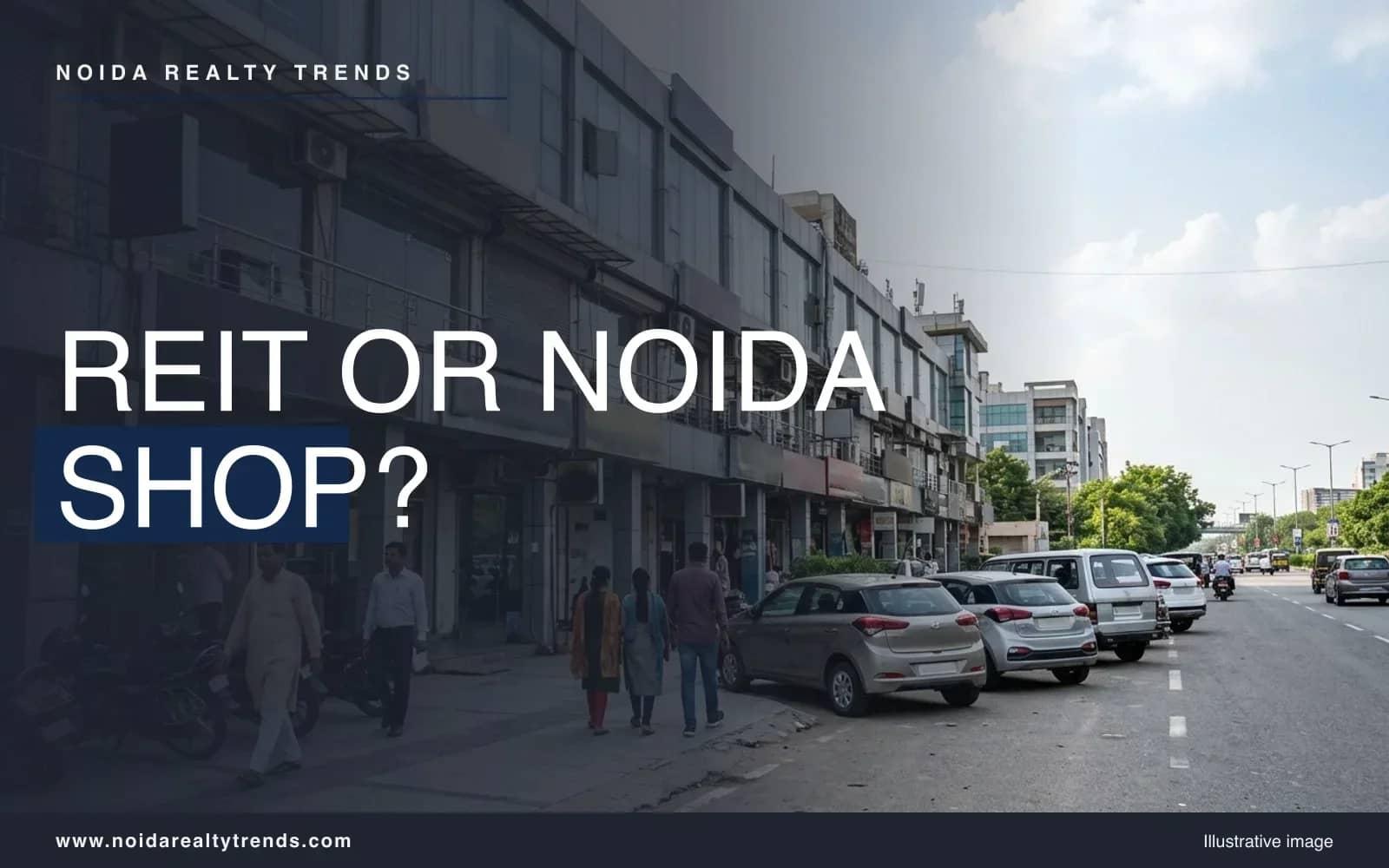
Answer: The right choice depends on capital, liquidity, involvement and risk tolerance, not on one option being universally better. A listed REIT suits investors who want a modest entry amount, daily liquidity and diversified exposure with low effort. A Noida shop in sectors like 72, 94, 97 or 98 can offer more control and upside but demands larger capital, tenant management, and tolerance for a long, uncertain exit. Verify every figure before deciding.
Evidence-led guide: we do not quote live prices, approvals or returns as our own claims. Verify project-specific facts on the official sources linked below before acting.
Should I invest in Noida commercial property or buy REIT shares?
Neither option is automatically superior. A REIT gives you fractional, liquid exposure to a diversified portfolio of commercial assets managed by a professional trust, with returns driven by rental distributions and unit price movement. Buying a shop or retail unit in Noida gives you direct ownership of one physical asset, with returns driven by rent, resale value and your own management decisions.
The practical difference is concentration and effort. A REIT spreads your money across multiple buildings, tenants and cities, so the failure or vacancy of one property has limited impact on your return. A single Noida shop puts most of that investment's risk in one project, one micro-market and often one or two tenants. That is not a flaw, it is simply a different risk profile that suits a different kind of investor.
How do REIT returns compare with direct commercial property returns in Noida?
A fair comparison has to use total return, meaning cash distributions or rent plus change in asset value, minus taxes, costs, vacancy, financing and maintenance. Looking at rent alone, or at unit price alone, gives an incomplete and often misleading picture.
REIT performance is relatively transparent: distributions, occupancy, debt levels and unit prices are publicly disclosed and can be checked through exchange data and annual reports. Direct Noida commercial property is harder to verify in the same way, because advertised asking prices are not necessarily transaction prices, and quoted rental yields often exclude vacancy periods, common-area maintenance charges, property tax, fit-out costs and brokerage.
There is no reliable basis to claim that Noida shops or REITs currently deliver a higher return as a general rule. A well-located, well-leased shop bought at a sensible price can outperform a REIT over several years. A shop that suffers from delayed possession, weak footfall, restricted usage permissions or a difficult exit can underperform significantly. The outcome depends on execution, not on the asset class alone.
Is it better to buy a shop in Noida or invest in a REIT?
It is better to buy a REIT if you want to start small, need liquidity, prefer diversification, and do not want the work of finding and managing tenants. It is better to buy a Noida shop if you have sufficient capital without over-concentrating your net worth, and you are prepared to verify the project thoroughly and tolerate a long holding and exit period.
A REIT suits investors who want exposure to commercial real estate as part of a broader portfolio without becoming a landlord. A Noida shop suits investors who want direct control over a specific asset, are comfortable with illiquidity, and have the time or resources to manage leasing, maintenance and compliance themselves.
- REIT fits you if: modest starting capital, need for liquidity, preference for diversified exposure, low appetite for hands-on management, tolerance for daily price fluctuation
- Noida shop fits you if: capital beyond what a REIT allocation would need, verified approvals and genuine commercial use on the unit, independently checked achievable rent rather than developer projections, patience for vacancy and a long exit timeline
How much money do I need to start: REIT or commercial space in Noida?
A REIT typically requires only the price of the units you choose to buy through a demat account, which depends on the specific REIT's current exchange price, trading lot and applicable brokerage, exchange charges and GST. This entry amount can be a fraction of what a physical shop would cost, but it varies by issue and by market price on the day, so the current figure should be checked against SEBI, NSE or BSE data rather than any historical number.
A Noida commercial unit requires far more than the quoted unit price. Budget for the agreement value, stamp duty and registration under Uttar Pradesh rules (verify current rates on IGRSUP), GST where applicable, brokerage, legal due diligence, interior fit-out, signage, ongoing maintenance and common-area charges, utility deposits, property tax, loan processing and interest if financed, and a vacancy reserve covering several months of expenses in case the unit stays unlet.
Marketing material for commercial projects in Sectors 72, 94, 97 and 98 sometimes shows different starting prices for similar-sounding configurations. This is exactly why the final cost must come from the project's official page and the signed agreement, not from an advertisement.
What should I check before choosing either option?
For a REIT, check the trust's latest annual report, occupancy levels across its portfolio, debt-to-asset ratio, and the consistency of past distributions, all of which are disclosed under SEBI's REIT regulations. For a Noida shop, the checks are different but equally non-negotiable.
Confirm the project's RERA registration and current construction status directly on UP RERA (up-rera.in) before paying anything. Most commercial units in Sectors 72, 94, 97 and 98 are sold on a leasehold basis under a 99-year lease from the Noida Authority, so confirm the lease terms and understand that a Transfer Memorandum charge applies when a leasehold unit changes hands, payable to the Authority. Check the sanctioned land use and building plan to ensure the specific unit is approved for the commercial activity you intend, and verify any rent or lease claim independently rather than relying on a developer's projected figure.
- REIT due diligence: SEBI-mandated annual report, occupancy and debt disclosures, distribution history, current unit price on NSE/BSE
- Noida shop due diligence: RERA registration status on up-rera.in, leasehold terms and Transfer Memorandum charges, sanctioned commercial land use, independently verified rent, maintenance and escalation clauses in the lease
What about Sector 72 retail oversupply concerns and similar objections?
Some buyers raise concerns about retail supply concentration in Sector 72, pointing to established centres like Spectrum Metro and Dasnac Arc alongside newer projects such as Central 50. This is a legitimate question to ask of any high-street or mall-format investment, whether in Sector 72 or elsewhere on the Noida Expressway belt covering Sectors 94 to 98.
The relevant rebuttal is catchment and footfall, not denial of supply. A sector with multiple retail destinations can sustain more than one successful project if the combined residential and working population in the catchment is large enough, and if each project differentiates on format, brand mix and access. Before buying into any one project, ask for the developer's own footfall and catchment population data, cross-check it against visible construction progress of nearby residential towers that will supply tenants and customers, and treat any single project's marketing claims as a starting point for verification, not a conclusion.
Is a Noida commercial shop a loss or a profit compared to a REIT, realistically?
Neither is guaranteed to be a profit, and treating either as risk-free is the biggest mistake buyers make. A Noida shop can be a profitable long-term holding if it is bought in a genuinely high-footfall location, leased to a stable tenant at a verified rent, and held through a market cycle, but it can also be a loss if the project faces delayed possession, weak occupancy, or if you are forced to sell quickly in an illiquid market.
A REIT removes single-asset concentration risk and gives you daily liquidity, but its unit price can fall with rising interest rates, portfolio vacancy or a decline in the broader commercial real estate sector, and distributions are never guaranteed. The honest verdict is conditional: a REIT is generally the lower-effort, lower-concentration choice suited to most first-time commercial investors, while a Noida shop can match or exceed that return only if you have the capital to avoid over-concentration, the patience for illiquidity, and the discipline to verify every claim before signing, rather than relying on projected rent or an assured-return pitch, which should always be treated as a red flag requiring independent legal and regulatory verification, not as a benefit.
Which Noida sectors are relevant if I do choose direct commercial property?
If you decide direct ownership suits your capital and risk appetite, the Noida Expressway belt covering Sectors 72, 94, 97 and 98 has an active mix of registered commercial projects from multiple developers, which is useful because it lets you compare options on the same verifiable criteria rather than relying on a single project's marketing.
Developers with retail or commercial-format projects in and around this corridor include Bhutani Group, Gaurs Group, ATS Greens and M3M, among others active in Noida more broadly. For example, M3M The Line in Sector 72 is described on M3M India Noida's official project page as offering retail, food court, dining and studio space, with catchment and area figures attributed to the company's own project material; buyers evaluating it alongside comparable high-street or mixed-use retail projects from other developers in the same belt should independently verify RERA registration, land use approval and achievable rent for each before comparing them on cost or expected return.
- Always compare at least two projects from different developers on the same checkable criteria: RERA status, sanctioned land use, lease terms and verified rent, never on marketing projections alone
How to verify this yourself
- Confirm any Noida commercial project's RERA registration and construction status directly on up-rera.in before paying any amount
- Check current circle rates and stamp duty applicable to commercial units in Sectors 72, 94, 97 and 98 on IGRSUP (igrsup.gov.in)
- Verify REIT unit prices, trading lots, occupancy and distribution history through SEBI, NSE or BSE disclosures rather than historical figures
- Independently verify any quoted rental yield or rent figure for a shop; do not rely on a developer's projected rent
- Confirm leasehold terms and current Transfer Memorandum charges with the Noida Authority before buying or reselling a commercial unit
- Treat any assured-return or guaranteed-rent offer as a due-diligence red flag requiring regulatory and legal verification, not as a selling point
Sources and where to verify
- UP RERA official portal
- IGRSUP, stamp duty and circle rates, Uttar Pradesh
- Noida Realty Trends: Is M3M a trusted Noida developer, how to verify before buying
- Noida Realty Trends: New residential projects on Noida Expressway, which to buy
- Noida Realty Trends: M3M's latest projects in Noida, current status and details
Frequently Asked Questions
Should I invest in Noida commercial property or buy REIT shares?+
It depends on your capital and involvement preference: REITs suit investors wanting liquidity, diversification and low effort with a modest starting amount, while a Noida shop suits those with larger capital who want direct control and can tolerate illiquidity and hands-on management, verified through RERA and independent rent checks.
How do REIT returns compare with direct commercial real estate investment in Noida?+
There is no reliable basis to say one consistently outperforms the other; the fair comparison uses total return, meaning rent or distributions plus value change minus taxes, vacancy, maintenance and financing costs, and outcomes depend heavily on execution and verified figures rather than the asset class itself.
Is it better to buy a shop in Noida or invest in a real estate REIT?+
A REIT is generally easier to start with and more liquid, while a Noida shop can offer greater control and upside if the project's RERA status, land use and achievable rent are independently verified; neither is automatically the better choice for every investor.
How much money do I need to start with a REIT versus a Noida shop?+
A REIT typically needs only the current unit price through a demat account, which should be checked on NSE or BSE, while a Noida shop needs a much larger budget covering the unit price, stamp duty, registration, GST, fit-out, maintenance and a vacancy reserve.
Is commercial property in Noida a loss or a profit compared to a REIT?+
Conditionally, a Noida shop can profit if bought at a verified fair price in a high-footfall project with confirmed approvals and leased at an independently checked rent, but it can underperform a REIT if vacancy, delayed possession or illiquidity occur, so the outcome depends on due diligence, not the asset type alone.
What is a Transfer Memorandum charge and why does it matter for Noida commercial units?+
A Transfer Memorandum charge is a fee payable to the Noida Authority when a leasehold commercial or residential unit changes ownership, since most such units sit on a 99-year lease rather than freehold title, and buyers should confirm the current charge and process before completing any resale transaction.
Tags