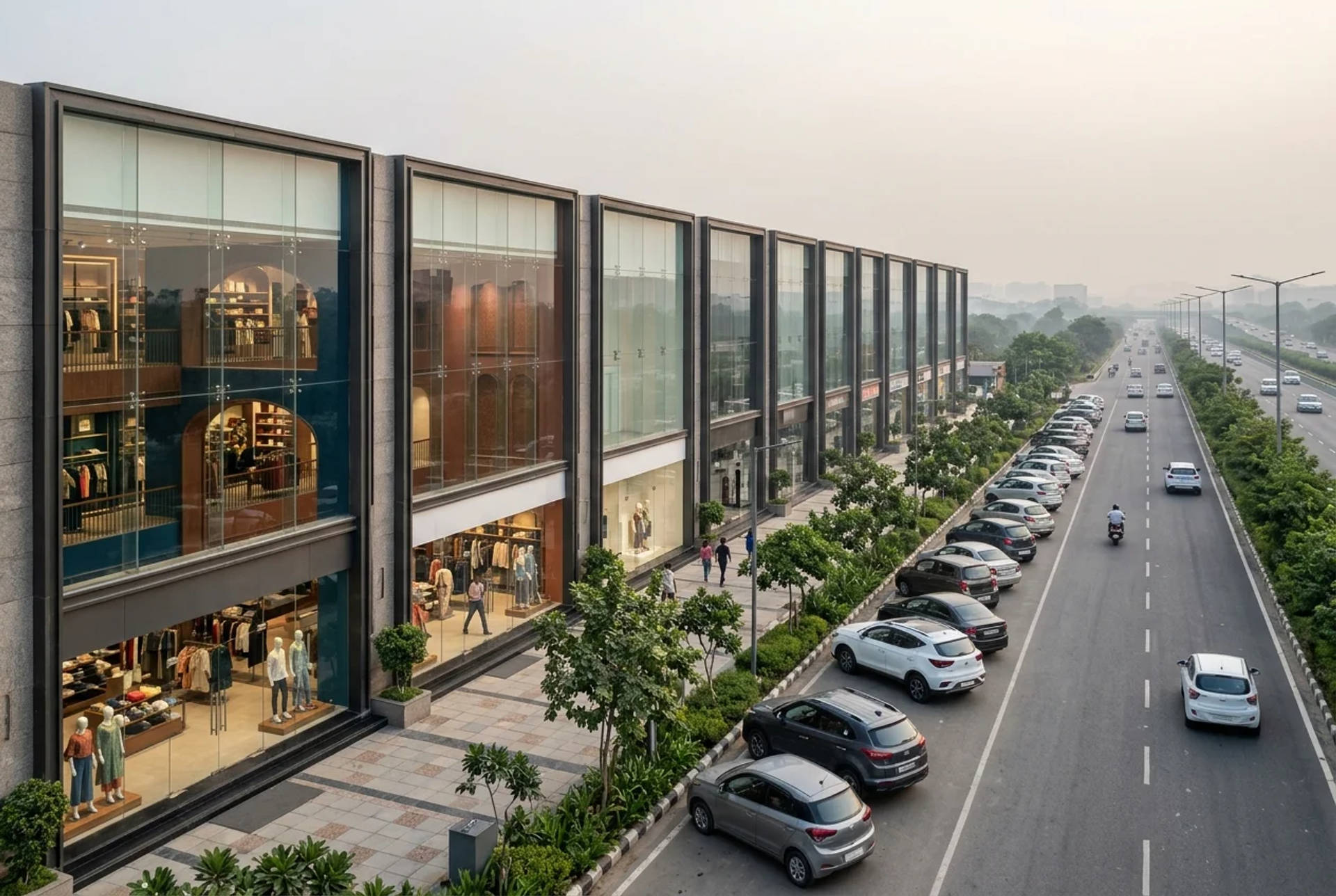
What rental yield do retail shops give in Noida right now?
Noida retail shop yields vary widely by location and cost. Here's how to calculate your own, sector by sector, with sources to verify every number.
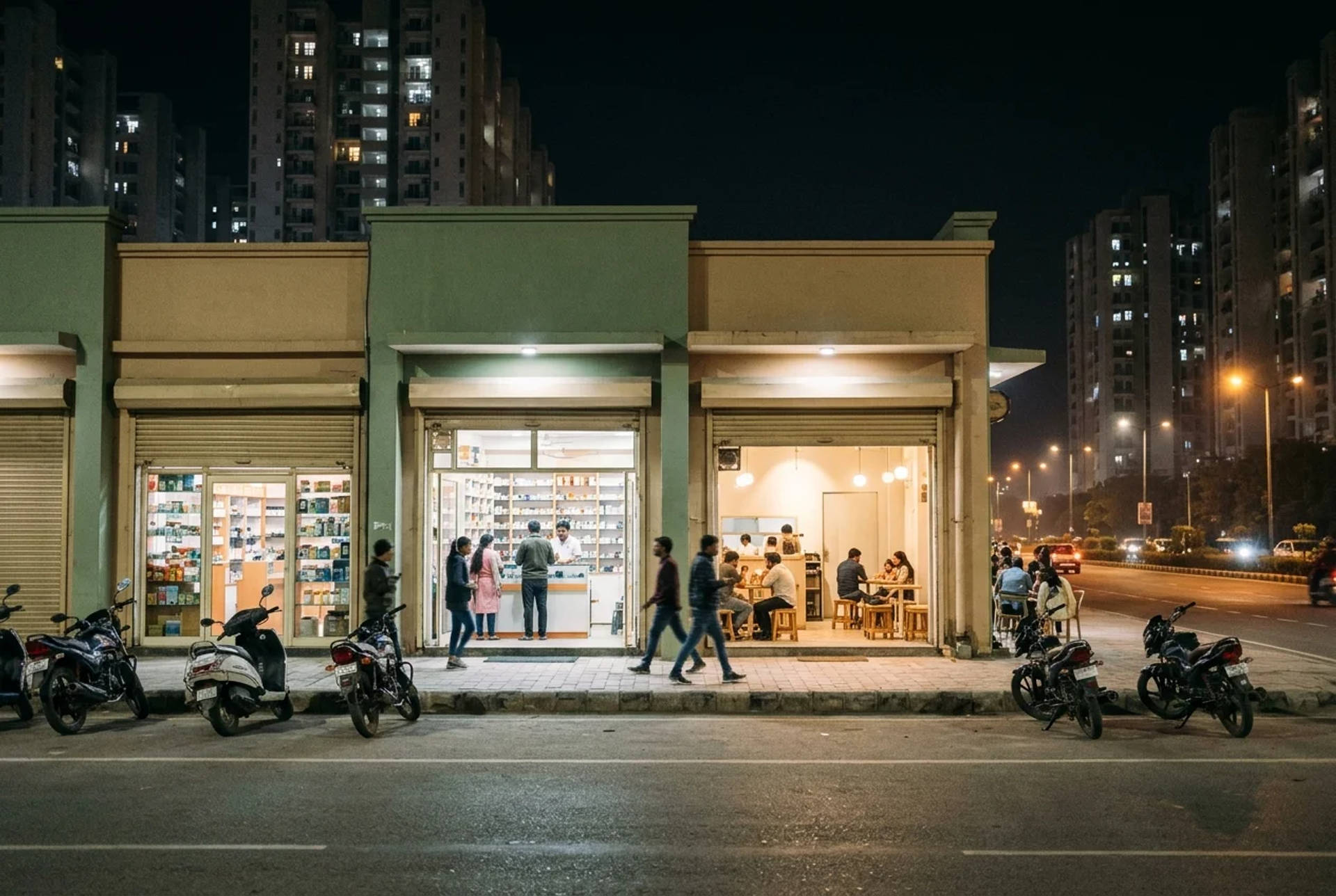
Answer: There is no single rental yield figure for Noida retail shops. Realistic underwriting ranges roughly 3 to 7 percent gross annually, but the actual number depends entirely on your purchase cost, floor, frontage, tenant quality and whether area is quoted as carpet or super area. Online listings show asking rents, not executed leases, so always calculate your own yield using actual purchase cost from IGRSUP and a signed or comparable lease, never a marketing projection.
Evidence-led guide: we do not quote live prices, approvals or returns as our own claims. Verify project-specific facts on the official sources linked below before acting.
What rental yield can a Noida retail shop realistically give?
A commonly cited underwriting range for Noida retail shops is roughly 3 to 7 percent gross annually, though this is not a guarantee and varies shop by shop. The gap between the low and high end is driven by purchase price, floor level, frontage visibility, parking, occupancy status and tenant quality, not by the city average.
Online listings for Sector 18 and Noida Expressway show asking rents from around ₹12,000 a month on the low end to ₹1 to 3 lakh a month or more for premium ground-floor units, but these are advertised asking rents, not confirmed achieved rents. A shop that sits vacant for four months in its first year, or rents below asking price, will show a materially lower real yield than the headline number suggests.
- Gross yield = annual rent divided by all-in purchase cost, multiplied by 100
- Net yield subtracts vacancy, maintenance, taxes and brokerage from annual rent before the same calculation
- Purchase cost must be verified against the registered sale deed and circle rate on IGRSUP (igrsup.gov.in), not the builder's quoted price
- Rent assumptions should be backed by a signed lease or genuinely comparable executed deals, not asking-rent listings alone
How do you calculate your own expected rental income?
Use the formula: Gross rental yield equals annual rent divided by all-in purchase cost, multiplied by 100. All-in cost means the base price plus stamp duty, registration, GST where applicable, and any Transfer Memorandum or maintenance deposit charges on a leasehold plot, not just the headline sale price quoted by a broker.
For example, a shop renting at ₹1,00,000 a month generates ₹12,00,000 in annual rent. Against an all-in cost of ₹2 crore that is a 6 percent gross yield. Against ₹3 crore it falls to 4 percent, and against ₹4 crore it drops to 3 percent. The rent figure does not change, but the yield changes sharply with purchase cost, which is why two buyers in the same building can report very different returns.
Net yield goes further: subtract vacancy periods, maintenance charges, property tax, brokerage and repair costs from the annual rent before dividing by purchase cost. A shop advertised at a high gross yield can still underperform once these deductions are applied honestly.
What do current Noida listings actually show?
Listings aggregated from property portals show a wide spread rather than one market number. In Sector 18, reported asking rents include figures such as roughly ₹80,000 a month and ₹2 to 3 lakh a month for different shop sizes, with another listing showing about ₹1.1 lakh a month for a 1,164 sq ft unit. Separate Sector 18 listings show figures from roughly ₹1.1 lakh for 560 sq ft to ₹1.72 lakh for 688 sq ft.
On the Noida Expressway, one aggregator reports asking rents ranging from about ₹12,000 to ₹1.31 lakh a month across units sized 157 to 1,171 sq ft. This wide range exists because Noida Expressway spans multiple sectors, projects, floors and stages of commercial maturity, so quoting a single average would be misleading.
These figures should never be averaged together to produce a city yield. A ground-floor corner shop with existing footfall is not comparable to a first-floor unit in a newly handed-over project, and a shop measured on carpet area is not comparable to one measured on super area without adjustment.
| Location | Reported asking rent range | What this means for yield |
|---|---|---|
| Sector 18 | Approx ₹80,000 to ₹3 lakh/month depending on unit size and floor | Stronger established demand but usually higher acquisition cost, so yield is not automatically higher |
| Noida Expressway | Approx ₹12,000 to ₹1.31 lakh/month across 157 to 1,171 sq ft listings | Wide spread reflects project and sector variation, not a single Expressway rate |
| Both locations | Figures are asking rents from listings, not executed leases | Always confirm with a signed lease or comparable registered deal before underwriting |
Sector 18 or Noida Expressway, which gives a better yield?
Sector 18 generally has the stronger current rental-demand case because it is an established retail destination with existing footfall, metro connectivity and a mature tenant mix. Its drawback is that purchase price is often correspondingly high, so a higher achieved rent does not automatically translate into a higher yield once the acquisition cost is factored in.
The Noida Expressway corridor, including the stretch through Sectors 72 to 98 often called the Billionaires Corridor for its luxury residential density, shows more variation. Where a project already has a completed residential catchment, visible road frontage and dedicated parking, a lower entry price can produce a better yield than an equivalent Sector 18 unit. But some Expressway projects face slower footfall build-up or delayed commercial activation, which raises vacancy risk in the early years.
The honest comparison is not which location is better, but which specific shop, in which specific building, with what specific tenant demand, gives the better net return after real vacancy and cost assumptions.
| Measure | Sector 18 | Noida Expressway (Sectors 72-98) |
|---|---|---|
| Demand maturity | Established, existing footfall | Project and sector dependent |
| Rent visibility | More comparable listings available | Broad range, weaker comparability across projects |
| Vacancy risk | Generally lower for good ground-floor units | Can be materially higher in newer or under-occupied projects |
| Capital cost | Often at a premium | Wider range depending on project stage |
| Yield takeaway | Rent may be higher, yield is not guaranteed to be higher | Potentially better yield in select projects, with higher execution risk |
Which retail shops are better positioned for rental income?
The shops most likely to sustain tenancy and rental growth share a specific set of features rather than a specific address. Ground-floor units with direct road visibility, located next to daily-needs anchors such as pharmacies, salons, food outlets or supermarkets, tend to lease faster and hold tenants longer than upper-floor or internal units.
A completed residential catchment matters more than a promised future population. A shop fronting thousands of already-occupied apartments has a different, more verifiable demand base than one in a project still filling up. Dedicated parking, clear signage rights and a sanctioned commercial plan with no restriction on the intended trade are also practical filters worth checking before purchase, not after.
- Ground-floor shops with direct road visibility and walk-in access
- Units adjacent to pharmacies, food outlets, salons or daily-needs retail
- Projects where the residential catchment is already completed and occupied, not projected
- Shops with dedicated parking and unobstructed signage rights
- Corner or near-entrance units with workable loading access
- A legally usable commercial title and sanctioned plan with no trade restriction
Should you trust an assured-return offer on a Noida shop?
No, not without independent verification, and assured or guaranteed return marketing should be treated as a due-diligence flag rather than a benefit. Any claim of a fixed assured return should be checked against a legally enforceable lease, an identifiable lessee, a documented payment history and verified UP RERA project approvals before any money changes hands.
Buyers should also confirm whether a quoted rent figure includes maintenance, GST, electricity, CAM charges, property tax or marketing costs, since these deductions materially change the real income a shop owner receives. A rent figure that looks attractive on a brochure can shrink substantially once these costs are separated out.
- Verify UP RERA registration, promoter details, approvals and any filed complaints for the specific project before signing
- Confirm whether quoted area is carpet or super area, since the difference directly affects true yield
- Ask for a signed lease or documented comparable rent, not just an asking-price listing
- Clarify what the quoted rent includes: maintenance, GST, CAM, electricity and property tax are often separate
- On leasehold plots, confirm Transfer Memorandum charges and the remaining tenure of the 99-year lease before purchase
How does this play out for Billionaires Corridor projects like M3M Jacob & Co?
Among retail-linked developments in the Sector 94 to 98 corridor, M3M Jacob & Co in Sector 97 is one identifiable project, alongside comparable commercial and mixed-use developments from other Noida Expressway developers such as Bhutani Group and Gaurs Group in nearby sectors. None of these projects currently have public, verifiable achieved-rent or occupancy data that would support a specific yield claim.
Before considering a retail unit in any Sector 72-98 project, including through the M3M India Noida official website, buyers should independently verify the exact legal project name and phase, UP RERA registration and promoter disclosures, completion and possession status, whether the unit is classified as retail, and whether pricing is quoted on carpet or super area. A sector's positioning on the Billionaires Corridor is a location fact worth noting, but it is not itself evidence of a specific rental yield.
What should a buyer check before signing anything?
Before signing a sale agreement or lease, a buyer should independently confirm the project's UP RERA registration number on up-rera.in, cross-check the quoted purchase price against the current circle rate on IGRSUP, and obtain either a signed lease or genuinely comparable executed rent data rather than relying on listing-site asking prices.
It is also worth separately confirming carpet versus super area, since yield calculations based on the wrong area figure can overstate returns by a significant margin. For leasehold sectors, check the remaining tenure of the 99-year lease and the applicable Transfer Memorandum charges, since these affect both resale value and total cost of ownership.
How to verify this yourself
- Confirm the project's UP RERA registration, promoter details and any filed complaints on up-rera.in before purchase
- Cross-check the quoted purchase price against the current circle rate for the specific sector on IGRSUP (igrsup.gov.in)
- Treat all online rent listings as asking rents; request a signed lease or genuinely comparable executed rent before calculating yield
- Confirm whether pricing and rent figures are based on carpet area or super area
- For leasehold plots, verify remaining lease tenure and applicable Transfer Memorandum charges
- Independently verify any assured-return claim against a registered lease, identifiable lessee and documented payment history
Sources and where to verify
- UP RERA official portal
- IGRSUP, Uttar Pradesh stamps and registration
- Housing.com, commercial shops for rent in Sector 18 Noida
- Square Yards, commercial properties for rent in Sector 18 Noida
- Rentalspaces, commercial shops for rent on Noida Expressway
Continue your Noida research
Frequently Asked Questions
What rental yield do retail shops in Noida actually give?+
There is no single fixed number; realistic underwriting typically falls in a 3 to 7 percent gross annual range, but the actual figure for any shop depends on its purchase cost, floor, frontage and tenant quality, so each shop must be calculated individually rather than assumed from a city average.
How much can I earn from renting out a retail shop in Noida?+
Your income equals the actual rent you can achieve, not the asking rent listed online; reported listings range from roughly ₹12,000 a month on lower-tier Expressway units to ₹1 to 3 lakh a month or more for premium Sector 18 units, but you should underwrite using a signed lease or comparable executed deal, not a portal listing.
Is buying a retail shop in Noida for rental income worth it?+
It can be worth it only if the net yield, after vacancy, maintenance, taxes and brokerage, clears your cost of capital and the unit has verifiable UP RERA approval, a completed catchment and a sanctioned commercial title; buying on asking-rent assumptions alone, or on assured-return promises, is where buyers most often see a loss rather than a profit.
Which gives a better rental yield, Sector 18 or Noida Expressway shops?+
Sector 18 generally has stronger established demand and footfall, but often at a higher acquisition cost, so its yield is not automatically higher; the Noida Expressway corridor through Sectors 72-98 shows more variation and can offer better yield in select, well-occupied projects, but carries higher vacancy risk in newer developments.
Should I trust a developer's assured-return offer on a Noida shop?+
No, treat any assured or guaranteed return claim as something to independently verify rather than a selling point; check it against a legally enforceable registered lease, an identifiable tenant and verified UP RERA disclosures before relying on it.
Does carpet area versus super area change my rental yield calculation?+
Yes, significantly; a yield calculated on super area will overstate the return per usable square foot compared to one calculated on carpet area, so always confirm which measurement a listing or sale agreement is using before comparing shops.
Tags