Why do flat prices vary so much across Noida sectors?
Noida flat prices swing sector to sector due to connectivity, land scarcity and project stage, not a single cheap or costly label.

Answer: Flat prices differ across Noida sectors because buyers are really paying for different combinations of connectivity, land scarcity, infrastructure maturity, developer track record, apartment size and construction stage, not one simple location label. A 90 sq m resale flat in an older, developed sector and a similar-sized unit in a newer expressway-facing sector can carry very different price tags because the underlying products, risks and amenities are not the same. There is no single cheapest sector without fixing property type, age, tenure and whether the figure quoted is an asking price or a registered transaction.
Evidence-led guide: we do not quote live prices, approvals or returns as our own claims. Verify project-specific facts on the official sources linked below before acting.
Why are flat prices different in different Noida sectors?
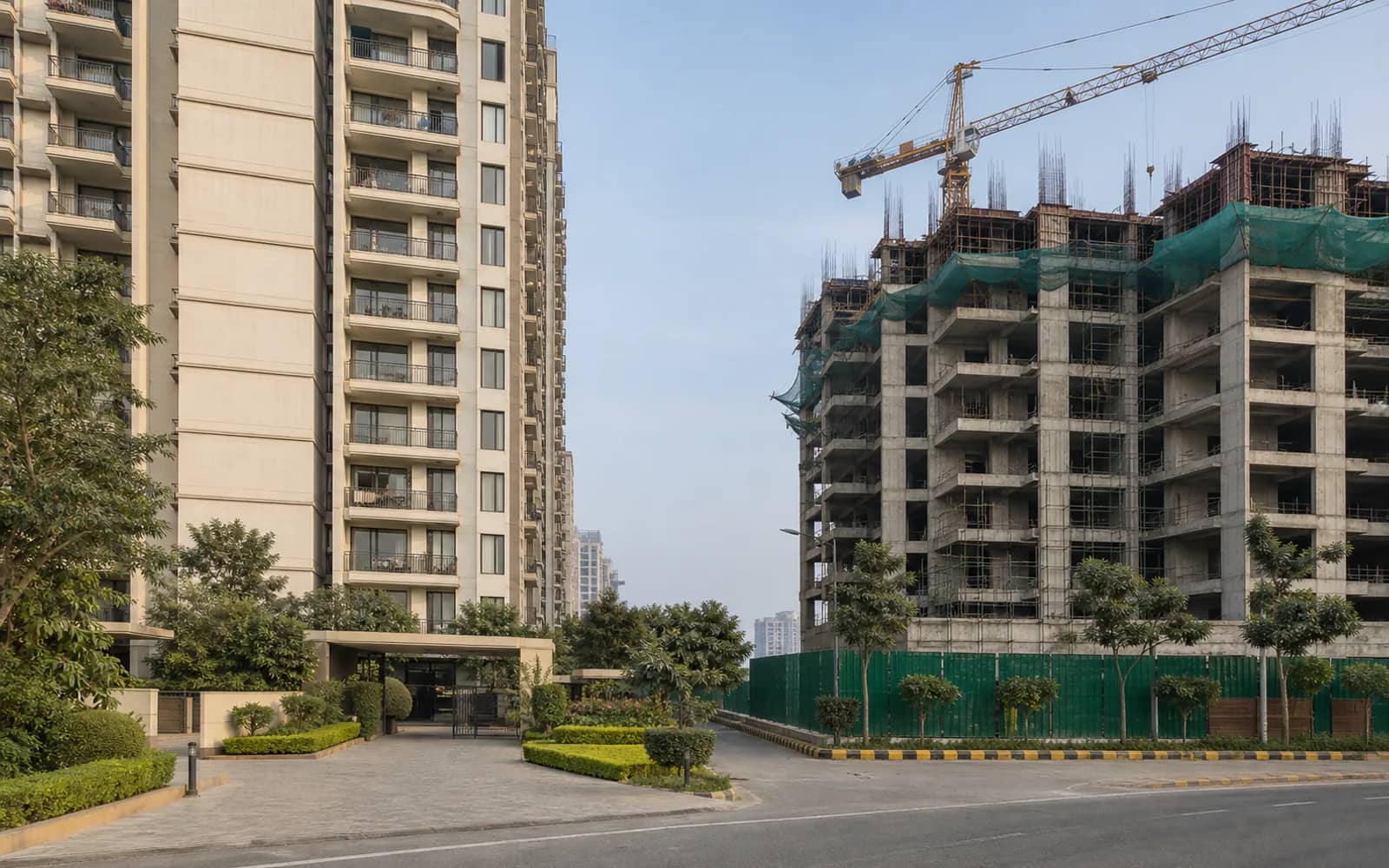
Prices vary because each sector is really selling a different bundle of location access, civic infrastructure, land availability and project quality, not just a number of square feet. Two flats of the same carpet area in two different sectors can be functionally different products once you account for commute time, road and drainage maturity, school and hospital access, and how established the resale market is.
Connectivity is usually the single biggest driver. Sectors near the Noida-Greater Noida Expressway, close to Delhi, near an operational metro station, or along major arterial roads tend to command a premium because residents save time and money on daily travel. Sectors farther from these links, or still waiting on promised road and transit upgrades, typically price lower, partly to compensate for that uncertainty.
Land scarcity compounds this. Older, more central sectors generally have little undeveloped land left, so new supply is limited and existing stock holds or gains value. Newer or peripheral sectors often have more under-construction inventory competing for the same buyer pool, which can keep entry prices lower until the area matures.
Which Noida sector has the cheapest flats?
There is no single verifiable answer to this without fixing the property type, age, size, tenure and whether the number is an asking price or a registered sale price, because these vary widely and are not standardised across listings. In practice, lower advertised prices are more commonly associated with older resale apartments, peripheral sectors, or newer sectors still building out infrastructure, but the cheapest advertised price is not automatically the cheapest safe purchase once maintenance, commuting cost and resale liquidity are factored in.
Before treating any sector as affordable, check the registered circle rate for that sector on IGRSUP (igrsup.gov.in) rather than relying on a broker's asking price, since circle rates and market prices can diverge significantly. Also confirm the project's registration status and sanctioned plan on UP RERA (up-rera.in), since an unregistered or stalled project can turn an apparently cheap flat into an expensive legal problem.
What makes some Noida sectors more expensive than others?
The largest price premiums generally trace back to connectivity, land scarcity, and the maturity of civic and commercial infrastructure around a sector, verifiable through authority records rather than a developer's brochure claims. A sector that already has functioning metro access, established markets, schools and hospitals, and limited new land supply will usually price higher than a sector still waiting for those same elements to be built out.
Developer reputation and resale liquidity also matter. A sector with a strong track record of on-time deliveries and an active resale market gives buyers more confidence, and that confidence shows up in price. Future infrastructure, such as a proposed metro extension or road widening, can lift sentiment and asking prices well before the project is actually operational, so buyers should distinguish between infrastructure that is announced, approved, under construction, or delivered.
- Established connectivity and shorter commute times to Delhi or key employment nodes
- Scarcity of remaining residential land in the sector
- Proximity to operating commercial, retail and institutional zones
- Quality and maintenance of roads, drainage, parks and utilities
- Developer track record and strength of the resale market
- Premium positioning: larger plots, gated layouts, newer amenities
- Expected future infrastructure, which should be verified rather than assumed
Is the Billionaires' Corridor (Sectors 94-98) priced differently, and why?
Sectors 94 to 98, often referred to as the Billionaires' Corridor or the Sector 94-98 luxury belt, sit directly along the Noida Expressway and have attracted a concentration of large-format luxury and branded residential launches, which generally positions pricing at the upper end compared with older, smaller-format sectors. This premium reflects expressway frontage, larger plot sizes, and a cluster of high-end developers choosing these sectors, rather than any single factor.
That said, a Sector 94-98 address does not automatically mean a verified bargain or a guaranteed premium. Buyers should still confirm each specific project's UP RERA registration, sanctioned configuration, and current construction stage before comparing it against another sector, because within the same corridor, an under-construction launch and a nearly-complete project are not priced on the same basis.
For comparison, Sector 72 nearby has a different profile: it combines retail-led developments such as Spectrum Metro, Dasnac Arc and Central 50 with residential stock, giving it a more mixed commercial-residential character than the predominantly luxury-residential framing of Sectors 94-98.
What is the best affordable Noida sector for a middle-class budget?
There is no universally best sector for a middle-class budget without knowing the buyer's specific budget, family size and commute needs, but a defensible approach is to prioritise ready-to-move or established resale flats over premium under-construction launches when monthly affordability and possession certainty matter most. Within that framework, older, developed sectors with functioning schools, markets, roads and transport links tend to offer more predictable total cost of ownership even if the flat itself is smaller.
Newer or peripheral sectors should only be shortlisted after verifying actual road access, water supply, drainage, electricity and current occupancy levels on the ground, not just a sales brochure's promised timeline. A sector that looks affordable on paper can become expensive in practice if commuting costs, construction delays or incomplete infrastructure eat into the savings.
Crucially, compare total monthly cost rather than just the quoted flat price: EMI, maintenance charges, parking fees, registration and stamp duty, likely repair costs, and any rent paid during a construction delay all belong in the comparison. A flat with a lower sticker price but higher monthly carrying cost is not actually the cheaper option.
How should a buyer compare prices across sectors fairly?
A fair comparison fixes every variable except price, which means checking sector, project, carpet area, floor, age, parking allocation, possession status, maintenance dues, lease tenure and the final all-in cost including GST, registration, brokerage, parking and club charges. Comparing a ready-to-move resale flat in one sector against an under-construction launch in another, without adjusting for these differences, will produce a misleading conclusion about which sector is actually cheaper.
Leasehold tenure is a particular point to verify carefully, since most Noida Authority allotments run on a 99-year lease rather than freehold ownership. Buyers should confirm the remaining lease term, understand Transfer Memorandum charges payable on resale, and check for any pending dues on the original lease before finalising a purchase, because these costs are not always reflected in an advertised asking price.
Treat UP RERA, IGRSUP and Noida Authority records as the primary sources for any price or status claim, rather than a broker's verbal assurance. Cross-check the project's sanctioned plan, declared completion date, and any recorded complaints before comparing its price against another sector's listings.
Does M3M's Sector 72 and Sector 94-98 positioning fit a middle-class budget?
M3M's Noida projects, spread across Sector 72 and the Sector 94-98 Billionaires' Corridor, are generally positioned toward retail-format, studio and branded luxury residential buyers rather than middle-class flat buyers, so they are not a natural fit for an affordability-first search. For context, comparable large-format projects from other developers in the same broad expressway belt include Gaurs Group and ATS Greens developments, which also sit toward the higher end of the market rather than the entry-level segment.
Any buyer evaluating an M3M project, or a comparable project from Gaurs, ATS, Mahagun or another developer, should independently verify the UP RERA registration number, sanctioned unit mix and declared completion date on up-rera.in rather than relying on secondary price reports, since advertised figures and final registered transaction prices can differ. Details on M3M's current Noida project lineup are available on the M3M India Noida official website, but RERA verification should always be done directly on the regulator's portal.
How to verify this yourself
- Confirm the project's UP RERA registration number, sanctioned unit mix and declared completion date on up-rera.in before comparing price across sectors
- Check the current circle rate for the specific sector on IGRSUP (igrsup.gov.in) rather than relying on a broker's asking price
- Verify lease tenure, remaining lease years and any pending dues with the Noida Authority before buying a leasehold flat
- Confirm Transfer Memorandum charges applicable on resale before finalising a purchase in any sector
- Cross-check claimed or proposed metro, road or infrastructure upgrades against NMRC and Noida Authority status rather than treating them as completed
- Compare total monthly cost, including EMI, maintenance, parking and registration, not just the quoted flat price
Sources and where to verify
- UP RERA official portal
- IGRSUP, Uttar Pradesh stamp and registration department
- M3M Noida 2026: what projects, where, and what do they cost
- Is M3M a trusted builder in Noida: check RERA status
Continue your Noida research
Frequently Asked Questions
Why are flat prices different in different Noida sectors?+
Because each sector offers a different combination of connectivity, land scarcity, infrastructure maturity and project quality, so a lower or higher price reflects real differences in the product, not an arbitrary label. Comparing prices only makes sense once property type, size, age and tenure are matched.
Which Noida sector has the cheapest flats?+
There is no single verified cheapest sector without fixing property type, age, size and tenure, since asking prices and registered transaction prices can differ widely. Lower prices are more commonly found in older resale stock or peripheral sectors, but each listing should be checked against IGRSUP circle rates and UP RERA registration before assuming it is a genuine bargain.
What makes some Noida sectors more expensive than others?+
Established connectivity, scarce remaining land, mature civic infrastructure and strong developer track records are the main drivers of higher prices, each verifiable through authority records. Future infrastructure promises should be treated cautiously until confirmed as operational rather than merely announced.
What is the best affordable Noida sector for a middle-class budget?+
There is no universal answer without knowing the buyer's specific budget and needs, but prioritising ready-to-move or established resale flats in developed sectors with functioning schools, markets and transport generally gives more predictable total costs than chasing the lowest advertised price in a newer sector.
Is buying a cheaper flat in a less developed Noida sector a loss or a profit in the long run?+
It depends on whether the sector's infrastructure actually develops as promised and whether the project is RERA-registered with a credible delivery timeline; a cheaper flat in a sector with verified ongoing infrastructure work can appreciate well, but a cheap flat bought purely on a broker's promise of future connectivity, with no registered project status, carries real risk of stagnant or falling resale value.
Should I worry about Sector 72's retail-heavy development affecting residential prices there?+
Sector 72 does combine significant retail development, including Spectrum Metro, Dasnac Arc and Central 50, with residential stock, which gives it a more mixed character than purely residential sectors, but this does not automatically depress residential prices; it mainly means buyers should evaluate the specific residential project's footfall, access and RERA status rather than assuming oversupply applies uniformly across the sector.
Tags