Mega Townships Are Reshaping Noida in 2026: Should Buyers Bet on Scale?
Why developers are building mega townships in Noida in 2026, how they differ from regular societies, and what first-time and middle-income buyers should verify first.
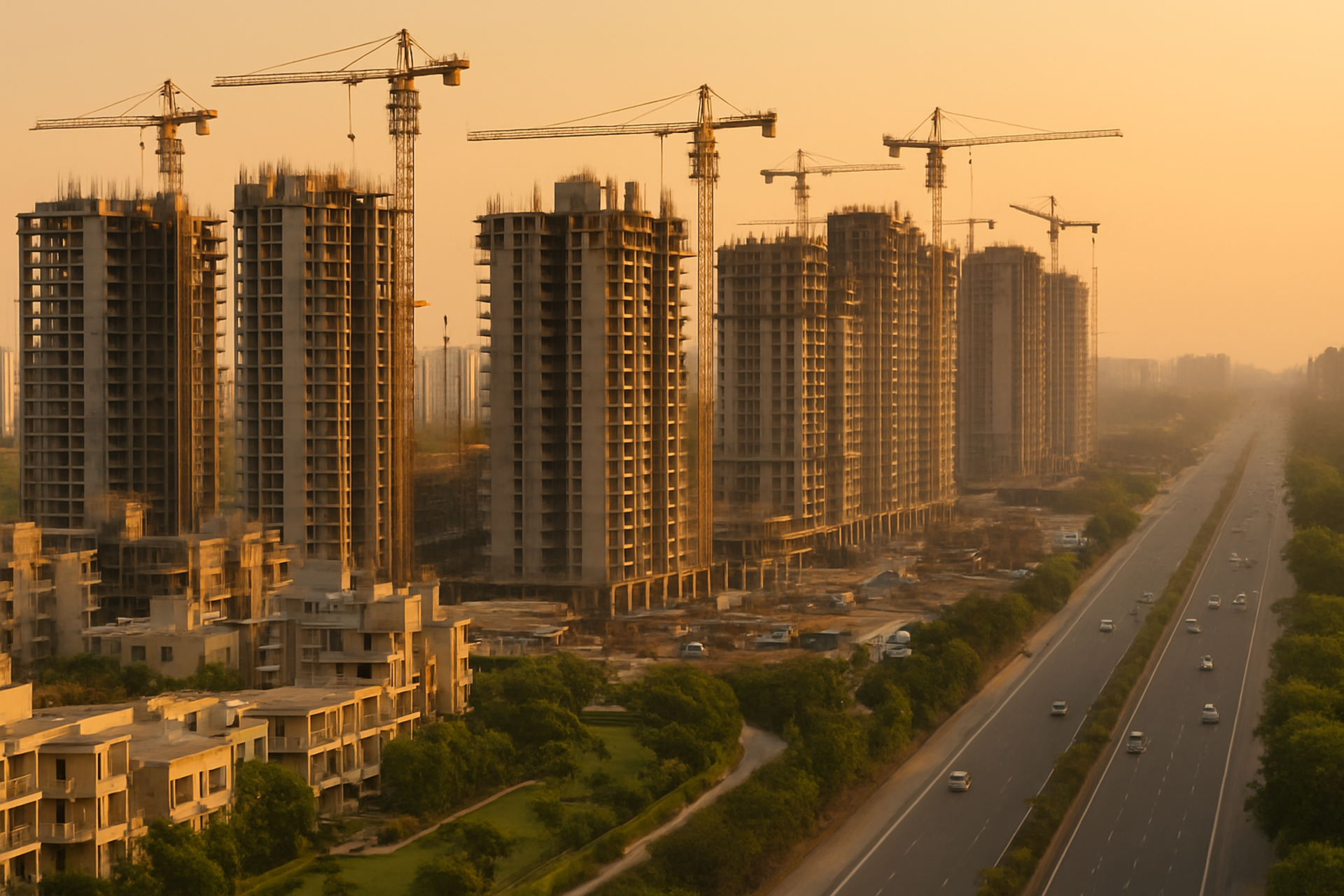
Answer: Developers are betting on mega townships in Noida because large land parcels, expressway access, and metro-linked corridors let them bundle housing, retail, and lifestyle amenities into one saleable ecosystem. For buyers, scale alone is not the point: a township is only as good as its UP RERA registration, phase-wise approvals, and verified possession record, so due diligence matters more than brochure size.
Evidence-led guide: we do not quote live prices, approvals or returns as our own claims. Verify project-specific facts on the official sources linked below before acting.
Why are big developers building mega townships in Noida right now?
Noida's mega-township wave is driven by land economics and infrastructure timing rather than a single developer's strategy. Large, contiguous parcels along the Noida Expressway and newer sectors give developers room to plan housing, retail, and open spaces together, instead of building isolated towers that depend entirely on the surrounding neighborhood for amenities.
Improving connectivity, including metro-linked corridors and expressway access, makes it commercially viable to sell a phased, multi-year project because buyers and lenders can see a credible infrastructure trajectory rather than a speculative one. This is a documented pattern in current Noida market coverage rather than a one-off trend tied to any single project.
The practical result is that many current listings and broker summaries emphasize proximity to metro stations and expressway junctions as a primary pricing driver, which shows that location fundamentals, not just township branding, continue to anchor value in these large-format developments.
What is the real difference between a mega township and a regular society project?
A mega township typically spans a much larger land parcel and is planned to include residential towers, retail and high-street commercial space, internal roads, parks, and often schools or clinics, delivered in phases over several years. A regular society project is usually smaller, residential-led, and more dependent on the surrounding sector's existing infrastructure for daily needs like shopping, dining, or open recreational space.
For a buyer, the practical distinction is dependency. In a mega township, more of daily life theoretically happens inside the boundary wall. In a regular society, residents rely more on nearby markets, standalone retail centers, and civic infrastructure that the builder does not control.
Neither format is automatically superior. A well-delivered regular society with strong RERA compliance can outperform a stalled mega township on the ground, so the format itself should never substitute for checking actual registration status, construction progress, and the developer's track record.
Are mega townships a good investment for first-time home buyers in 2026?
Mega townships can suit first-time buyers when the project is properly registered with UP RERA, the promoter's approvals are clean and current, and the buyer is genuinely comfortable with a phased, multi-year development horizon rather than expecting an early handover.
The risk profile changes sharply if a first-time buyer is committing most of their savings to a project still in early construction. Large integrated developments often span multiple phases, and advertised possession timelines can shift, so any date quoted in a brochure or by a sales team should be checked against the project's actual UP RERA filing before being treated as fact.
For a first-time buyer, occupancy status, legal clarity of title, and monthly affordability should outrank size, brand visibility, or the number of amenities promised. A smaller, RERA-compliant, near-complete project is often a safer first purchase than a sprawling township still years from its first phase handover.
Which mega township belts offer the best value for middle-income families?
Value-conscious middle-income families typically find better entry pricing in Noida's newer, still-developing Expressway-linked belts rather than the most established premium sectors. To verify whether a specific belt offers genuine value, consult IGRSUP for current circle-rate data by sector, as these official rates directly determine registration costs and can differ meaningfully from marketing estimates.
This does not mean every peripheral project is a bargain. The exact value depends on the specific project's construction quality, developer track record, and how realistic the handover timeline is relative to what is filed with UP RERA. A lower entry price with a stalled project is not value, it is risk.
Because online circle-rate aggregators can lag official revisions, any number used for budgeting should be cross-checked directly on IGRSUP rather than taken from a summary page or a builder's marketing material.
How do Sector 72, 94, 97 and 98 townships compare on verifiable criteria?
Sectors 72, 94, 97, and 98, often referred to together as the Billionaires' Corridor or the Sector 94-98 luxury belt, sit along the Noida Expressway and have drawn multiple large-format residential and mixed-use launches from national developers. Any comparison between projects in this belt should rest only on facts that can be independently checked, not on marketing language.
Projects listed in third-party databases should be treated as leads to verify directly on UP RERA rather than confirmed status. Verify RERA registration, promoter details, and phase-specific completion timelines before relying on any project summary.
Other large developers active in comparable Noida Expressway and peripheral belts include Gaurs Group, ATS Greens, Mahagun, and Godrej Properties, each with their own registered projects and disclosure records. A sound comparison weighs RERA registration status, phase-wise construction progress, and the developer's documented delivery history across projects, applied equally to every name on the list.
What should buyers verify before booking in any Noida mega township?
Before booking in any mega township, whether it carries a national developer's name or a smaller regional builder's, the checklist stays the same. Start with the UP RERA registration number, promoter identity, and the officially filed completion date for the specific tower or phase being sold, not the project as a whole.
Next, confirm the circle rate applicable to that sector on IGRSUP, since this determines actual stamp duty and registration cost, and can differ meaningfully from what a sales brochure implies. Also check NOIDA Authority records for land-use status and layout approval to confirm the parcel is legally cleared for the mix of residential, retail, and other uses being marketed.
Because most Noida land is sold on a 99-year leasehold basis, buyers should also understand Transfer Memorandum charges that apply on resale, and confirm these directly with NOIDA Authority rather than assuming a flat percentage. Any claim of an assured return on a retail or commercial component within a township should be treated as a due-diligence red flag requiring registered lease verification, not as a selling point.
Is buying into a Noida mega township worth it, or a loss risk, in 2026?
The honest answer is conditional. A mega township is a reasonable bet when the specific phase being purchased is UP RERA registered, has demonstrable construction progress matching its filed timeline, and the buyer's budget does not depend on an early, unverified possession date.
It becomes a loss risk when a buyer stretches finances based on brochure renderings and marketing timelines for phases that are still years from groundbreaking, or when the promoter's disclosure history shows repeated timeline revisions. Township scale does not reduce this risk, it can amplify it, because more capital and more years are typically involved before final handover.
For most middle-income and first-time buyers, the safer approach is to prioritize projects, or specific phases within a township, that are near completion or already partially occupied, with prices and timelines confirmed against UP RERA and IGRSUP records rather than sales team assurances.
Bottom line for Noida buyers evaluating mega townships in 2026
Mega townships are multiplying in Noida because large land parcels, expressway access, and an active infrastructure pipeline make integrated, phased development commercially attractive for developers. That trend is real and documented, but it does not automatically translate into a good deal for every buyer.
For first-time buyers, the safest path is to treat mega townships as a category to evaluate project-by-project and phase-by-phase, prioritizing legal clarity, verified possession status, and monthly affordability over sheer scale or amenity lists. For middle-income families, newer Expressway-linked belts often offer better entry pricing than premium central sectors, but only a direct check of UP RERA registration and the current IGRSUP circle rate can confirm whether a specific project represents real value or an inflated promise.
How to verify this yourself
- Confirm the specific phase's RERA registration number, promoter details, and filed completion date on UP RERA before booking
- Check the current circle rate for the exact sector on IGRSUP rather than relying on brochure or aggregator estimates
- Verify land-use status and layout approval for the township's mixed-use plan with NOIDA Authority
- Confirm metro and expressway proximity claims against actual NMRC and Noida Authority notices
- Understand Transfer Memorandum charges applicable on leasehold resale directly with NOIDA Authority
- Treat any assured-return offer on retail or commercial space as a red flag requiring registered lease verification
Sources and where to verify
- UP RERA official portal
- IGRSUP circle rate and registration portal
- Noida Circle Rate 2026: Home Buyers and Investors Guide, Buniyad
- Circle Rate Noida and Greater Noida Sector-wise, Sobha
- M3M India Noida official project portal
Continue your Noida research
Frequently Asked Questions
Why are developers building mega townships in Noida instead of standalone towers?+
Large contiguous land parcels, expressway access, and metro-linked corridors let developers bundle housing, retail, and amenities into one phased project, which is easier to market and finance than isolated towers, according to current Noida market coverage.
What is the difference between a mega township and a regular housing society in Noida?+
A mega township spans a larger parcel with integrated retail, roads, and open spaces delivered in phases, while a regular society is smaller, residential-led, and relies more on the surrounding sector's existing infrastructure.
Are mega townships a good investment for first-time buyers in Noida in 2026?+
They can be, but only if the specific phase is UP RERA registered, approvals are clean, and the buyer does not depend on an unverified early possession date; occupancy status and legal clarity should outrank size or branding.
Is buying into a Noida mega township a loss or a profit in 2026?+
It depends on verification, not scale: a RERA-registered, near-complete phase with confirmed construction progress is a reasonable bet, while stretching finances on an early-stage phase based on brochure timelines carries real loss risk.
Which Noida belt offers the best value for middle-income families buying into a township?+
Newer, still-developing Expressway-linked belts generally show lower circle rates than premium central sectors per IGRSUP data, but the exact value must be confirmed directly on IGRSUP since online summaries can lag official revisions.
Should buyers trust an assured-return offer on retail space inside a Noida township?+
No, assured-return claims should be treated as a due-diligence flag requiring verification of a registered lease and regulatory compliance, not as a genuine investment benefit.
Tags