
High Street Retail in Noida: What's Fuelling the 2026 Boom and Where Investors Should Look
Noida's high street retail demand is rising on dense catchments, metro access and mixed-use formats. Here's what investors should verify before buying in 2026.
Answer: Noida's high street retail is booming because dense residential catchments, metro-linked footfall, and mixed-use project formats are converging in central and expressway-adjacent micro-markets. Sector 72, the Billionaires' Corridor (Sectors 94-98) and similar transit-connected pockets are drawing investor interest, but actual returns depend on RERA-verified possession, frontage, tenant mix and catchment population, not launch marketing claims.
Evidence-led guide: we do not quote live prices, approvals or returns as our own claims. Verify project-specific facts on the official sources linked below before acting.
Why Is High Street Retail Growing So Fast in Noida Right Now?
Noida's high street retail momentum is being pulled by three overlapping forces: population density from new housing clusters, sustained IT and business activity feeding daily footfall, and a wave of mixed-use projects that bundle retail with entertainment, food and hospitality formats. Sectors that already carry established residential and working populations, particularly around central Noida and the Noida Expressway belt, are seeing the strongest developer and investor activity.
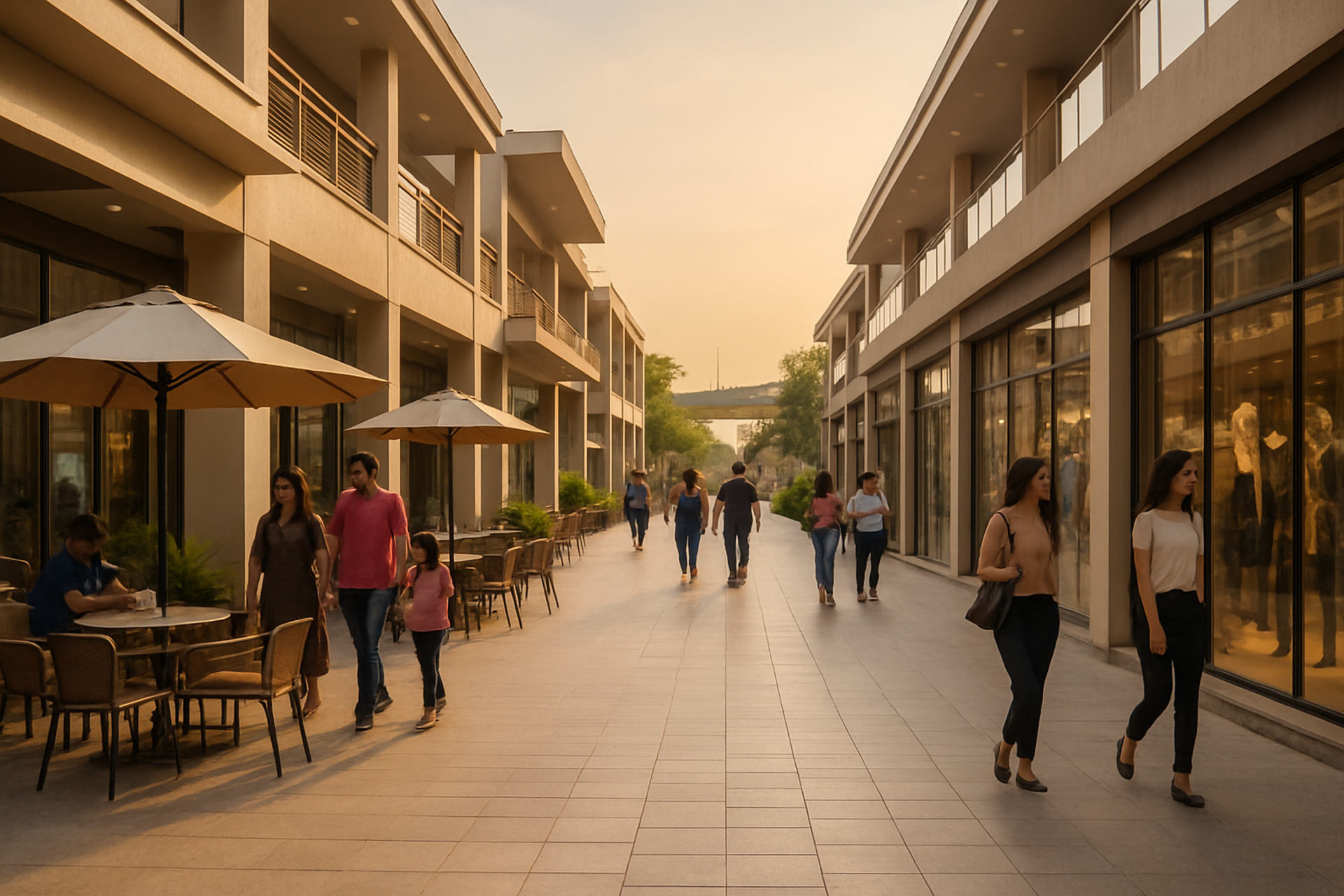
Retail here is no longer just about ground-floor shops facing a road. Developers are designing entire precincts, open-air high streets alongside enclosed malls, food courts next to studios, and entertainment zones meant to hold footfall on-site well beyond typical office hours. This shift matters for investors because a shop's value is increasingly tied to the ecosystem around it, not just its own frontage.
Which Noida Micro-Markets Have the Best High Street Retail Potential?
Within the scope of genuinely investment-relevant zones, Sector 72 and the Billionaires' Corridor spanning Sectors 94 to 98 stand out for a combination of catchment density, expressway or metro access, and active mixed-use development. These are also the sectors where RERA-registered commercial projects with disclosed timelines are actually available for scrutiny, which matters more than any brochure claim.
Sector 72 sits close to central Noida's established residential and commercial base, giving it walk-in demand from day one of possession. The Billionaires' Corridor along the Noida-Greater Noida Expressway benefits from signal-free connectivity and proximity to both Delhi's affluent southern belt and Noida's own high-density sectors between 90 and 150. Any retail decision in these belts should still be checked against the specific project's UP RERA filing, since positioning alone does not guarantee delivery or footfall.
What Exactly Is Driving Retail Business Growth on These Streets?
Four practical drivers explain the current retail growth pattern, and each one is verifiable independently rather than being a marketing assumption.
- Dense catchments: sectors around central Noida and the expressway corridor already have residential and employment populations that support daily retail footfall, distinct from projects betting on future population growth.
- Transit and road access: projects near metro stations or major expressway stretches get better visibility and walk-in potential; frontage on a signal-free stretch compounds this advantage over time.
- Mixed-use bundling: pairing retail with food courts, studios, serviced suites and entertainment is designed to extend dwell time and repeat visits beyond a single shopping trip.
- Investor appetite for income-generating retail: strong demand for rental-yielding commercial assets is evident in how developers structure and market such projects, though any specific return figure should be treated as a developer claim until verified against actual signed leases.
How Does M3M The Line in Sector 72 Fit This Picture?
M3M The Line in Sector 72 is one of the RERA-registered mixed-use commercial projects that illustrates this retail-plus-format trend in practice. According to M3M's project material and third-party listings, the project carries UP RERA registration number UPRERAPRJ246070, with a launch timeline cited as August 2023 and targeted possession indicated for July 2028; both dates and the current construction status should be confirmed directly on the UP RERA listing at up-rera.in before any commitment, since possession timelines on under-construction commercial projects can shift.
The project is positioned around retail, food and beverage outlets, and serviced suites, with its Sector 72 location marketed for proximity to the metro and central Noida connectivity. Listed entry prices across different seller and aggregator pages have been cited from roughly the mid-60-lakh mark for smaller units to well above a crore for larger retail formats. Because these figures vary meaningfully by source, unit size and floor placement, the only reliable figure is whatever appears on the developer's current allotment sheet and the UP RERA filing at the time of purchase.
What Does M3M's Sector 94 Retail Development Look Like?
A more expansive example of the high-street trend sits in Sector 94, on the Noida-Greater Noida Expressway at effectively the Delhi border. According to M3M's official project material, the development combines approximately 1.6 million square feet of commercial space, an enclosed mall component and an open high street component, alongside ultra-luxury residential units under the same masterplan. Readers should verify these figures and current status against M3M's official Noida website and the relevant UP RERA filing rather than relying on launch-period figures alone.
The open high street component is designed as a walkable, open format aimed at independent designers, boutique and artisanal brands with a cafe-led, all-day social atmosphere, drawing design inspiration from established Delhi retail precincts. The enclosed mall component is positioned at the bridge-to-luxury and global designer segment. Per M3M's project material, the development is stated to sit within a catchment spanning multiple Noida sectors and South Delhi, with a secondary catchment extending to surrounding metros. Readers evaluating this project for investment should verify current pricing, unit availability, possession status, and catchment figures through M3M India Noida's official website and the relevant UP RERA filing rather than relying on any single marketing claim.
How Do Investors Address the Retail Oversupply Concern?
A fair objection raised by cautious buyers is that Noida already has a crowded retail landscape, with established shopping centers and strips competing for the same tenant pool. This concern is legitimate and should not be waved away.
The rebuttal is not that oversupply doesn't exist, but that catchment quality and format differentiation determine which specific assets absorb demand and which struggle. A retail project anchored to a genuinely large residential and employment catchment, with a distinct format such as an open high street paired with an enclosed luxury mall rather than a single generic shopping arcade, is positioned differently from a standalone strip that depends on passing traffic alone. Investors should ask any project, including developments in Sector 94 or Sector 72, for its actual anchor tenant commitments, footfall projections tied to real catchment data, and RERA-disclosed timelines, rather than accepting oversupply worries or bullish claims at face value in either direction.
Can 50 Lakh Rupees Buy a Good Noida High Street Retail Investment?
Fifty lakh rupees can be enough to enter some Noida high street retail opportunities, but whether it delivers good returns depends entirely on unit size, exact location within the project, lease-up risk, payment plan structure, and the possession timeline, not on brochure promises.
Based on listed entry prices cited for smaller units at M3M The Line in Sector 72, some retail formats have been advertised from the mid-60-lakh range and rise well past a crore for larger or better-positioned units. That suggests 50 lakh may fall short for many prime ground-floor retail units unless a smaller format, staggered payment plan, or early-phase pricing window is available. Before committing, investors should request the current unit-wise price list, cross-check it against the UP RERA filing for that specific project, and calculate a realistic rent-to-price ratio using comparable rents already being paid in the same micro-market rather than any headline yield figure quoted by a broker.
What Should Investors Verify Before Buying Retail in These Sectors?
A disciplined checklist matters more here than any single location claim, because a well-located shop in a poorly executed project can still underperform, and a modest location in a well-anchored, well-timed project can outperform expectations.
- Frontage and floor placement: ground or first-floor units facing the main circulation path typically command stronger footfall and resale value than upper floors or interior units.
- Footfall generators nearby: confirmed anchors such as a multiplex, large-format electronics or lifestyle stores, food court operators, or a dense residential population within walking distance.
- RERA-cleared possession timeline: verify the registration number, approved plan and current construction status directly on UP RERA rather than relying on a sales brochure date.
- Comparable rents: check what similar shops in the same micro-market are actually renting for today, not what a developer projects for a future, fully-leased scenario.
- Exit liquidity: ask how actively similar units in the same project or nearby projects have resold, since illiquid retail stock can trap capital even if rental income is reasonable.
- Land title and registry: confirm ownership and encumbrance status through IGRSUP before final payment, especially on resale or investor-to-investor transactions.
How to verify this yourself
- Confirm UP RERA registration number, approved layout and current construction status for any project, including M3M The Line (UPRERAPRJ246070), directly on up-rera.in
- Verify current unit-wise pricing and payment plan with the developer's latest allotment sheet, not third-party aggregator listings
- Cross-check land title, encumbrance and registry status on IGRSUP before final payment
- Confirm actual achieved rents for comparable retail units in the same micro-market rather than relying on projected yield figures
- Verify leasehold terms and Transfer Memorandum charges with the Noida Authority before any resale transaction
- For metro or Expressway connectivity claims, confirm current station and route status with NMRC or the relevant road authority
- Verify M3M Sector 94 RERA registration number and current construction status on up-rera.in
Sources and where to verify
- UP RERA official portal
- IGRSUP registry and title verification
- M3M The Line project listing, Square Yards
- M3M The Line, Sector 72 project details, 99acres
- M3M India Noida official website
Continue your Noida research
Frequently Asked Questions
Is investing in Noida high street retail worth it right now, or is it a loss-making bet?+
It can be worth it, but only conditionally: a retail unit in a project with a large verified catchment, confirmed anchor tenants, RERA-disclosed possession timelines and realistic comparable rents can deliver steady rental income and appreciation, while a unit bought purely on launch marketing or oversupplied strip locations without anchor commitments carries genuine downside risk. The difference lies entirely in due diligence, not in the sector name.
Why is high street retail growing faster than mall-format retail in parts of Noida?+
Open, walkable high street formats are growing because they combine lower operating costs for tenants with an all-day social atmosphere, cafes, boutique brands and outdoor seating that keeps footfall flowing beyond typical mall hours. Developers including M3M have adopted this design approach by pairing open high streets with enclosed mall components under single masterplans in Noida.
Is Sector 72 or the Billionaires' Corridor better for high street retail investment?+
Both have distinct, verifiable strengths: Sector 72 benefits from proximity to central Noida's established residential and commercial base and metro-linked positioning, while the Billionaires' Corridor across Sectors 94 to 98 offers Expressway frontage and access to a much larger combined catchment spanning Noida and South Delhi; the right choice depends on the specific project's RERA status, tenant mix and your own budget and risk profile.
Does M3M The Line in Sector 72 offer assured rental returns?+
Any assured or guaranteed rental claim attached to a commercial project should be treated as a due-diligence flag, not a benefit; verify whether such an arrangement is backed by a registered lease agreement, check the project's UP RERA disclosures, and confirm the claim independently rather than relying on marketing language.
Can I invest 50 lakh rupees in Noida high street retail and expect good returns?+
Fifty lakh rupees can secure entry-level units in some projects, since smaller formats at M3M The Line in Sector 72 have been listed from roughly the mid-60-lakh mark in some sources, but whether returns are good depends on unit size, floor placement, actual achieved rents in that micro-market, and the project's possession timeline, all of which need independent verification before committing capital.
What is the leasehold status of retail land in these Noida sectors, and does it affect resale?+
Most Noida Authority-allotted commercial land, including in Sector 72 and the Billionaires' Corridor sectors, is on a 99-year leasehold basis, which means resale and transfer typically require a Transfer Memorandum with associated charges payable to the Authority; buyers should confirm the exact TM charge and process for their specific unit with the Noida Authority before finalising a resale purchase.
Tags


