Does the FNG Expressway actually raise Noida property prices?
FNG Expressway impact on Noida real estate explained: which sectors gain, what to verify before buying, and why Noida-Greater Noida Expressway sits outside its belt.
Answer: The FNG Expressway can support long-term appreciation in parts of Noida, but the effect is gradual and uneven, not automatic. Gains depend on completed links, working interchanges and measurable travel-time cuts rather than announcements alone. Sectors with direct, documented access stand to benefit most. Properties marketed as 'FNG-facing' without a confirmed road connection carry real risk, so verify alignment status with NOIDA Authority and UP RERA before paying any premium.
Evidence-led guide: we do not quote live prices, approvals or returns as our own claims. Verify project-specific facts on the official sources linked below before acting.
What exactly is the FNG Expressway meant to change for Noida?
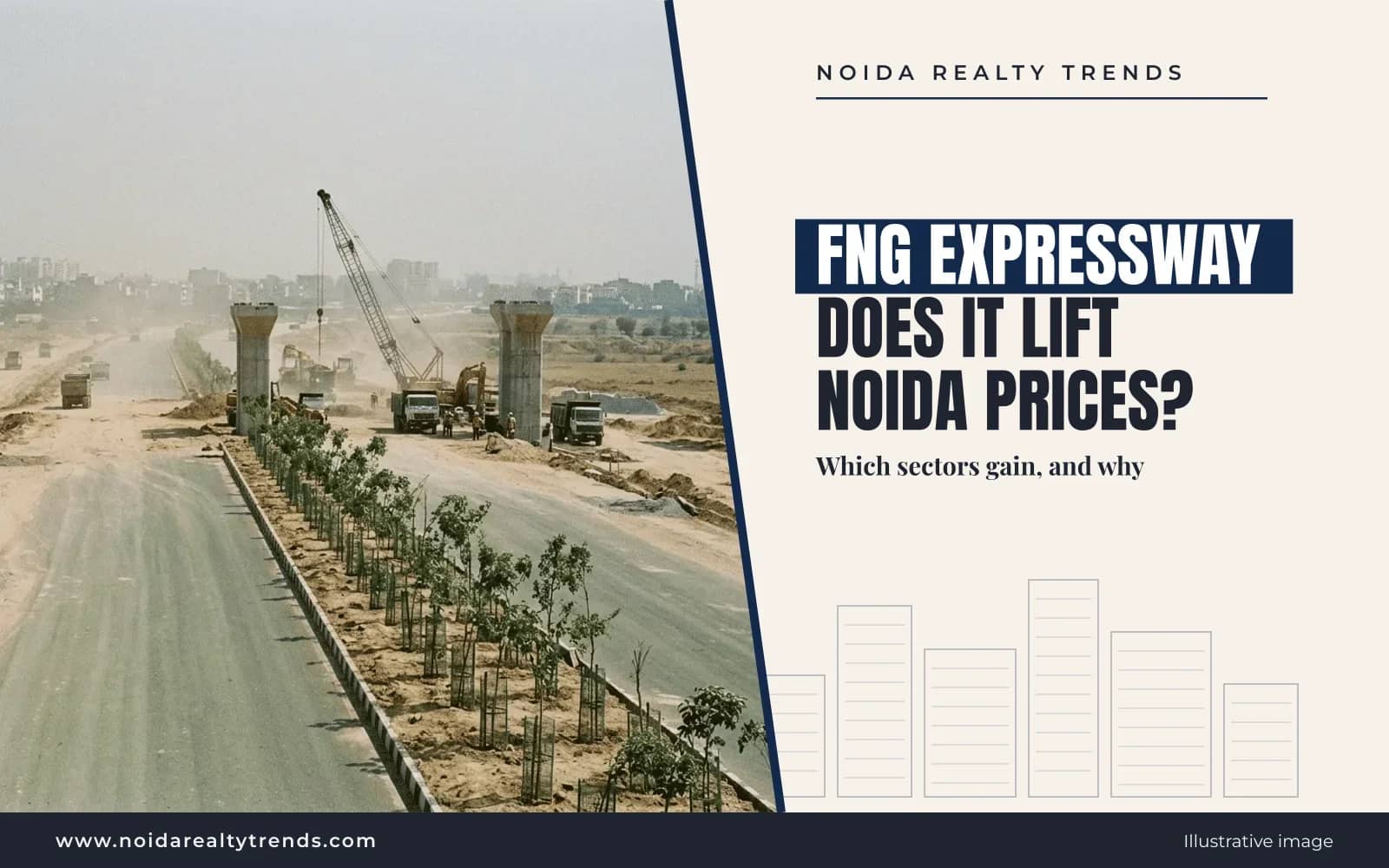
The Faridabad-Noida-Ghaziabad Expressway is planned to cut east-west travel time across Noida and its neighbouring corridors. For Noida specifically, the expected gains are shorter road travel between the city's eastern and northern sectors and adjoining markets, better access for jobs, logistics, education and retail catchments, and reduced load on existing congested corridors.
None of this is automatic or immediate. A proposed or partially built road produces a much weaker, less reliable price signal than a fully operational, well-interchanged corridor. Until missing links, land acquisition and approvals are finished and traffic is actually flowing, FNG remains a future-value story rather than a present one. Treat any claim of an already-realised price jump with scepticism and ask for dated, sourced evidence.
Will the FNG Expressway increase property prices in Noida?
Potentially yes in specific pockets, but unevenly and not as a blanket rule across the city. Price effects from a road project are strongest once the stretch is fully usable, interchanges give practical access to a sector, travel times are measurably shorter, and nearby schools, retail and employment nodes have had time to mature around the new connectivity.
There is no reliable, sourced basis for a single percentage uplift that applies across Noida because of FNG. Asking prices already vary widely by sector, project, construction stage, builder track record and unit size, and a broker quoting a flat percentage increase tied to FNG should be treated as a sales pitch, not a verified figure. Cross-check any such claim against live transaction data and guidance values on IGRSUP, actual registered sale deeds, and comparable sales in the same micro-market, rather than accepting a verbal projection.
Which Noida sectors benefit most from the FNG Expressway?
The likely beneficiaries are sectors sitting on or near the confirmed FNG alignment and its connecting roads, mainly the northern and north-eastern sectors in the 112 to 122 range that are commonly discussed in relation to the Noida side of the corridor, plus adjoining residential sectors in the 119 to 121 band where benefit depends on final access roads and interchange placement.
Sectors further along the Noida-Greater Noida Expressway corridor, broadly in the 140 to 150 range, may see some indirect benefit through wider connectivity improvements, though that belt is more strongly tied to the Noida-Greater Noida Expressway than to FNG itself. Areas right next to major junctions and approach roads can see a commercial activity boost but also carry higher risk of noise and congestion. None of this ranking should be treated as final until the exact alignment, interchange design, right-of-way and construction status are confirmed through NOIDA Authority and state infrastructure notifications.
It is worth stating plainly what this means for the Noida-Greater Noida Expressway belt of Sectors 94 to 98 and for Sector 72: these established Noida Expressway sectors sit outside the core FNG-beneficiary zone described above. Their investment case rests on Noida Expressway connectivity, proximity to the Noida International Airport corridor, and existing retail and residential development, not on FNG access. Readers should not treat FNG as a reason to buy in these sectors, and should not treat the absence of FNG exposure as a weakness either, since these sectors were never part of the FNG alignment story in the first place.
How do you tell a genuine FNG-linked opportunity from a marketing claim?
A simple three-tier filter works: the best bet for actual day-to-day convenience is a property a short, verified drive from a functioning interchange; the best bet for possible future appreciation is an area where infrastructure and civic services are still visibly expanding around a confirmed alignment; and the highest-risk category is any property advertised as 'FNG-facing' or 'FNG-adjacent' without a confirmed access road, an approved layout, or an actually completed connection.
Before accepting a premium tied to FNG proximity, ask the seller or broker for the specific road section status, the interchange it connects to, and documentary confirmation from NOIDA Authority. If none of that is available, treat the FNG reference as aspirational marketing rather than a priced-in fact.
Is buying property near FNG worth it for a budget buyer?
It can be worthwhile, but only if usable connectivity and legal certainty are prioritised over a future-story premium. A more suitable purchase for a budget buyer is a project where the road connection is already usable or has a clearly documented completion plan, the project is registered with UP RERA, title and sanctioned plan are independently verifiable, and the asking price is in line with comparable nearby sectors rather than inflated purely on FNG expectations.
Warning signs include a seller offering a large premium for an 'upcoming FNG' connection, a property that is actually far from the real alignment or interchange, access that depends on an unbuilt internal or service road, and a project whose RERA details, promoter history or completion date cannot be independently confirmed. For a budget buyer, a completed or occupied project with established transport and civic services already in place is generally a safer bet than a cheaper unit whose entire value case depends on FNG completion arriving on schedule.
How does FNG-linked buying compare with buying in an established corridor like Noida-Greater Noida Expressway?
The two are different risk profiles, not a straight either-or choice, and comparing them fairly means separating what is verifiable today from what depends on future completion.
Sectors 94 to 98 on the Noida-Greater Noida Expressway, and Sector 72 already have documented Noida Expressway access, existing retail and residential stock, and projects carrying current UP RERA registrations that can be checked today. Developers active in this belt include M3M, whose Sector 72 and Sector 94 projects carry listed UP RERA numbers, alongside other NCR developers with completed or ongoing Noida Expressway projects such as Godrej Properties, Gaurs Group and ATS Greens in their respective sectors. The appreciation case here rests on connectivity and development that already exists and can be inspected, not on a future road opening.
FNG-adjacent sectors, by contrast, carry a connectivity story that is still being built out. The upside may be larger in percentage terms if the road completes on schedule and interchanges work as planned, but that upside is conditional and currently unverifiable. A buyer weighing the two should decide, with eyes open, whether they are paying for infrastructure that exists now or infrastructure that is promised for later.
What should every buyer verify before paying an FNG-linked premium?
Verification should happen before negotiation, not after booking. Check the project's UP RERA registration number directly on up-rera.in to confirm promoter name, sanctioned plan, and declared completion date. Confirm the actual road and interchange status with NOIDA Authority rather than relying on a broker's description of 'upcoming connectivity.'
Also check the current circle rate for the specific sector on IGRSUP, since guidance values reflect government assessment rather than aspirational broker pricing, and visit the site during peak traffic hours, late evening, and after rainfall to assess real-world access and noise, not just the daytime showroom experience.
How to verify this yourself
- Confirm FNG alignment, interchange locations and construction status directly with NOIDA Authority and state infrastructure notifications before attributing any price premium to the expressway
- Check the specific project's UP RERA registration number on up-rera.in for promoter details, sanctioned plan and declared completion date
- Verify current circle rates and guidance values for the relevant sector on IGRSUP rather than relying on broker-quoted FNG-linked premiums
- Review actual registered sale deed transactions and comparable sales in the same micro-market instead of accepting a verbal appreciation projection
- Visit the site at peak traffic hours, late evening and after rainfall to assess real access, noise and road conditions independent of marketing material
Sources and where to verify
Continue your Noida research
Frequently Asked Questions
Does the FNG Expressway already increase Noida property prices today?+
Not uniformly and not yet in a verifiable, sourced way. Price effects strengthen once a stretch is fully operational with working interchanges and measurable travel-time cuts; until then, any 'FNG premium' quoted by a seller should be checked against IGRSUP guidance values and actual registered transactions rather than accepted at face value.
Which Noida sectors are most likely to benefit from FNG connectivity?+
Sectors sitting directly on or near the confirmed alignment, broadly the 112 to 122 band and adjoining sectors in the 119 to 121 range, are the most commonly cited beneficiaries, with benefit depending on final interchange placement. This ranking should be confirmed against NOIDA Authority notifications before any purchase decision.
Is buying near FNG worth it for a budget buyer or is it a loss waiting to happen?+
It can be worth it if the project has usable connectivity today or a clearly documented completion plan, is UP RERA registered, and is priced in line with comparable sectors rather than inflated on FNG hype. It becomes a likely loss if the entire price premium rests on an unbuilt road and unverified promoter claims, since budget buyers have less cushion to absorb a delayed or cancelled connectivity benefit.
Are Sector 94 to 98 and Sector 72 part of the FNG-beneficiary belt?+
No. These Noida Expressway sectors, including the Noida-Greater Noida Expressway, sit outside the core FNG alignment and connecting roads described in infrastructure notifications. Their value case rests on existing Noida Expressway connectivity and current development, not on FNG access, so buyers should not expect an FNG-driven premium in these sectors.
How can a buyer tell a genuine FNG-linked property from a marketing claim?+
Ask for documented confirmation of the specific road section's construction status and its connecting interchange from NOIDA Authority, and treat any 'FNG-facing' claim without that paperwork as unverified marketing language rather than a priced-in fact.
What should I check before paying extra for 'FNG proximity'?+
Confirm the project's UP RERA registration on up-rera.in, check the current circle rate for that sector on IGRSUP, and verify the actual road and interchange status with NOIDA Authority, since broker claims about upcoming connectivity are not a substitute for official confirmation.
Tags