FNG Expressway and Noida Property Prices: What to Know in 2026
Will the FNG Expressway raise Noida property prices? A sector-by-sector, verify-before-you-buy look at the real impact.
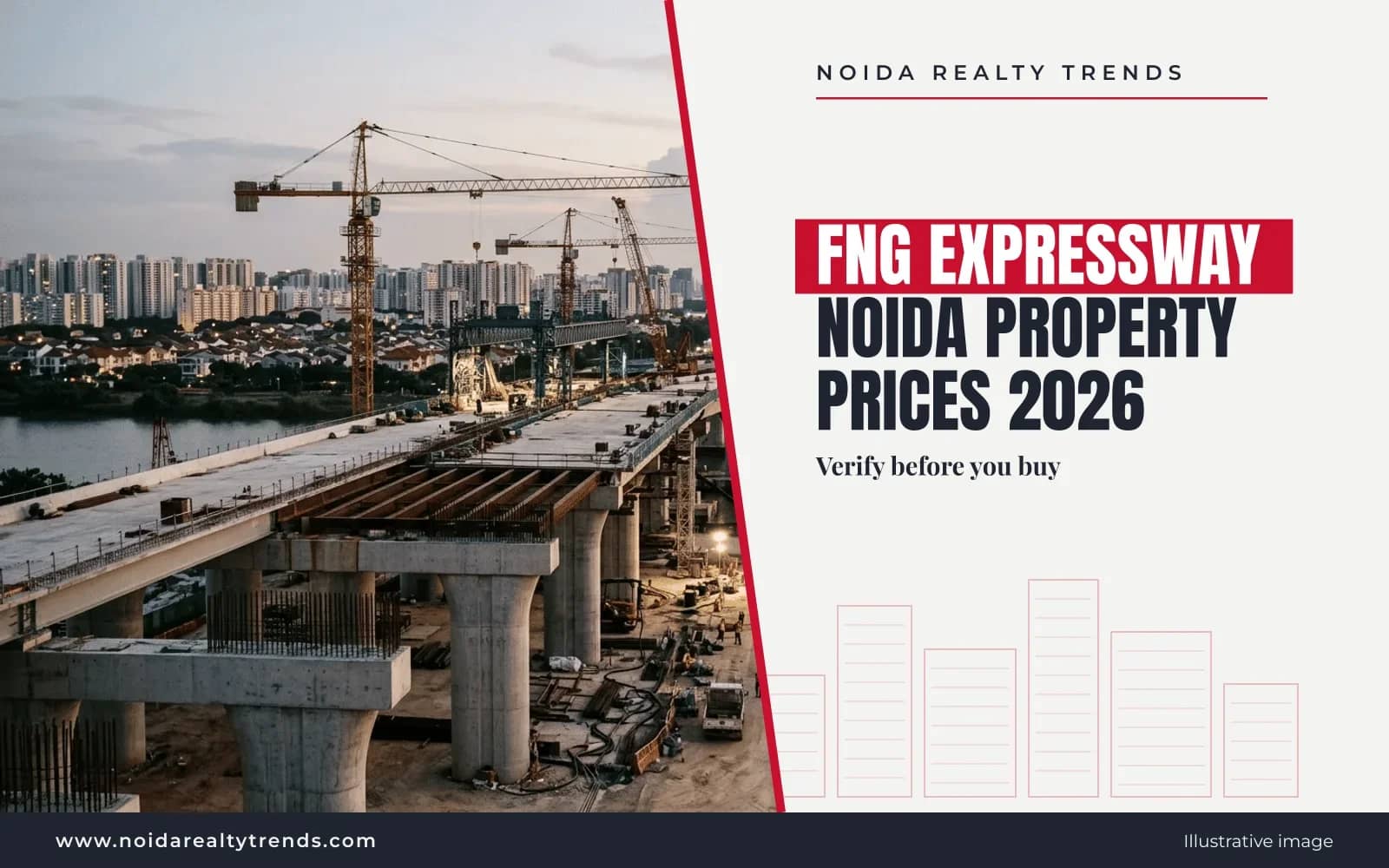
Answer: The FNG Expressway (Faridabad-Noida-Ghaziabad) could support long-term appreciation in sectors with confirmed interchange access, but its final alignment, land acquisition and opening timeline are not yet fixed. Treat it as one factor among many, not a reason to buy on its own. Verify alignment status with the Noida Authority and UP RERA registration for any project before paying a so-called FNG premium.
Evidence-led guide: we do not quote live prices, approvals or returns as our own claims. Verify project-specific facts on the official sources linked below before acting.
How will the FNG Expressway impact Noida property prices?
The FNG Expressway is designed to connect Faridabad, Noida and Ghaziabad, cutting travel friction between eastern Noida, Greater Noida West and the Delhi-NCR periphery. Improved connectivity of this kind has historically supported selective price appreciation in Indian cities, but the scale, timing and even the final geography of the benefit in Noida remain unconfirmed until the relevant authorities finalise alignment and interchange points.
Four plausible effects are worth separating. First, cross-river connectivity could reduce commute times between eastern Noida, Ghaziabad and Faridabad. Second, lower travel friction could make sectors that currently depend on one or two arterial roads more attractive. Third, better logistics access could lift demand for rental housing, retail and warehousing near interchanges specifically, not the corridor broadly. Fourth, a construction premium may appear as visible progress milestones are hit, while delays, missing links or poor last-mile roads can just as easily erode that premium.
No specific percentage price uplift should be treated as reliable without independent transaction evidence. A broker quoting a fixed appreciation figure for FNG-linked property is making a forecast, not reporting a verified fact, and should be checked against actual registered sale deeds via IGRSUP (igrsup.gov.in) rather than accepted at face value.
Which Noida sectors will benefit most from FNG Expressway?
The sectors most likely to benefit are those near confirmed junctions on the Noida-Ghaziabad-Faridabad route, not every sector loosely described as near FNG. Based on the current alignment discussion, four broad pockets are commonly cited, each with caveats that depend on final execution.
Sectors 121 to 123 and adjoining areas are relevant for access toward Ghaziabad and Greater Noida West, subject to how the final junction design plays out. Sectors 137 to 143 could see improved regional access, but the benefit depends on connection quality to the Noida Expressway and local feeder roads. Sectors 75 to 79 may see an indirect benefit through better movement toward central Noida and Ghaziabad. Sectors 150 to 152 in the southern Noida belt could benefit if the network improves links to the Noida Expressway and southern employment zones.
The single most important variable is proximity to an actual functioning entry or exit point, not a sector label on a brochure map. A listing described as FNG-facing should be checked against the latest alignment and land-acquisition status published by the Noida Authority, the relevant Ghaziabad development authority and Uttar Pradesh government agencies, since marketing maps often show a planned route rather than a confirmed one.
Should you invest in Noida property before the FNG Expressway opens?
Buying ahead of completion can work, but only with a long holding period and a purchase price that is justified even if the FNG premium never fully materialises. The strongest cases share several features: the property is legally approved and registered with UP RERA, the location already has usable roads, schools, retail and employment access independent of FNG, and the project shows clear title, sanctioned plans and transparent construction milestones.
Waiting is the more conservative choice when the investment case depends almost entirely on the expressway, when the access road or interchange near a specific project is not yet confirmed, or when a seller promises a fixed opening date or guaranteed appreciation. Commercial, studio or retail inventory with uncertain occupancy carries extra risk in this scenario, since rental income cannot be assumed simply because a road may eventually open nearby.
A useful discipline is to ask: would this property still make sense at today's price if FNG were cancelled tomorrow? If the answer is no, the purchase is a bet on infrastructure timing rather than a property investment, and that bet should be sized accordingly.
What should you verify before paying an FNG-linked premium?
Four checks matter more than any FNG marketing claim. UP RERA registration confirms the promoter, approved plans, declared completion date, quarterly progress reports and any litigation disclosures for the specific project and phase, searchable at up-rera.in. Noida Authority records confirm land allotment, lease deed status, sanctioned building plan and whether the project has completion or occupancy certification along with genuine road access.
IGRSUP records establish title, registered deeds and encumbrances, and also show the applicable stamp duty position for the transaction. Where the investment thesis leans on metro access in addition to the expressway, NMRC publications on station status and route progress should be checked directly rather than assumed from a project brochure.
None of these checks confirm that FNG itself will open on a particular date. They confirm that the property you are buying has a sound legal and physical foundation regardless of what happens to the expressway timeline, which is the more durable protection for a buyer.
What are the budget-friendly Noida locations near the FNG corridor for investors?
Budget-friendly is relative to unit size, tenure, possession status and asset type, so a precise price ranking without a current verified transaction dataset would be unreliable. The areas below are worth screening rather than treating as guaranteed bargains.
Sectors 121 to 123 are often considered relatively accessible residential entry points compared with premium central Noida, but actual FNG access and local congestion should be checked rather than assumed. Sectors 137 to 143 offer a broad apartment and rental market, so compare resale inventory, maintenance charges, occupancy levels and distance to employment hubs before assuming affordability translates into returns.
Sectors 75 to 79 benefit from established residential infrastructure, which can reduce execution risk even if a given property is not directly adjacent to the expressway alignment. Greater Noida West pockets on the Noida side can show lower entry prices than central Noida, but the thesis depends heavily on road capacity, infrastructure completion and oversupply risk, which has been a recurring concern in that belt. Peripheral pockets such as Kondli-Mamura may show lower quoted prices, but title clarity, unauthorized construction risk, land-use permissions and municipal services require especially careful verification before any purchase.
How do the known objections to FNG-linked buying hold up?
The most common objection is that FNG has been discussed for years without a confirmed opening date, and that similar long-delayed road projects elsewhere in NCR have left early buyers holding overpriced inventory for far longer than expected. This is a fair concern and should not be dismissed: a buyer paying a premium today for a road that opens five or ten years later, if at all, is taking a timing risk that no broker can responsibly guarantee away.
A second objection is that marketing material frequently labels large swathes of eastern and southern Noida as FNG-adjacent, when only properties near a confirmed interchange are likely to see a meaningful access benefit. The rebuttal here is procedural, not promotional: check the Noida Authority's current alignment and land-acquisition status for the specific stretch near a project, rather than accepting a sector-wide claim.
A third objection concerns commercial and retail inventory marketed on the strength of future FNG footfall, echoing concerns raised about retail oversupply in established Noida micro-markets such as Spectrum Metro, Dasnac Arc and Central 50 in Sector 72, where multiple large retail formats compete for the same catchment. The same caution applies to any retail unit sold primarily on a future-traffic story: occupancy and footfall should be assessed on current, not projected, demand.
Is buying near FNG Expressway a loss or a profit in 2026?
It can be either, and the honest answer depends on what you are actually buying, not on FNG alone. A profit scenario looks like this: a RERA-registered project with sanctioned plans, usable roads and independent rental or resale demand today, bought at a price that would still make sense without any FNG uplift, held for several years while infrastructure matures.
A loss scenario looks like this: a unit bought mainly because a broker cited FNG and a future price target, in a project with unclear title or unconfirmed interchange access, where the buyer needs to sell or lease within a short window and the expressway has not yet opened or has been rerouted away from that stretch.
The honest verdict is conditional: FNG is a genuine long-term infrastructure tailwind for parts of Noida, but it is not, by itself, sufficient reason to buy a specific property. The property has to clear its own legal, locational and rental-demand tests first.
How to verify this yourself
- Confirm FNG Expressway alignment, interchange locations and land-acquisition status directly with the Noida Authority and relevant Ghaziabad development authorities before assuming any property has direct access
- Check UP RERA (up-rera.in) for project registration, promoter details, sanctioned plans, declared completion date and quarterly progress reports
- Verify title, registered deeds and encumbrances through IGRSUP (igrsup.gov.in), and confirm the applicable stamp duty position before paying
- Treat any broker-quoted appreciation percentage tied to FNG as unverified until checked against actual registered transaction data
- For metro-dependent investment theses, confirm station status and route progress through NMRC publications rather than project brochures
- Review leasehold tenure terms, Transfer Memorandum charges and any assured-return claims with independent legal counsel before signing
Sources and where to verify
- UP RERA official portal
- IGRSUP, Uttar Pradesh registration and stamps department
- Noida Authority official website
Continue your Noida research
Frequently Asked Questions
Will FNG Expressway increase Noida property prices?+
It could support price appreciation in sectors with confirmed interchange access over the long term, but no verified percentage uplift exists yet, and delays, missing links or rerouting could reduce or postpone any benefit. Treat specific appreciation figures quoted by brokers as unverified claims until checked against actual registered transactions on IGRSUP.
Which Noida sectors benefit most from FNG Expressway?+
Sectors near confirmed junctions typically cited include areas around Sectors 121 to 123, 137 to 143, 75 to 79, and 150 to 152, but the real determinant is proximity to an actual functioning interchange, not a sector label. Always check the latest alignment and land-acquisition status with the Noida Authority before assuming a property has direct FNG access.
Should I buy Noida property before FNG Expressway opens?+
Possibly, but only if the property makes sense on its own merits, legal title, RERA registration, existing road and social infrastructure, and independent rental demand, even without the FNG premium. Avoid buying purely on the promise of a future opening date that no authority has confirmed.
Is it too late to invest if FNG Expressway hasn't opened yet?+
No, it is not too late, because the expressway's final alignment and opening timeline are still being finalised by the relevant authorities, which means early-stage pricing has not necessarily priced in a confirmed benefit. The risk is the opposite of being too late: buying too early on an unconfirmed premium without checking legal and construction fundamentals.
What is the biggest risk with FNG-linked property claims?+
The biggest risk is treating marketing language like FNG-facing or FNG-adjacent as equivalent to confirmed interchange access, when in many cases the final alignment and junction points have not been fixed. Always verify directly with the Noida Authority and cross-check any assured-return or guaranteed-appreciation claim, since assured returns on property are a regulatory caution point, not a legitimate selling point.
Are FNG-linked retail or commercial units a safe bet?+
Not automatically, since several existing Noida retail markets including Spectrum Metro, Dasnac Arc and Central 50 already illustrate how oversupply can suppress occupancy even in developed catchments. A retail or commercial unit sold mainly on future FNG footfall projections should be assessed on current demand and existing RERA disclosures, not projected traffic.
Tags