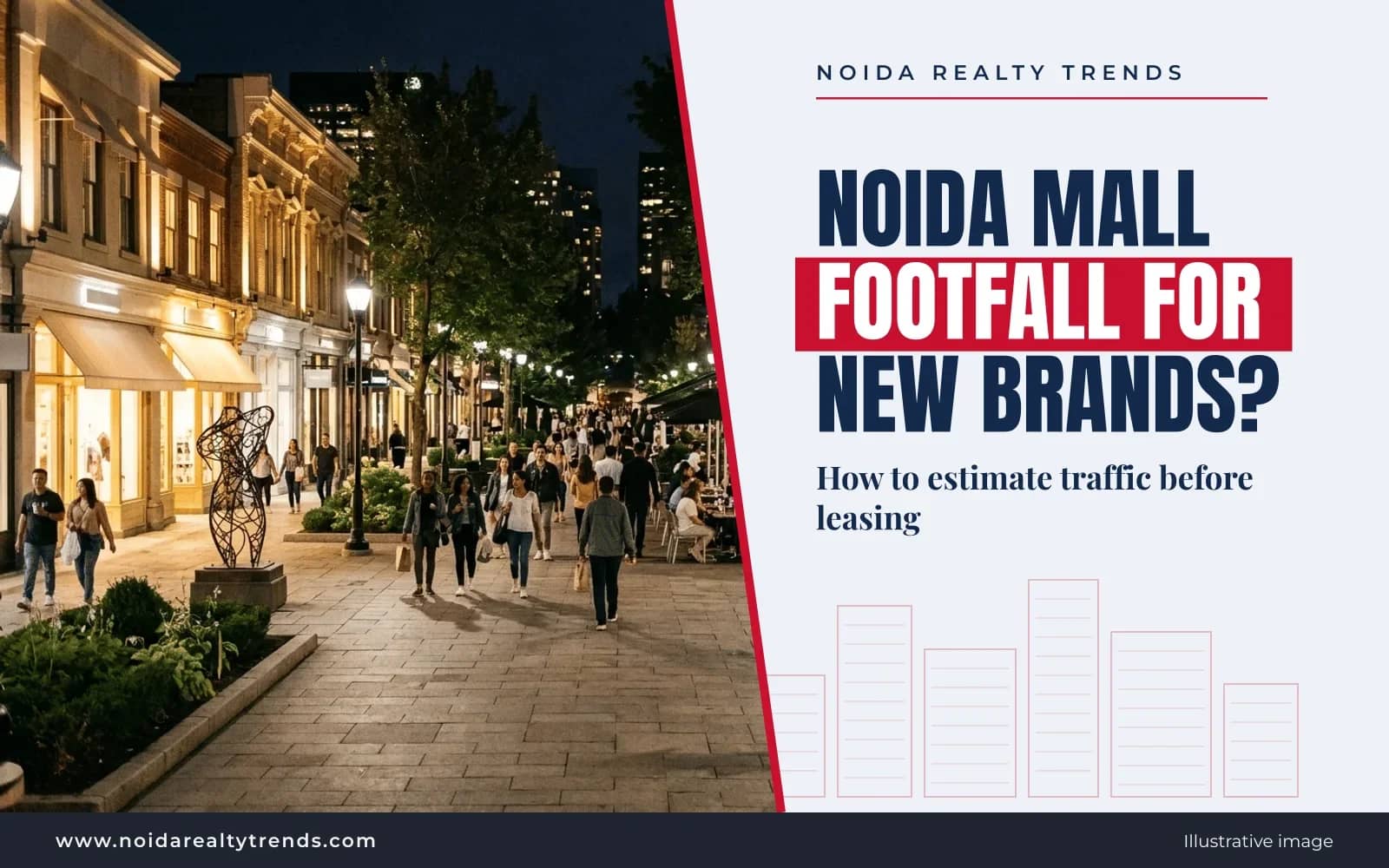
Is opening a shop in a new Noida mall risky in 2026?
Weigh the real risks of leasing in a newly opened Noida mall versus an established one before signing.
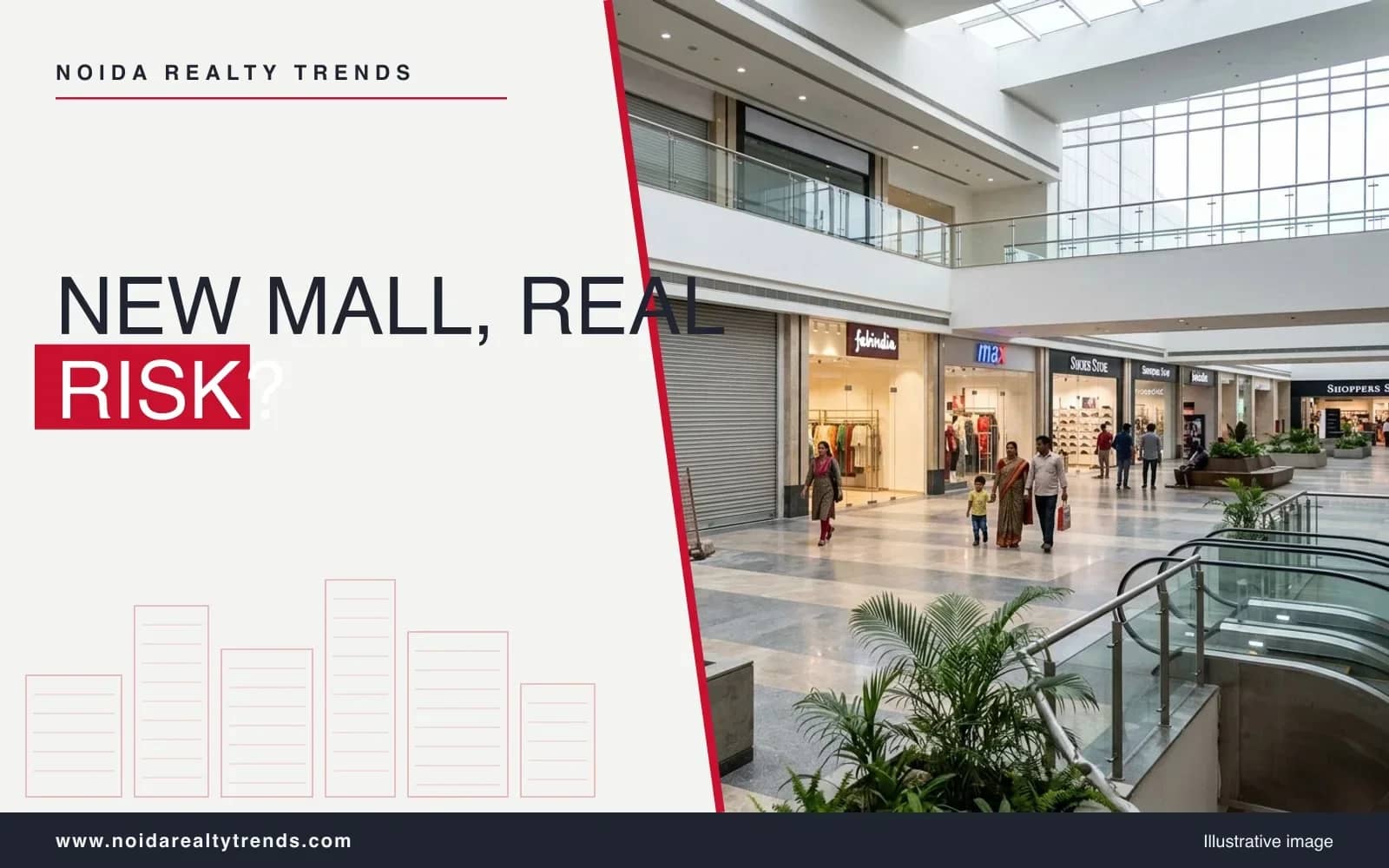
Answer: Opening a shop in a newly opened Noida mall carries more demand risk than an established mall, mainly around unproven footfall, delayed occupancy and tenant mix changes. It can still work if the mall already has anchor tenants open, verifiable occupancy, clear catchment population and a lease with a rent free fit out period and exit protections rather than a long lock in based on projected footfall.
Evidence-led guide: we do not quote live prices, approvals or returns as our own claims. Verify project-specific facts on the official sources linked below before acting.
Why is a newly opened mall considered riskier for a shop owner?
A newly opened mall is riskier mainly because a marketing launch or possession letter does not prove that paying customers will actually show up and keep coming back. Retail demand depends on factors that take time to mature: an occupied residential catchment nearby, metro and road access, a working anchor tenant mix, food and beverage draw, visibility from main roads, and how much competing retail already exists in the corridor.
In an established mall, most of these questions already have answers because the mall has operating history. In a newly opened mall, they are still projections. That gap is the core of the risk, not any single defect in a specific project.
What specific problems show up in brand new malls?
The most common issues are a mix of partial opening, cost surprises and tenant mix risk, and they tend to appear together rather than alone.
A mall can be legally possession-ready while still operating well below its advertised plan for a year or more. Treat a possession letter or launch event as the start of due diligence, not the end of it.
- Partial opening: retail floors handed over but many units still under fit-out, anchors delayed, common areas or parking incomplete
- High total occupancy cost: common area maintenance, marketing fund, power back-up, HVAC, parking and property tax can turn a modest headline rent into a much higher real cost
- Tenant mix risk: too many similar stores, no confirmed anchor, or developer-reserved units that never get leased out
- Exit risk: long lock-in periods signed before actual sales performance is known, with no break clause tied to footfall or occupancy
How do I check if a new Noida mall is actually ready for my shop?
You check readiness with documents and data, not with brochure promises. Ask the developer or leasing team for a written tenant schedule showing signed tenants, stores already open, anchor and entertainment commitments, and the count of vacant units still unleased.
Also ask for independent footfall data across at least one weekday and one weekend, confirmation that fire, parking and utility approvals are in place, and proof that the surrounding residential catchment is actually occupied rather than still under construction. A developer that can answer all of this with documents is behaving differently from one that only offers projected numbers.
- Written tenant schedule: signed vs open vs vacant units
- Footfall or occupancy data from actual operating days, not projections
- Confirmation of fire, parking and utility clearances
- Catchment occupancy: how many nearby homes or offices are actually occupied today
- Anchor and entertainment tenants already trading, not just announced
Should I open now or wait for the mall to mature?
Open now only if the mall is legally operational, has several anchor or destination tenants already trading, sits in an occupied catchment, and the landlord offers a ramp-up period with reasonable exit rights. Wait if the mall is still being sold mainly on projected footfall, if the developer will not share current occupancy data, or if the lease has a long lock-in with no performance-based exit.
A simple test many retailers use: can your business survive 12 to 18 months of below-target sales while the mall fills up. If the answer is no, a newly opened mall with unproven footfall is a weak starting point regardless of how attractive the headline rent looks.
- Open now if: mall operational, anchors trading, occupied catchment, ramp-up lease terms available
- Wait if: projections-only sales pitch, undisclosed occupancy, unresolved approvals, long lock-in with no exit, impulse-purchase business model in an unproven mall
Established versus new Noida malls: what actually differs?
The practical difference comes down to which risks are known versus unknown at the time you sign. An established mall trades lower demand uncertainty for higher rent and tougher negotiating room. A new mall can offer lower entry cost and more negotiating flexibility, but the footfall, tenant mix and timing risk are still open questions.
For Sector 72 specifically, independent retail analysis has flagged existing competition and possible oversupply concerns around established names like Spectrum Metro, Dasnac Arc and Central 50. That does not mean every Sector 72 retail project is weak, but it does mean a shop owner evaluating any Sector 72 mall, new or established, should ask pointedly how the specific catchment, anchor mix and footfall data compare with those already-operating centres, rather than assuming scale alone solves the demand question.
| Factor | Established mall | New mall |
|---|---|---|
| Footfall evidence | Usually available from actual operations | Often based on projections |
| Occupancy | Easier to verify | May be uncertain |
| Rent | Often higher | May look lower, but total occupancy cost can match or exceed it |
| Competition | Stronger, proven demand already split | Possibly lower initially, unproven |
| Tenant mix | More predictable | Can change materially before stabilisation |
| Lease bargaining power | Usually favours landlord | Often more negotiable for early tenants |
| Demand risk for an independent shop | Lower | Higher |
Where on the Noida Expressway does a mixed retail format reduce this risk?
Mixed high-street-plus-mall formats with a defined catchment and named anchor categories give a retailer more to verify than a single standalone mall building on projections alone. In Sectors 94 to 98 on the Noida Expressway, large-format retail developments from several groups sit close to the Delhi border with signal-free Expressway access, which is a location fact worth checking independently rather than taking on trust.
One example worth naming for scale is M3M's retail development in Sector 94, which per M3M's official project material combines The Avenue, an open high-street format, with The Emporium, an enclosed mall, across roughly 1.6 million square feet of commercial space, alongside residential towers in the same development. M3M's material also cites a primary catchment of roughly 7 lakh people within about a 12-minute drive and a secondary catchment of roughly 15 lakh people within 25 to 45 minutes, spanning Central Noida, South and East Delhi, Greater Noida, Ghaziabad and Faridabad. These are developer-stated figures and should be checked against independent footfall and occupancy data once the mall is trading, using the same due-diligence steps outlined above, rather than accepted on the brochure alone.
For comparison and balance, other large-format and mixed-use retail developments in the wider Noida Expressway belt come from groups including Bhutani Group, Gaurs Group, ATS Greens, Supertech and Max Estates, each with their own tenant mix, catchment claims and delivery record that a prospective shop owner should verify independently before signing, in exactly the same way.
What should a lease actually protect me against before I sign?
A lease should protect you against paying full rent before the mall proves it can draw customers, and against the developer changing the promised tenant mix after you commit. At minimum, negotiate a rent-free fit-out period, a short initial term or break option, and a clear statement of who pays GST, maintenance, utilities, property tax, insurance and repairs.
Also insist the agreement specifies rent commencement only after agreed mall conditions are met, such as a minimum number of anchors open, and a termination right if occupancy or footfall stays below an agreed threshold for a defined period. None of this is unusual to ask for in a new mall; it is standard caution, and a serious developer should not refuse it outright.
- Rent-free fit-out period and clear rent commencement trigger
- Short initial term or break option tied to a ramp-up period
- Sales-based or stepped rent instead of a flat minimum guarantee from day one
- Termination right if footfall or occupancy stays below an agreed threshold
- Written allocation of GST, CAM, utilities, property tax, insurance and repair costs
- No penalty if the tenant mix changes materially from what was promised
What about assured-return retail schemes in new malls?
Assured-return or guaranteed-rental offers on a retail unit in a new mall should be treated strictly as a due-diligence red flag, not a selling point. Verify any such arrangement against the registered lease deed, confirm the lessee is a real, named operating entity rather than a shell, and check the developer's or scheme's standing on UP RERA (up-rera.in) before relying on any guaranteed figure.
Community experience across Indian retail and commercial launches treats unusually generous assured-return promises as a sign to slow down, not speed up. If a developer cannot show you an actual registered lease with a named, verifiable tenant, do not treat a verbal or brochure-stated return as a basis for a buying or leasing decision.
How to verify this yourself
- Confirm the mall's actual operational and occupancy status, including which anchors are open versus only announced, directly with the developer or on-site, not from marketing material alone
- Check RERA registration, project status and any disclosed timelines for the specific retail block on UP RERA (up-rera.in)
- Request a written tenant schedule distinguishing signed, open and vacant units before signing any lease
- Verify any assured-return or guaranteed-rental claim against the actual registered lease deed and the named lessee entity
- Confirm fire, parking and utility approvals for the retail block with the developer or local authority rather than assuming possession equals full operational readiness
- Check current circle rates and applicable charges, including Transfer Memorandum costs where relevant, on IGRSUP (igrsup.gov.in) before finalising any purchase-linked leasing structure
Sources and where to verify
Frequently Asked Questions
Is it safe to open a retail store in a newly opened mall in Noida?+
It can be reasonably safe if the mall already has anchor tenants trading, documented occupancy, an occupied catchment and a lease with ramp-up protections, but it carries more demand risk than an established mall until those things are verified rather than promised.
How risky is leasing space in a brand new Noida shopping mall?+
The main risks are unproven footfall, possible partial or delayed opening, higher-than-expected total occupancy costs once CAM and other charges are added, and a tenant mix that can still change before the mall stabilises.
Is a new mall in Noida good for my shop or should I wait?+
Open now only if anchors are already trading, occupancy and footfall data are available, and the lease gives you a rent-free fit-out period plus an exit right; wait if the pitch relies mainly on projected footfall and an undisclosed tenant list.
Which is safer for a retail shop in Noida: an established mall or a new one?+
An established mall is generally safer on demand risk because footfall and occupancy are already proven, while a new mall can offer lower entry cost and more negotiable terms but with higher uncertainty, so the right choice depends on how much below-target sales your business can survive.
Is leasing a shop in a new Noida mall a loss or a profit in the long run?+
It is more likely to be a profit if you lease on ramp-up terms with a rent-free fit-out period, verify anchor tenants and catchment occupancy before signing, and can survive 12 to 18 months of below-target sales; it tends to become a loss when retailers sign long, high-cost leases based only on projected footfall with no exit protection.
Does an assured return on a mall shop in Noida reduce the risk?+
No, an assured-return offer does not reduce the underlying footfall and tenant-mix risk and should be checked carefully against the actual registered lease deed and the lessee's standing on UP RERA before being treated as reliable.
Tags