How to Rent Out a Shop in Noida: Step by Step Guide
A practical, step-by-step guide to renting out a shop in Noida: legal checks, rent setting, lease terms, and finding tenants.
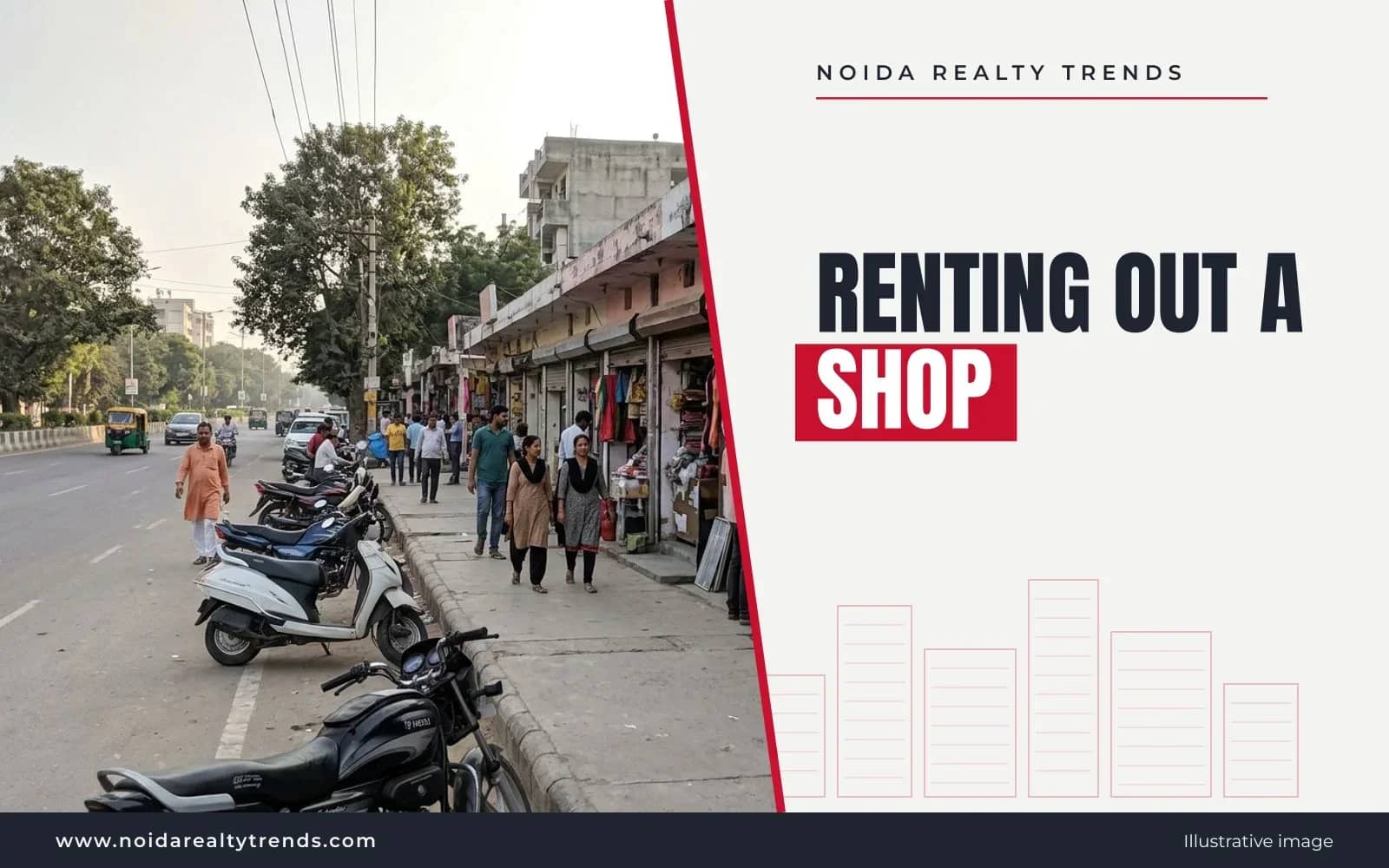
Answer: To rent out a shop in Noida, first verify the unit's legal status and permitted use with the Noida Authority and, if RERA-registered, on UP RERA. Then benchmark rent against at least three comparable live listings in the same sector, draft a detailed lease covering deposit, lock-in and maintenance, and market the unit through brokers and portals while screening tenants for business type and compliance needs.
Evidence-led guide: we do not quote live prices, approvals or returns as our own claims. Verify project-specific facts on the official sources linked below before acting.
What do I need to check before I can legally rent out my shop in Noida?
Before you advertise a shop for rent, confirm the unit is legally usable for the business you intend to attract. Most commercial units on the Noida Expressway belt, including Sectors 72, 94, 97 and 98, sit on long-term Noida Authority leasehold rather than freehold title, and the original lease deed can carry restrictions on subletting, transfer or change of commercial use.
Gather the sale deed, allotment letter, lease deed and possession documents, then cross-check them against the sanctioned plan to see whether the unit is approved for retail, food and beverage, clinic or another specific category. If the project is RERA-registered, pull up the project and unit disclosures on UP RERA (up-rera.in) to confirm the promoter name, approved layout and declared completion status before you sign anything with a prospective tenant.
Also collect maintenance and utility dues, property tax records where applicable, and any mall, society or commercial-association rules. If your prospective tenant is a restaurant, salon or clinic, verify in advance whether the unit has the exhaust, drainage, fire clearance and power load that business actually requires, because a shop that looks ready on paper may not be ready for every trade.
- Sale deed, allotment letter or lease deed, plus possession documents
- Noida Authority lease conditions on subletting and permitted use
- Sanctioned plan and approved use category for the unit
- UP RERA project and unit disclosures where the project is registered
- Maintenance, utility and property tax dues cleared and documented
How do I work out what rent to charge for my shop?
There is no single reliable "Noida shop rent" figure, so the only defensible method is to benchmark against at least three comparable, currently available shops rather than relying on a sale price or a broker's verbal claim. Rent on the Noida Expressway belt varies by sector, floor, frontage, carpet versus super area, footfall, anchor tenants already in place, and the categories of business the unit is permitted to host.
Never use a project's advertised sale price as a shortcut to estimate rent; sale price and rental yield move independently and conflating them is one of the most common mistakes owners make. Instead, ask brokers active in Sectors 72, 94, 97 and 98 for recent concluded deals, not just asking prices, and insist they separate the quoted base rent from maintenance, common-area charges, electricity, parking and marketing contributions.
Ground-floor units with main-road frontage in an operating retail complex typically command different rent than upper-floor or back-of-complex units, and occupancy of neighbouring shops matters as much as the building's brand name. Get written comparables, not just a single broker's opinion, before you fix an asking rent.
- Collect at least three live comparable listings in the same sector and floor type
- Separate base rent from maintenance, electricity, parking and marketing charges
- Ask for evidence of recently concluded deals, not just asking prices
- Check anchor tenant occupancy and footfall patterns in the same complex
- Never anchor your rent expectation to the project's original sale price
What should a commercial lease agreement in Noida actually cover?
A proper lease for a Noida shop should go well beyond a one-page rent receipt and spell out every operational and financial term in writing. At minimum it should name both parties fully, state the exact unit number, floor and area, and define the permitted business activity precisely enough to avoid disputes later.
Critical clauses include monthly rent and any escalation schedule, security deposit amount and refund timeline, lock-in and notice periods, a rent-free fit-out period if offered, and a clear split of maintenance, utility, tax and repair responsibilities between landlord and tenant. Add signage rights, operating hours, common-area access, subletting restrictions, default and late-payment terms, restoration obligations at exit, and a dispute-resolution clause.
Have a property lawyer verify the Noida Authority lease terms, approvals and the draft agreement before signing, and check registration and stamp duty requirements with IGRSUP (igrsup.gov.in), since the applicable amount depends on the rent, term, deposit and the specific instrument used. Skipping this step to save a small fee is one of the most expensive mistakes a landlord can make.
- Full legal names, exact unit details and permitted business activity
- Rent, escalation, security deposit amount and refund timeline
- Lock-in period, notice period and any rent-free fit-out period
- Maintenance, utility, tax and repair responsibility split
- Signage, operating hours, subletting restrictions and exit/restoration terms
What is the best way to find a tenant for my shop?
The most effective approach combines a local commercial broker who actively works Sectors 72, 94, 97 and 98, listings on major property portals, on-site signage with a direct phone number, and outreach to business associations and nearby residential communities. No single channel reliably covers the whole market, so running two or three in parallel shortens vacancy time.
Your listing should state the exact sector and complex name, carpet and super area separately, floor and frontage details, rent, deposit and maintenance shown separately rather than bundled, the available date, parking and power details, and the preferred or permitted business use. Include photographs, a floor plan and a location map so serious tenants can shortlist quickly without repeated site visits.
Screen every prospective tenant for business type, funding position, expected opening date, prior operating history and willingness to follow building rules before you shortlist them, not after. A tenant who cannot show a clear opening plan or compliance history is a bigger risk than a slightly lower rent offer from a more credible business.
- Combine a local broker, major portals, on-site signage and direct outreach
- State carpet/super area, rent, deposit and maintenance as separate line items
- Include photos, floor plan and location map in every listing
- Screen tenants for business type, funding, opening timeline and operating history
Should I worry about retail oversupply in Sector 72 before renting out my shop?
Oversupply concerns around Sector 72 retail, often raised with reference to established complexes like Spectrum Metro and Dasnac Arc, and newer developments like Central 50, are a fair question to ask rather than dismiss. More retail stock in one stretch does mean more competition for footfall and for tenants, and owners should factor that into realistic rent expectations rather than assuming any shop rents itself.
The counter-consideration is that footfall in an established, already-occupied complex with a working anchor mix is a different proposition from footfall in a newly launched project still filling up its first tenants. Before renting out a unit in any Sector 72 complex, ask for actual occupancy percentage, the anchor tenant list, and footfall data if the operator will share it, rather than relying on the brand name of the developer or the glossiness of the marketing material.
This due-diligence approach applies equally across Sectors 72, 94, 97 and 98: a shop's rentability depends far more on documented occupancy, catchment population and access than on which developer built it.
- Ask for current occupancy percentage and anchor tenant list, not just brand reputation
- Request footfall data where the mall or complex operator is willing to share it
- Compare rent expectations against complexes that are already operating, not just launching
- Treat developer brand as one input, not a substitute for occupancy evidence
What ongoing costs and risks should I budget for as a landlord?
Budget for brokerage, which is usually negotiated rather than fixed by any standard rate, legal drafting and verification fees, and registration or stamp duty costs where the lease term and deposit trigger them under IGRSUP rules. Factor in repair, repainting and signage-removal costs between tenancies, plus maintenance and utility charges during any vacant period.
Avoid advertising a business use that your unit is not actually approved for, taking a large cash deposit without proper documentation, or handing over possession before the agreement and payment terms are fully executed. These shortcuts tend to surface as disputes only after a tenant has already moved in.
Never promise guaranteed rent or footfall to a prospective tenant or to yourself as an informal return benchmark. Any offer framed as an "assured return" or guaranteed-rent arrangement tied to a commercial unit should be treated as a red flag requiring independent verification of the underlying lease registration and the entity making the promise, not as a selling point to rely on.
- Brokerage, legal fees, and registration/stamp duty on the lease instrument
- Repair, repainting and signage costs between tenancies
- Vacant-period maintenance and utility charges
- Treat any guaranteed-rent or assured-return offer as a due-diligence flag, not a benefit
Which Noida Expressway sectors and projects are relevant for shop owners right now?
Sectors 72, 94, 97 and 98 on the Noida Expressway host a mix of retail-led and mixed-use developments at different stages of completion, and the right approach depends on which specific unit and complex you own or are considering. In Sector 72, established complexes such as Spectrum Metro and Dasnac Arc operate alongside newer entrants like Central 50, while mixed-use projects with retail, food court and studio-style units are also active in the sector. Before any leasing decision, verify the project's RERA registration status, promoter details and declared completion date directly on UP RERA (up-rera.in).
Further along the corridor in Sectors 94, 97 and 98, projects from developers including Godrej Properties, ATS Greens, Gaurs Group and Bhutani Group sit alongside other branded commercial and mixed-use developments; each should be assessed on its own RERA disclosures, occupancy status and documented delivery record rather than on brand reputation alone.
Whichever project or sector you own a shop in, the leasing fundamentals do not change: verify the Authority lease and RERA status, benchmark rent against live comparables, document the lease fully, and screen tenants properly.
- Sector 72: Spectrum Metro, Dasnac Arc, Central 50 and other retail/mixed-use options at various completion stages
- Sectors 94, 97, 98: mixed-use and retail developments from multiple developers along the Expressway belt
- Always verify current RERA status and completion date for any project before leasing decisions
- Apply the same due-diligence checklist regardless of developer or sector
How to verify this yourself
- Verify the Noida Authority lease terms and any subletting or commercial-use restrictions before advertising the shop
- Check the project's RERA registration, promoter details and declared completion status on UP RERA (up-rera.in)
- Confirm registration and stamp duty requirements for the specific lease instrument on IGRSUP (igrsup.gov.in)
- Benchmark rent against at least three live comparable listings and verified concluded deals, not sale prices
- Confirm fire safety, exhaust, drainage and power load suitability for the specific business type before leasing
- Treat any guaranteed-rent or assured-return offer as a red flag requiring independent verification
Sources and where to verify
- UP RERA official portal
- IGRSUP official portal (stamp duty and registration)
- Noida Realty Trends: Is M3M a trusted Noida developer, how to verify before buying
- Noida Realty Trends: Which Noida developer has the best mixed-use project in 2026
Continue your Noida research
Frequently Asked Questions
Is renting out a shop in Noida actually worth it, or can it be a loss?+
It depends on the unit, location and lease terms, not on the sector alone. A ground-floor shop with good frontage in an already-occupied complex with verified footfall and a properly documented lease can generate steady rental income, but an upper-floor or poorly located unit in an under-occupied complex, or one let on an undocumented cash basis, can sit vacant or generate disputes instead of income. Verify occupancy, comparable rents and lease terms before assuming either outcome.
How do I find out what rent to charge for my shop space?+
Collect at least three comparable, currently available shop listings in the same sector, floor type and complex category, and ask brokers for evidence of recently concluded deals rather than only asking prices. Separate base rent from maintenance, electricity and parking charges in every comparison, and never use the project's original sale price as a shortcut to estimate rental value.
Do I need a lawyer to rent out a small shop, or is a simple agreement enough?+
A simple one-page agreement is not advisable even for a small shop, because Noida commercial units are typically held on Authority leasehold with specific subletting and use restrictions that a generic template will not address. Have a property lawyer verify the lease terms, approvals and the draft rental agreement, and check registration and stamp duty requirements with IGRSUP before signing.
Can I rent out my shop before the project has received completion or occupancy documentation?+
Treat an under-construction or undelivered commercial unit as not immediately rentable until the relevant completion or occupancy documentation is in place. Advertising or leasing before that stage risks both tenant disputes and compliance issues, so confirm the project's declared completion status on UP RERA first.
What is the biggest documentation mistake shop owners make when renting out space?+
Taking a large cash deposit without proper documentation or handing over possession before the lease agreement and payment terms are fully executed are the two most common and costly mistakes. Use banking channels for rent and deposit payments, issue receipts, and retain tenant KYC and business registration documents from day one.
Should I be cautious about brokers or listings that promise guaranteed rent for my shop?+
Yes, any promise of guaranteed rent or assured returns tied to a commercial shop should be treated as a due-diligence flag rather than a benefit, and independently verified against the underlying lease registration and the entity making the offer. Legitimate rental income depends on a real, documented tenant and lease, not on a third-party guarantee.
Tags