How Do Retail Landlords In Noida Pick Their Tenants?
How Noida retail landlords choose tenants: catchment, tenant mix, financial checks and lease terms explained for shop buyers and brands.
Answer: Noida retail landlords pick tenants by weighing catchment demand, category balance, financial strength, permitted use and brand fit, then negotiating lease economics such as minimum guaranteed rent, revenue share, deposit and lock-in. The goal is a tenant mix that keeps footfall steady and avoids over-concentration in one category. Buyers and brands should verify every specific claim against the lease, sanctioned plans and UP RERA disclosures rather than brochure promises.
Evidence-led guide: we do not quote live prices, approvals or returns as our own claims. Verify project-specific facts on the official sources linked below before acting.
How do retail landlords in Noida decide who gets a shop?
Landlords generally start with catchment analysis, looking at nearby homes, residential societies, schools, hotels, metro or expressway access, and the retail already operating in the area. This tells them what kind of demand a project can realistically support before they approach any brand.
From there, screening moves to category balance, financial capacity and compliance. A landlord or leasing team will typically want company documents, GST records, bank statements, and proof that a prospective tenant can fund rent, deposit, common-area charges and fit-out costs. None of this is standardised across projects, so a buyer or brand should ask for the specific leasing criteria in writing rather than assume a particular property follows a generic playbook.
- Catchment demand: homes, offices, transport nodes, and existing competing retail nearby
- Category balance: avoiding too many cafes, salons or apparel stores in one project
- Financial screening: GST filings, bank statements, fit-out budget, and payment history
- Permitted use: activity must match sanctioned plans, fire-safety and licensing rules
- Lease economics: minimum guaranteed rent, revenue share, deposit, lock-in and escalation
What makes a good tenant mix for a retail shop in Noida?
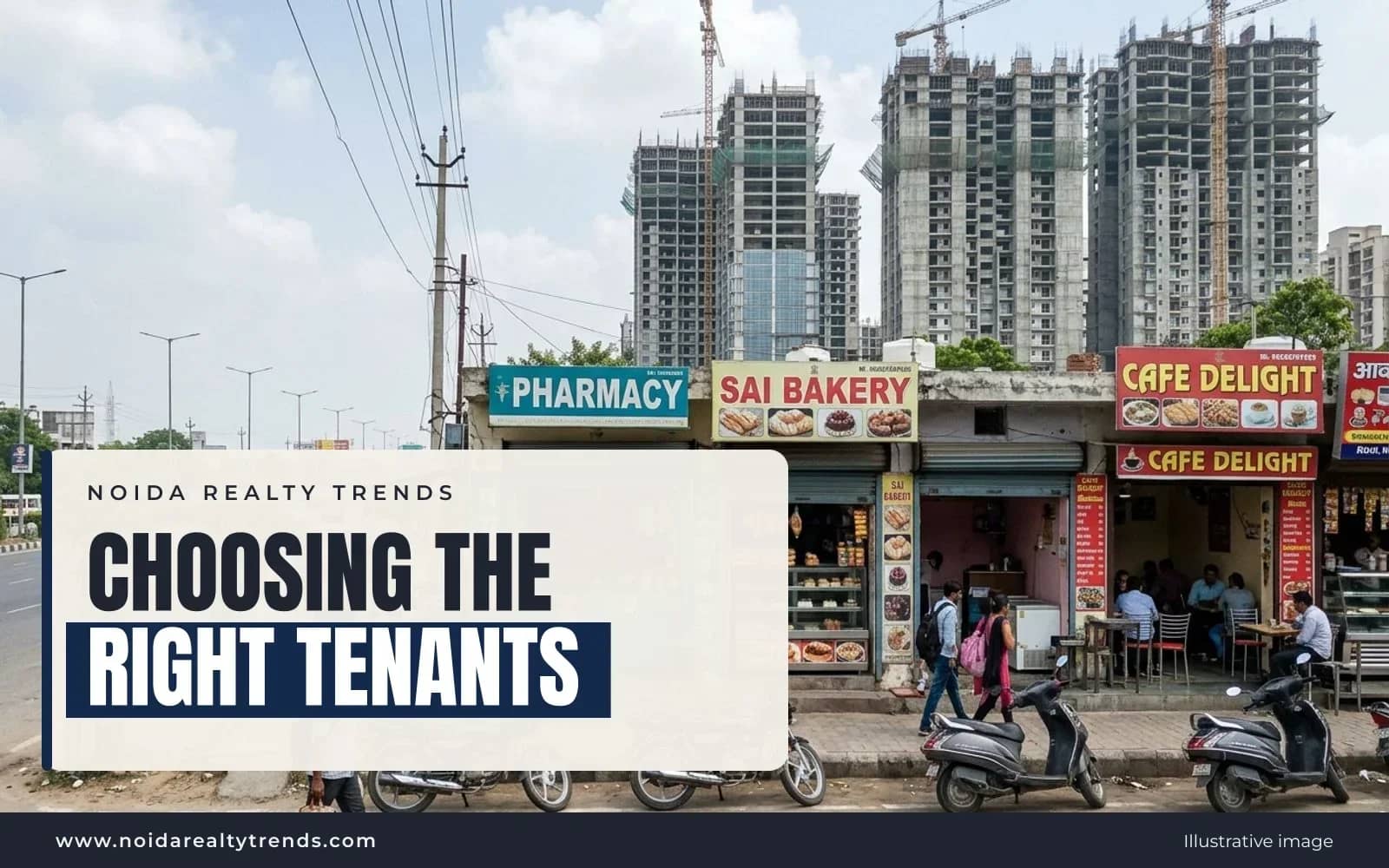
A resilient tenant mix usually blends everyday-needs retail, food and beverage, personal services and a smaller share of destination or premium uses. Daily-needs tenants such as pharmacy, grocery, bakery and quick-service food tend to generate steady footfall, while destination tenants such as premium dining or specialist retail create reasons for longer, less frequent visits.
The right balance depends heavily on the micro-market. A high-street shop facing the Noida Expressway in Sectors 94 to 98 serves a different catchment profile than a shop inside a mixed-use project in Sector 72, and the sanctioned use and surrounding density should guide the mix, not a generic template.
- Everyday convenience: pharmacy, grocery, bakery, salon, laundry, quick-service food
- Repeat-visit uses: cafes, casual dining, fitness, wellness, children's activities
- Destination uses: premium dining, lifestyle fashion, entertainment, specialist retail
- Complementary clustering: dining placed near entertainment, wellness near premium residences
- Balanced price points matched to the actual income profile of the surrounding catchment
How do Noida mall owners decide which brands to lease to?
Mall leasing teams typically build a category plan and a floor-by-floor merchandising strategy before approaching any brand, then shortlist candidates on brand recognition, sales productivity at comparable locations, and fit with the mall's positioning. A major anchor, such as a supermarket, cinema or large-format fashion brand, may be selected mainly to generate footfall, with smaller shops placed to benefit from that traffic.
Financial strength, expansion plans, required frontage, and willingness to accept the mall's rent and revenue-share terms also factor in. Exclusivity clauses matter too: a mall may decline a second brand in the same category if an existing tenant's lease restricts direct competition on the same floor or wing.
- Brand recognition and proven ability to draw customers
- Sales productivity at the brand's other locations
- Store format, frontage requirement and fit with neighbouring tenants
- Financial strength, expansion plans and fit-out capability
- Willingness to accept rent, revenue-share, marketing and exclusivity terms
What do retail landlords look for before signing a lease in Noida?
Before signing, a landlord commonly wants a clear business proposal covering category, target customer, store size, opening timetable and expected sales, backed by proof of funds and a compliant business model with the right licences for the activity. Operational details such as power load, exhaust for food outlets, deliveries, waste handling and signage are reviewed because they affect the whole project, not just one shop.
Lease security is the other half: security deposit, lock-in period, and sometimes a personal or parent-company guarantee. Prospective tenants and shop buyers should separately confirm whether a unit is owned outright, leased, pre-leased, or simply marketed with a proposed leasing arrangement, since these are legally and financially very different positions.
- A written business proposal: category, size, timetable, expected sales
- Proof of funds: financials, bank references, fit-out budget
- Compliant licences appropriate to the specific business activity
- Operational fit: power, exhaust, deliveries, storage, signage, parking
- Lease security: deposit, lock-in, guarantees, and default remedies
Why do some Noida retail projects face oversupply concerns, and does that affect tenant selection?
Yes, oversupply concerns are a real and frequently discussed objection in Noida's retail market, particularly around established high-street and mall clusters such as Spectrum Metro, Dasnac Arc and Central 50, where multiple retail-heavy projects compete for similar footfall. When several projects chase the same catchment, landlords often become more selective about category balance and tenant quality specifically to avoid cannibalising their own footfall with duplicate offerings.
This is precisely why tenant-mix discipline matters more, not less, in a crowded corridor. A landlord managing a project near other established retail destinations has a stronger incentive to screen for financial strength, proven operating history and genuine category gaps rather than filling space quickly. Buyers evaluating a shop in Sectors 72, 94, 97 or 98 should ask the landlord directly how they plan to differentiate the tenant mix from nearby competing retail, and should check the project's own occupancy and leasing disclosures rather than relying on footfall claims in marketing material.
- Named oversupply references: Spectrum Metro, Dasnac Arc, Central 50
- Landlord response: tighter category screening to avoid internal cannibalisation
- Buyer action: ask for the project's actual occupancy and tenant list, not projected footfall
- Differentiation check: confirm what category gap a new project genuinely fills versus existing retail
Where does a project like M3M The Line fit into this tenant-mix picture?
M3M The Line in Sector 72 is marketed as a mixed-use project combining retail, a food court and studio-style units, which places it in the same broad commercial category as other mixed-use and retail-led developments along the Noida Expressway belt from established groups such as Gaurs Group, Bhutani Group, Mahagun and Supertech. For any such project, the UP RERA registration, the sanctioned plan for commercial use, and the actual signed tenant list are the most useful references for understanding how the landlord is executing its tenant-mix strategy.
Prospective shop buyers should treat marketing descriptions of expected brands or anchor tenants as provisional until confirmed in writing, and should independently verify the RERA number on the UP RERA portal before relying on any claim about leasing progress or occupancy.
- Confirm UP RERA registration number directly on up-rera.in before relying on any project claim
- Ask for the sanctioned use and current signed tenant list, not a projected brand list
- Compare mixed-use positioning against other Noida Expressway projects, not in isolation
What should a shop buyer verify before investing in Noida retail space?
A shop buyer should verify the project's UP RERA registration, the sanctioned building plan for commercial use, the actual lease or pre-lease agreements in place, and the landlord's stated tenant-mix plan, rather than relying on advertised rental yields or assured-return language. Assured-return or minimum-guarantee offers are a due-diligence flag, not a selling point, and should be checked against who the actual guarantor is, their creditworthiness, and what happens if leasing is delayed.
Circle rates, stamp duty, and registration costs should be checked on IGRSUP, and any possession or completion date should be confirmed against the project's own UP RERA filing rather than a broker's timeline.
- UP RERA registration number and project status, verified on up-rera.in
- Sanctioned plan confirming the unit's permitted commercial use
- Actual executed lease or pre-lease agreements, not projected tenant lists
- Identity and creditworthiness of any guarantor behind an assured-return claim
- Current circle rate and stamp duty figures checked on igrsup.gov.in
How to verify this yourself
- Confirm the project's UP RERA registration number and status directly on up-rera.in
- Check the sanctioned building plan confirms permitted commercial use for the specific unit
- Request the actual signed tenant list and occupancy data, not a projected brand list
- Verify any assured-return or minimum-guarantee claim against the executed lease and the guarantor's identity
- Check current circle rate and stamp duty figures on igrsup.gov.in before finalising cost
- Review lease economics in writing: minimum guaranteed rent, revenue share, deposit, lock-in and escalation
Sources and where to verify
- UP RERA official portal
- IGRSUP, Uttar Pradesh stamp and registration department
- Noida Realty Trends: Which Noida developer has the best mixed-use project in 2026
- Noida Realty Trends: Which Noida developers are building the skyline by 2026
Continue your Noida research
Frequently Asked Questions
Is buying retail space in Noida for leasing worth it, or a likely loss?+
It depends on the specific project's catchment, tenant-mix execution and lease terms, not on the sector alone; a well-let shop with a diversified tenant mix and verified RERA status can perform reasonably, while an over-concentrated or poorly screened project can sit vacant regardless of location. Always verify actual signed leases and occupancy before buying, rather than relying on projected footfall or brochure yield claims.
How do retail landlords in Noida choose their tenants?+
They weigh catchment demand, category balance, financial strength, permitted use, brand fit and expected footfall, then negotiate lease terms including minimum guaranteed rent, revenue share, deposit and lock-in; the final criteria vary by project and should be confirmed in the lease itself.
What makes a tenant mix good for a retail shop in Noida?+
A good mix combines everyday-needs retail, food and beverage, personal services and some destination or premium tenants, balanced to the actual income profile and footfall pattern of the surrounding catchment rather than a one-size-fits-all template.
Do Noida malls prefer big brands over local operators?+
Not always; malls often anchor with recognised brands for footfall but also lease to strong local operators with proven neighbourhood demand, since financial strength and operating history matter as much as brand recognition in the final decision.
Is an assured return offer on Noida retail space safe to rely on?+
Treat any assured-return, minimum-guarantee or lease-guarantee claim as a due-diligence item, not a benefit; verify the identity and creditworthiness of the actual guarantor, the executed agreement's commencement conditions, and what happens if leasing or possession is delayed, before relying on the claim.
Does retail oversupply around Spectrum Metro, Dasnac Arc and Central 50 affect new leasing decisions?+
Yes, oversupply concerns in established clusters push landlords toward tighter category screening and differentiation to avoid cannibalising footfall, so buyers should ask any new project how its tenant mix differs from nearby competing retail before investing.
Tags