What footfall can a new brand expect in a Noida mall?
No audited citywide footfall figure exists for Noida malls. Here is how a brand should actually estimate traffic before signing a lease.
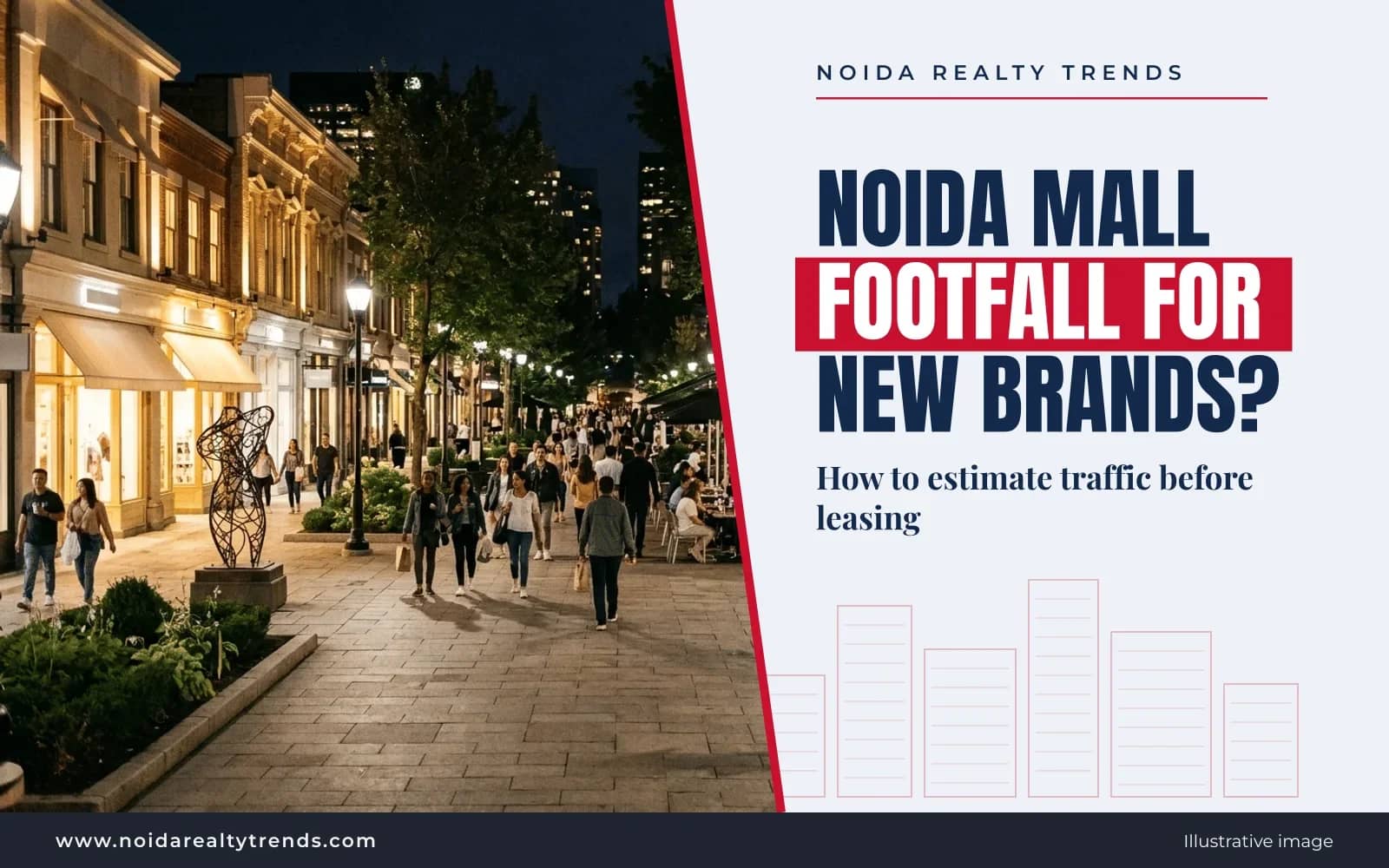
Answer: There is no verified, audited figure for footfall at any specific new Noida mall, and no reliable citywide monthly shopper total exists either. One third-party listing puts DLF Mall of India at roughly 1 million to 2-3 million monthly visitors on the same page, a spread that shows how unreliable public numbers are. A brand should request daily entry counts, catchment data, tenant lists and conversion benchmarks directly from mall management rather than relying on marketing claims of high footfall.
Evidence-led guide: we do not quote live prices, approvals or returns as our own claims. Verify project-specific facts on the official sources linked below before acting.
What footfall should a brand actually expect in a new Noida mall?
Nobody should accept a round number quoted by a leasing team as the expected footfall for an unopened mall. A new mall has no operating history, so any footfall projection offered before launch is, by definition, a forecast, not a fact. The only widely cited public benchmark in the market is for an established, fully operating destination, DLF Mall of India in Sector 18, and even that figure is inconsistent: one third-party mall-industry listing shows close to 1 million average monthly visitors on the same page as a separate claim of 2 to 3 million monthly visitors. Treat that spread as a warning about the quality of publicly available footfall data generally, not as a number to extrapolate from.
For a project still under construction or newly launched, a brand should build its own estimate rather than accept the developer's adjectives. Marketing collateral across the Noida retail market commonly uses phrases like "high footfall" or "strong visibility", including in promotional material for projects on the Noida Expressway and in Sector 72. These are positioning statements, not measured statistics, and should be read as such until backed by a number, a date and a source.
- Ask for daily entry counts, not vehicle counts or ad impressions
- Ask whether the number is unique visitors or includes repeat visits
- Request separate weekday and weekend figures
- Get the signed tenant list and confirmed opening dates, not intent letters
- Check parking capacity and current utilisation, not just capacity on paper
- Confirm category-specific conversion benchmarks from comparable tenants already trading
How do you actually calculate expected sales from footfall?
The only defensible method is to work backward from conservative inputs, not forward from a developer's headline number. A usable formula is: expected monthly transactions equals monthly visitors multiplied by the share of visitors relevant to your category, multiplied by your store's realistic conversion rate. The mall operator should be the source for the first input, and comparable tenants already trading in similar malls should validate the second and third.
Run this calculation twice: once using the operator's stated footfall, and once using a figure 30 to 50 percent lower, to see whether the lease still makes commercial sense in a downside scenario. If the business only works at the optimistic number, the risk sits entirely with the tenant, not the landlord.
Which Noida mall has the best customer traffic for retail?
Sector 18's DLF Mall of India is the strongest publicly indicated candidate for sheer traffic volume, given the third-party estimates noted above, and it benefits from an established retail identity that newer projects have not yet built. But "best traffic" is not one answer, it depends on what you are selling.
A mass-fashion or food-and-beverage brand cares about total daily footfall and dwell time. A luxury or bridge-to-luxury brand cares less about raw numbers and more about the income profile of the catchment and whether the mall is positioned to attract that specific shopper. On the Noida Expressway, for instance, M3M's Sector 94 development, M3M The Cullinan Avenue, pairs The Avenue, an open high-street format, with The Emporium, an enclosed luxury mall, and cites a primary catchment of roughly 7 lakh people within a 12-minute drive and a secondary catchment of roughly 15 lakh people within 25 to 45 minutes, spanning Central Noida, South Delhi and the Noida Expressway corridor, according to M3M's project material. That is a catchment claim, not an audited footfall number, and should be verified the same way any other projection is verified: ask for the methodology and the date.
Comparable high-street and mixed retail formats elsewhere in the city, such as Bhutani Group's Expressway projects or Gaurs Group's retail developments, should be benchmarked on the same criteria: catchment population, signed anchor tenants, parking ratio and access, not on which marketing deck uses the word "premium" more often.
How many shoppers visit Noida malls per month, citywide?
There is no reliable, audited citywide total in the public domain, and brands should be wary of anyone who quotes one. Adding up individual mall claims would double-count repeat shoppers who visit more than one mall in a month and would mix incompatible definitions of a visit, since some counts are footfall-in, others are unique visitors, and others blend the two.
The only identifiable public reference point remains the DLF Mall of India figure discussed above, and even that single data point carries a stated range wide enough to make city-level extrapolation unsound. For a genuine citywide or sector-level estimate, request data from the mall operator directly, from a retail trade association, or from a retail research firm that publishes its methodology, and corroborate any commercial-use or access claim with Noida Authority records.
Is opening a shop in a new Noida mall worth it on a small budget?
It can be worthwhile, but a small-budget retailer should generally lease a small unit, kiosk or food-court counter first rather than buy a shop outright on the promise of future appreciation or rental income. Leasing lets a brand test real demand in a specific mall before committing capital to ownership, and it avoids the irreversible downside of buying into a project that underperforms on footfall after launch.
The safer sequence is to test the concept through a short lease or pop-up, get mall-specific visitor and sales data once the property is trading, model a downside case using materially lower footfall than the operator's own forecast, and only then evaluate a longer lease or purchase. Before signing anything, verify the shop's RERA registration status on UP RERA, confirm the permitted use matches the intended business, and check that the lease explicitly states handover date, fit-out period, rent escalation, lock-in period and exit rights, including compensation if the mall's opening is delayed.
Total capital planning should include interior fit-out, security deposit, trade licenses, opening inventory, staffing and several months of working capital, not just the headline rent or purchase price. A unit that looks affordable on rent-per-square-foot alone can still fail if the total cash outlay is underestimated.
What should you never accept as "footfall proof" before signing a lease?
Never accept the phrase "assured returns", "guaranteed rentals" or "assured footfall" as a selling point without a contractual definition naming the payer, the exact amount, the duration and the security backing it. Indian regulators have repeatedly flagged assured-return retail schemes as a due-diligence red flag, and any mall or developer offering one should be able to produce a registered, enforceable lease document, not a verbal or brochure-level promise.
Also treat renderings of crowded atriums, drone shots of parking lots, and social-media engagement numbers as marketing assets, not footfall evidence. None of these substitute for an audited entry count, a signed anchor-tenant list with confirmed opening dates, or an independently verified catchment study.
- Reject verbal or brochure-level "assured return" promises; demand a registered, enforceable lease
- Ask who pays the assured amount, for how long, and what security backs the commitment
- Verify RERA registration status and project disclosures directly on UP RERA (up-rera.in)
- Confirm permitted commercial use and access approvals with Noida Authority records
- Request the last 12 months of entry data for any mall that is already operating, not just a launch-year claim
What due diligence steps actually protect a new tenant or buyer?
A short, non-negotiable checklist separates a defensible leasing decision from a speculative one. Confirm the project's RERA registration and promoter disclosures on UP RERA before signing anything, since this is the single most reliable public record available on a Noida commercial project. Cross-check any price or rent figure against current listings and the circle rate published on IGRSUP, since asking rent and achievable rent can diverge meaningfully in an unproven mall.
Separately verify the land is leasehold, as most Noida Authority-allotted commercial plots are, and understand that any future transfer will attract a Transfer Memorandum charge payable to Noida Authority, a cost that is frequently underestimated by first-time commercial buyers. Finally, request a written, dated tenant-opening schedule rather than a verbal assurance of "anchor tenants are finalised", since a mall that opens with half its units vacant will not deliver the footfall any tenant was promised.
How to verify this yourself
- Confirm any mall's footfall figure directly with mall management or an independently audited source, not a third-party directory listing alone
- Verify project RERA registration, promoter disclosures and possession status on UP RERA (up-rera.in) before signing a lease or purchase agreement
- Check current circle rates for the specific sector on IGRSUP (igrsup.gov.in) before comparing asking price or rent to market value
- Confirm leasehold status and ask for the applicable Transfer Memorandum charge from Noida Authority before any resale or assignment
- Request a dated, written anchor-tenant and opening schedule rather than a verbal claim that "tenants are finalised"
- Model your lease decision using a footfall figure at least 30 to 50 percent below the operator's own projection
Sources and where to verify
- UP RERA official portal
- IGRSUP official portal (circle rates)
- Occupi mall listing data (DLF Mall of India footfall estimates)
- Noida Realty Trends: Which Noida developers are building the skyline
Continue your Noida research
Frequently Asked Questions
What footfall should my brand expect in a new Noida mall?+
There is no reliable published figure for a new, unopened mall, so do not accept a round number from a leasing brochure. Request the operator's catchment study, signed tenant list and opening schedule, then model your own sales using a conservative 30 to 50 percent discount on any footfall figure the operator provides.
Which Noida mall has the best customer traffic for retail?+
DLF Mall of India in Sector 18 is the strongest publicly indicated option for raw traffic volume based on available third-party estimates, though those figures are inconsistent and unaudited. For catchment-based positioning rather than raw footfall, compare projects on stated criteria like primary and secondary catchment population, anchor tenant mix and access, as cited in each developer's own project material.
How many shoppers visit malls in Noida per month, citywide?+
No authoritative citywide total exists in public data. The only identifiable reference point is a third-party estimate for DLF Mall of India that itself ranges from roughly 1 million to 2-3 million monthly visitors on the same listing, which shows why city-level totals cannot be responsibly calculated from public sources.
Is opening a shop in a new Noida mall worth it, or will it be a loss, for a small budget retailer?+
It can be worth it if you lease rather than buy initially, verify RERA registration and tenant commitments before signing, and your business case survives a downside footfall scenario well below the operator's forecast. It becomes a likely loss if you buy a unit based solely on projected appreciation, assured-return promises, or unverified footfall claims without a signed anchor-tenant list and a realistic conversion model.
Should I trust a developer's claim of "assured footfall" or "guaranteed rentals"?+
No, treat these phrases as a due-diligence flag rather than a benefit. Insist on a registered, enforceable lease that names the payer, amount, duration and security, since verbal or brochure-level assurances carry no legal weight and are commonly cited as a scam-adjacent red flag in Indian commercial real estate.
What is the minimum data I should request before signing a retail lease in Noida?+
Ask for daily entry counts (not vehicle counts), unique-versus-repeat visitor splits, weekday and weekend figures, the signed tenant list with confirmed opening dates, parking utilisation, and category-specific conversion benchmarks from comparable tenants, then verify RERA status independently on UP RERA.
Tags